


Paroxysmal supraventricular tachycardia and the risk of ischemic stroke
- PMID: 23632982
- PMCID: PMC3950597
- DOI: 10.1161/STROKEAHA.113.001118
Paroxysmal supraventricular tachycardia and the risk of ischemic stroke
Abstract
Background and purpose: It is unknown whether supraventricular arrhythmias other than atrial fibrillation or flutter are associated with stroke.
Methods: To examine the association between paroxysmal supraventricular tachycardia (PSVT) and stroke, we performed a retrospective cohort study using administrative claims data from all emergency department encounters and hospitalizations at California's nonfederal acute care hospitals in 2009. Our cohort comprised all adult patients with ≥ 1 emergency department visit or hospitalization from which they were discharged alive and without a diagnosis of stroke. Our primary exposure was a diagnosis of PSVT recorded at an encounter before stroke or documented as present-on-admission at the time of stroke. To reduce confounding, we excluded patients with diagnoses of atrial fibrillation. We defined PSVT, stroke, and atrial fibrillation using International Classification of Diseases, Ninth Revision, Clinical Modification codes previously validated by detailed chart review.
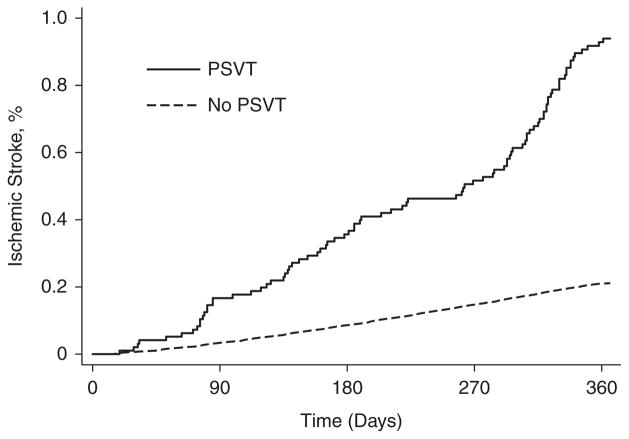
Results: Of 4 806 830 eligible patients, 14 121 (0.29%) were diagnosed with PSVT and 14 402 (0.30%) experienced a stroke. The cumulative rate of stroke after PSVT diagnosis (0.94%; 95% confidence interval, 0.76%-1.16%) significantly exceeded the rate among patients without a diagnosis of PSVT (0.21%; 95% confidence interval, 0.21%-0.22%). In Cox proportional hazards analysis controlling for demographic characteristics and potential confounders, PSVT was independently associated with a higher risk of subsequent stroke (hazard ratio, 2.10; 95% confidence interval, 1.69-2.62).
Conclusions: In a large and demographically diverse sample of patients, we found an independent association between PSVT and ischemic stroke. PSVT seems to be a novel risk factor that may account for some proportion of strokes that are currently classified as cryptogenic.
Keywords: arrhythmia; embolism; epidemiology; fibrillation; risk factors; stroke; tachycardia.
Figures
References
-
- Marnane M, Duggan CA, Sheehan OC, Merwick A, Hannon N, Curtin D, et al. Stroke subtype classification to mechanism-specific and undetermined categories by TOAST, A-S-C-O, and Causative Classification system. Stroke. 2010;41:1579–1586. - PubMed
-
- Furie KL, Kasner SE, Adams RJ, Albers GW, Bush RL, Fagan SC, et al. Guidelines for the prevention of stroke in patients with stroke or transient ischemic attack. Stroke. 2011;42:227–276. - PubMed
-
- Healey JS, Connolly SJ, Gold MR, Israel CW, Van Gelder IC, Capucci A, et al. ASSERT Investigators. Subclinical atrial fibrillation and the risk of stroke. N Engl J Med. 2012;366:120–129. - PubMed
-
- Alhadramy O, Jeerakathil TJ, Majumdar SR, Najjar E, Choy J, Saqqur M. Prevalence and predictors of paroxysmal atrial fibrillation on Holter monitor in patients with stroke or transient ischemic attack. Stroke. 2010;41:2596–2600. - PubMed
-
- Binici Z, Intzilakis T, Nielsen OW, Køber L, Sajadieh A. Excessive supraventricular ectopic activity and increased risk of atrial fibrillation and stroke. Circulation. 2010;121:1904–1911. - PubMed
Publication types
MeSH terms
Grants and funding
LinkOut - more resources
Full Text Sources
Other Literature Sources
Medical
