


The human environment interface: applying ecosystem concepts to health
- PMID: 23633105
- PMCID: PMC7121839
- DOI: 10.1007/82_2013_317
The human environment interface: applying ecosystem concepts to health
Abstract
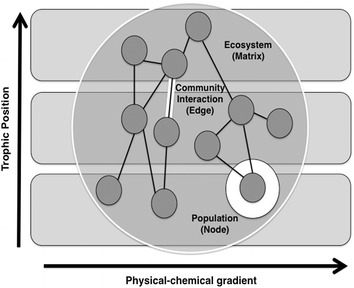
One Health approaches have tended to focus on closer collaboration among veterinarians and medical professionals, but remain unclear about how ecological approaches could be applied or how they might benefit public health and disease control. In this chapter, we review ecological concepts, and discuss their relevance to health, with an emphasis on emerging infectious diseases (EIDs). Despite the fact that most EIDs originate in wildlife, few studies account for the population, community, or ecosystem ecology of the host, reservoir, or vector. The dimensions of ecological approaches to public health that we propose in this chapter are, in essence, networks of population dynamics, community structure, and ecosystem matrices incorporating concepts of complexity, resilience, and biogeochemical processes.
Figures
References
-
- Azam F, Fenchel T, Field JG, Gray JS, Meyer-Reil LA, Thingstad F. The ecological role of water-column microbes in the sea. Mar Ecol Prog Ser. 1983;10:257–263. doi: 10.3354/meps010257. - DOI
-
- Bardgett RD. The biology of soil: a community and ecosystem approach. New York: Oxford University Press; 2005.
-
- Begon M, Harper JL, Townsend CR. Ecology: individuals, populations and communities. Oxford: Blackwell Science; 1996.
Publication types
MeSH terms
LinkOut - more resources
Full Text Sources
Other Literature Sources
Medical
