


Brief co-incubation of sperm and oocytes for in vitro fertilization techniques
- PMID: 23633370
- PMCID: PMC11375493
- DOI: 10.1002/14651858.CD009391.pub2
Brief co-incubation of sperm and oocytes for in vitro fertilization techniques
Abstract
Background: The in vitro fertilization (IVF) technique is commonly used and is the only treatment option for a proportion of infertile couples. To obtain better outcomes of IVF, it is important to enhance embryo quality by optimizing IVF techniques. In IVF procedures, oocytes and sperm are routinely co-incubated overnight, which may expose oocytes and zygotes to suboptimal culture conditions with increased reactive oxygen species (ROS) produced by sperm in this long term culture. As an attempt to avoid possible detrimental effects on the oocytes from long exposure to sperm, the brief co-incubation insemination protocol was developed. However, despite a number of studies in this area, it is unclear whether brief co-incubation improves the IVF outcomes compared with the standard overnight insemination protocol.
Objectives: This Cochrane review aimed to determine whether brief co-incubation of sperm and oocytes improves outcomes compared with the standard overnight insemination protocol for women undergoing IVF.
Search methods: We searched the Cochrane Menstrual Disorders and Subfertility Group Register (14 June 2012), Cochrane Central Register of Controlled Trials (CENTRAL) (The Cochrane Library 2012, 1st quarter), MEDLINE (1948 to 14 June 2012), EMBASE (1989 to 14 June 2012), PsycINFO (1806 to 14 June 2012) and CINAHL (1980 to 26 July 2012). In addition, we searched trials registers, reference lists of articles, conference proceedings (American Society for Reproductive Medicine (ASRM), European Society of Human Reproduction and Embryology (ESHRE)) and contacted experts in the field.
Selection criteria: We included randomized controlled trials (RCTs) comparing brief co-incubation of gametes with the standard overnight insemination protocol.
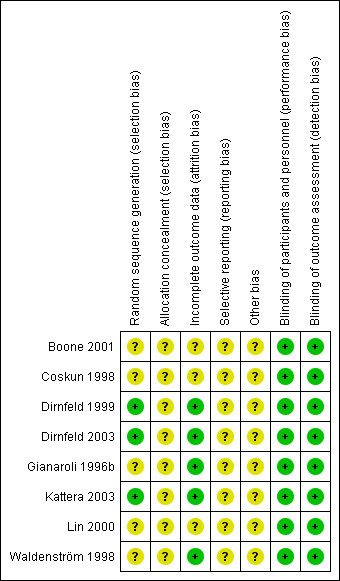
Data collection and analysis: Two review authors independently assessed studies for inclusion and trial quality, and extracted data. Disagreements were resolved by discussion with a third author. Statistical analysis was performed using RevMan software.
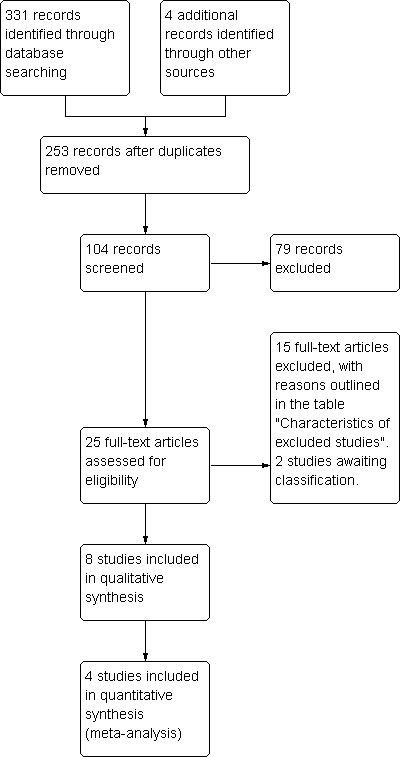
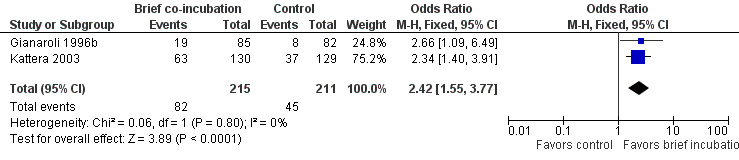
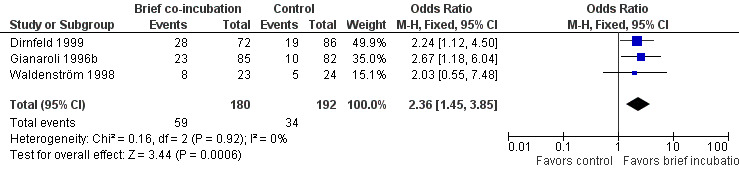
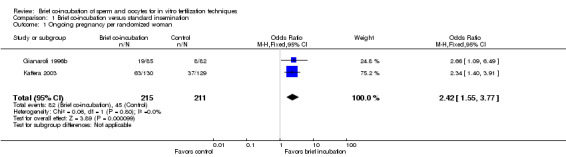
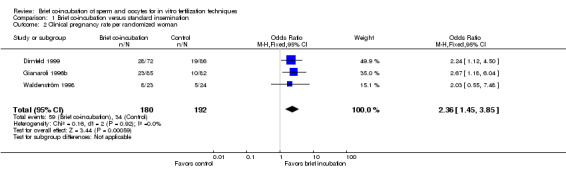
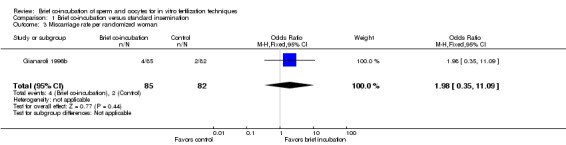
Main results: Eight RCTs with 733 women in total that compared brief co-incubation and the standard insemination protocol were included. Live birth was not reported in the included studies. For ongoing pregnancy rate, there were 127 ongoing pregnancies in two trials including 426 women. The low quality evidence showed that brief co-incubation was associated with an increased ongoing pregnancy rate compared to the standard insemination protocol (pooled odds ratio (OR) 2.42, 95% confidence interval (CI) 1.55 to 3.77; P < 0.0001, I(2) = 0%). Measuring clinical pregnancy rate, there were 93 clinical pregnancies in three trials including 372 women. The low quality evidence showed that brief co-incubation was associated with a significantly higher clinical pregnancy rate than the overnight insemination protocol (pooled OR 2.36, 95% CI 1.45 to 3.85; P = 0.0006, I(2) = 0%). For the miscarriage rate, there were six miscarriages in one trial including 167 women. This low quality evidence suggested no significant difference in the odds of miscarriage between brief co-incubation and standard insemination (OR 1.98, 95% CI 0.35 to 11.09; P = 0.44).
Authors' conclusions: This review has provided evidence that brief co-incubation of sperm and oocytes may improve the ongoing pregnancy and clinical pregnancy rates for infertile women undergoing IVF cycles. More RCTs are required to assess whether brief co-incubation would contribute to a higher live birth rate and a lower miscarriage rate compared to the standard overnight insemination protocol.
Conflict of interest statement
None
Figures

Update of
References
References to studies included in this review
Boone 2001 {published data only}
Coskun 1998 {published data only}
Dirnfeld 1999 {published data only}
-
- Dirnfeld M, Bider D, Koifman M, Calderon I, Abramovici H. Shortened exposure of oocytes to spermatozoa improves in vitro fertilization outcome: a prospective randomized, controlled study. Human Reproduction 1999;14(10):2562‐4. - PubMed
Dirnfeld 2003 {published data only}
-
- Dirnfeld M, Shiloh H, Bider D, Harari E, Koifman M, Lahav‐Baratz S, Abramovici H. A prospective randomized controlled study of the effect of short coincubation of gametes during insemination on zona pellucida thickness. Gynecological Endocrinology 2003;17(5):397‐403. - PubMed
Gianaroli 1996b {published data only}
-
- Gianaroli L, Fiorentino A, Magli MC, Ferraretti AP, Montanaro N. Prolonged sperm‐oocyte exposure and high sperm concentration affect human embryo viability and pregnancy rate. Human Reproduction 1996;11(11):2507‐11. - PubMed
Kattera 2003 {published data only}
-
- Kattera S, Chen C. Short coincubation of gametes in in vitro fertilization improves implantation and pregnancy rates: a prospective, randomized, controlled study. Fertility and Sterility 2003;80(4):1017‐21. - PubMed
Lin 2000 {published data only}
Waldenström 1998 {published data only}
-
- Waldenström U, Hamberger L, Nilsson L, Ryding M. Short‐time sperm‐egg exposure to prevent zona hardening. Journal of Assisted Reproduction and Genetics 1998;70:190.
References to studies excluded from this review
Barraud 2003 {published data only}
-
- Barraud V, Sifer C, Lemkecher B, Martin‐Pont T, Sellami A, Porcher R, et al. Short time sperm‐oocyte exposure during IVF improves embryo quality. Proceedings Title: The 19th Annual Meeting of the ESHRE, Madrid, Spain. 2003:i156‐7.
Barraud 2008 {published data only}
-
- Barraud‐Lange V, Sifer C, Pocaté K, Ziyyat A, Martin‐Pont B, Porcher R, et al. Short gamete co‐incubation during in vitro fertilization decreases the fertilization rate and does not improve embryo quality: a prospective auto controlled study. Journal of Assisted Reproduction and Genetics 2008;25(7):305‐10. - PMC - PubMed
Bungum 2005 {published data only}
-
- Bungum L, Humaidan P, Bungum M. Effect of ultrashort coincubation (30 seconds) of gametes in IVF. Proceedings Title: The 21st Annual Meeting of the ESHRE, Copenhagen, Denmark. 2005:i157.
Bungum 2006 {published data only}
-
- Bungum M, Bungum L, Humaidan P. A prospective study, using sibling oocytes, examining the effect of 30 seconds versus 90 minutes gamete co‐incubation in IVF. Human Reproduction 2006;21(2):518‐23. - PubMed
Gianoroli 1996a {published data only}
-
- Gianaroli L, Cristina Magli M, Ferraretti AP, Fiorentino A, Tosti E, Panzella S, Dale B. Reducing the time of sperm‐oocyte interaction in human in‐vitro fertilization improves the implantation rate. Human Reproduction 1996;11(1):166‐71. - PubMed
Granham 1999 {published data only}
-
- Graham MC, Phipps WR, Partridge AB, Paulhamus LA. Lack of effect of shortened sperm‐oocyte exposure time on in vitro fertilization (IVF) and embryo quality. Fertility and Sterility 1999;72(3 Suppl 1):S15.
Hammit 1999 {published data only}
-
- Hammitt DG, Barud KM, Galanits TM, Wentworth MA, Walker DL, Damario MA, et al. Comparison of short and long sperm‐oocyte coincubation in organ culture dishes (OCD) and tubes (TU). Fertility and Sterility 1999;72(3 Suppl 1):S15.
Lundqvist 2001 {published data only}
-
- Lundqvist M, Johansson U, Lundkvist O, Milton K, Westin C, Simberg N. Reducing the time of co‐incubation of gametes in human in‐vitro fertilization has no beneficial effects. Reproductive Biomedicine Online 2001;3(1):21‐4. - PubMed
Navarro 2004 {published data only}
-
- Navarro C, Lopez E, Stone BA, Marrs RP. Short co‐incubation of sperm with oocytes is associated with an increased incidence of polyspermy in human in vitro fertilization (IVF). Fertility and Sterility 2004;82:S325.
Quinn 1998 {published data only}
-
- Quinn P, Lydic ML, Ho M, Bastuba M, Hendee F, Brody SA. Confirmation of the beneficial effects of brief coincubation of gametes in human in vitro fertilization. Fertility and Sterility 1998;69(3):399‐402. - PubMed
Swenson 1998 {published data only}
-
- Swenson K, Summers‐Chase D, Check JH, Choe J. Preliminary evidence that shortening the incubation time of sperm and oocyte may improve implantation rates with in vitro fertilization (IVF). Fertility and Sterility 1998;69(3):594.
Swenson 1999 {published data only}
-
- Swenson K, Check JH, Summers‐Chase D, Choe JK, Nazari A. A randomized study comparing the effect of standard versus short incubation of sperm and oocyte on subsequent pregnancy and implantation rates following in vitro fertilization‐embryo transfer (IVF‐ET). Fertility and Sterility 1999;72 Suppl 1:16S‐7S. - PubMed
Swenson 2000 {published data only}
-
- Swenson K, Check JH, Summers‐Chase D, Choe JK, Check ML. A randomized study comparing the effect of standard versus short incubation of sperm and oocyte on subsequent pregnancy and implantation rates following in vitro fertilization embryo transfer. Archives of Andrology 2000;45(1):73‐6. - PubMed
Xiong 2011 {published data only}
Zhang 2009 {published data only}
-
- Zhang NY, Sun HX, Hu YL, Wang B, Xu ZP. Combination of short‐period sperm‐oocyte coincubation and early rescue intracytoplasmic sperm injection after total failure of in vitro fertilization. Zhonghua Nan Ke Xue 2009;15(6):538‐41. - PubMed
References to studies awaiting assessment
Jamieson 1999 {published data only}
-
- Jamieson ME, George MA, Butcher L, Grossart E, Mitchell PAL, Mowat L, et al. The effect of reduced sperm :oocyte exposure time on embryo development. Proceedings Title: 11th World Congress on In Vitro Fertilization and Human Reproductive Genetics 1999:115.
Pattanayak 2001 {published data only}
-
- Pattanayak M, Ray R, Santosh L. A comparative study of short and standard exposures of oocytes to sperm in in vitro fertilisation. Proceedings Title: 17th World Congress on Fertility and Sterility 2001:24.
Additional references
Agarwal 2005
-
- Agarwal A, Allamaneni S, Nallella K, George A, Mascha E. Correlation of reactive oxygen species levels with the fertilisation rate after in vitro fertilisation: a qualified meta‐analysis. Fertility and Sterility 2005;84:228‐31. - PubMed
Aitken 1996
-
- Aitken RJ, Buckingham DW, West K, Brindle J. On the use of paramagnetic beads and ferro fluids to assess and eliminate the leukocytic contribution to oxygen radical generation by human sperm suspensions. American Journal of Reproductive Immunology 1996;35:541‐51. - PubMed
Aitken 1987
-
- Aitken RJ, Clarkson JS. Cellular basis of defective sperm function and its association with the genesis of reactive oxygen species by human spermatozoa. Journal of Reproduction and Fertility 1987;81:459‐69. - PubMed
Angell 1986
-
- Angell RR, Templeton AA, Messinis IE. Consequences of polyspermy in man. Cytogenetics and Cell Genetics 1986;42:1‐7. - PubMed
Bansal 2010
Bedaiwy 2004
-
- Bedaiwy MA, Falcone T, Mohamed MS, Aleem AA, Sharma RK, Worley SE, et al. Differential growth of human embryos in vitro: role of reactive oxygen species. Fertility and Sterility 2004;82:593‐600. - PubMed
Canipari 2000
-
- Canipari R. Oocyte‐‐granulosa cell interactions. Human Reproduction Update 2000;6:279‐89. - PubMed
De Placido 2002
-
- Placido G, Wilding M, Strina I, Alviggi E, Alviggi C, Mollo A, et al. High outcome predictability after IVF using a combined score for zygote and embryo morphology and growth rate. Human Reproduction 2002;17:2402‐9. - PubMed
du Plessis 2008
-
- du Plessis SS, Makker K, Desai NR, Agarwal A. Impact of oxidative stress on IVF. Expert Review of Obstetrics and Gynecology 2008;3:539‐54.
Dumoulin1992
-
- Dumoulin JCM, Bras M, Land JA, Pieters MH, Enginsu ME, Gerardts JP, Evers JL. Effect of the number of inseminated spermatozoa on subsequent human and mouse embryonic development in vitro. Human Reproduction 1992;7:1010‐3. - PubMed
Evenson 2000
-
- Evenson DP, Jost LK. Sperm chromatin structure assay is useful for fertility assessment. Methods in Cell Science 2000;22:169‐89. - PubMed
Fiorentino1994
-
- Fiorentino A, Magli MC, Fortini D, Feliciani E, Ferraretti AP, Dale B, Gianaroli L. Sperm:oocyte ratios in an in vitro fertilization (IVF) program. Journal of Assisted Reproduction and Genetics 1994;11:97‐103. - PubMed
Gianaroli 1996a
-
- Gianaroli L, Cristina Magli M, Ferraretti AP, Fiorentino A, Tosti E, Panzella S, Dale B. Reducing the time of sperm‐oocyte interaction in human in‐vitro fertilization improves the implantation rate. Human Reproduction 1996;11(1):166‐71. - PubMed
Henkel 2003
-
- Henkel R, Kierspel E, Hajimohammad M, Stalf T, Hoogendijk C, Mehnert C, et al. DNA fragmentation of spermatozoa and assisted reproduction technology. Reproductive Biomedicine Online 2003;7:477‐84. - PubMed
Henkel 2011
Higgins 2011
-
- Higgins JPT, Green S, editors. Cochrane Handbook for Systematic Reviews of Interventions Version 5.1. The Cochrane Collaboration, 2011.
Hopewell 2007a
Hopewell 2007b
Hopewell 2007c
Krausz 1994
-
- Krausz C, Mills C, Rogers S, Tan SL, Aiken RJ. Stimulation of oxidant generation by human sperm suspensions using phorbol esters and formyl peptides: Relationships with motility and fertilization in vitro. Fertility and Sterility 1994;62:599‐605. - PubMed
Larson 2000
-
- Larson KL, DeJonge CJ, Barnes AM, Jost LK, Evenson DP. Sperm chromatin structure assay parameters as predictors of failed pregnancy following assisted reproductive techniques. Human Reproduction 2000;15:1717‐22. - PubMed
Lopes 1998
-
- Lopes S, Sun JG, Jurisicova A, Meriano J, Casper RF. Sperm deoxyribonucleic acid fragmentation is increased in poor‐quality semen samples and correlates with failed fertilisation in intracytoplasmic sperm injection. Fertility and Sterility 1998;69:528‐32. - PubMed
Mahfouz 2010
-
- Mahfouz R, Sharma R, Thiyagarajan A, Kale V, Gupta S, Sabanegh E, Agarwal A. Semen characteristics and sperm DNA fragmentation in infertile men with low and high levels of seminal reactive oxygen species. Fertility and Sterility 2010;94:2141‐6. - PubMed
Nasr‐Esfahani 1990
-
- Nasr‐Esfahani MH, Aitken RJ, Johnson MH. Hydrogen peroxide levels in mouse oocytes and early cleavage stage embryos developed in vitro or in vivo. Development 1990;109:501‐7. - PubMed
Parinaud 1993
-
- Parinaud J, Labal B, Mieusset R, Richoilley G, Vieitez G. Influence of sperm parameters on embryo quality. Fertility and Sterility 1993;60:888‐92. - PubMed
Saleh 2003
-
- Saleh RA, Agarwal A, Nada EA, El‐Tonsy MH, Sharma RK, Meyer A, et al. Negative effects of increased sperm DNA damage in relation to seminal oxidative stress in men with idiopathic and male factor infertility. Fertility and Sterility 2003;79:1597‐605. - PubMed
Simon 2011
-
- Simon L, Lutton D, McManus J, Lewis SE. Sperm DNA damage measured by the alkaline Comet assay as an independent predictor of male infertility and in vitro fertilization success. Fertility and Sterility 2011;95:652‐7. - PubMed
Song 2002
-
- Song F, Khan KS, Dinnes J, Sutton AJ. Asymmetric funnel plots and publication bias in meta‐analyses of diagnostic accuracy. International Journal of Epidemiolology 2002;31:88‐95. - PubMed
Twigg 1998
-
- Twigg J, Fulton N, Gomez E, Irvine DS, Aitken RJ. Analysis of the impact of intracellular reactive oxygen species generation on the structural and functional integrity of human spermatozoa: lipid peroxidation, DNA fragmentation and effectiveness of antioxidants. Human Reproduction 1998;13:1429‐36. - PubMed
van der Ven 1985
-
- Ven HH, Al‐Hasani S, Diedrich K, Hamerich U, Lehmann F, Krebs D. Polyspermy in in vitro fertilization of human oocytes: frequency and possible causes. Annals of the New York Academy of Sciences 1985;442:88‐95. - PubMed
van Loendersloot 2010
-
- Loendersloot LL, Wely M, Limpens J, Bossuyt PM, Repping S, Veen F. Predictive factors in in vitro fertilization (IVF): a systematic review and meta‐analysis. Human Reproduction Update 2010;16:577‐89. - PubMed
Venkatesh 2011
-
- Venkatesh S, Shamsi MB, Dudeja S, Kumar R, Dada R. Reactive oxygen species measurement in neat and washed semen: comparative analysis and its significance in male infertility assessment. Archives of Gynecology and Obstetrics 2011;283:121‐6. - PubMed
Virroet 2004
-
- Virro MR, Larson‐Cook KL, Evenson DP. Sperm chromatin structure assay (SCSA) parameters are related to fertilisation, blastocyst development,and ongoing pregnancy in in vitro fertilisation and intracytoplasmic sperm injection cycles. Fertility and Sterility 2004;81:1289‐95. - PubMed
Wang 2003
-
- Wang WH, Day BN, Wu GM. How does polyspermy happen in mammalian oocytes?. Microscopy Research and Technique 2003;61:335‐41. - PubMed
Zorn 2003
-
- Zorn B, Vidmar G, Meden‐Vrtovec H. Seminal reactive oxygen species as predictors of fertilization, embryo quality and pregnancy rates after conventional in vitro fertilization and intracytoplasmic sperm injection. International Journal of Andrology 2003;26:279‐85. - PubMed
Publication types
MeSH terms
Substances
LinkOut - more resources
Full Text Sources
Other Literature Sources
Medical
