


Targeted resequencing implicates the familial Mediterranean fever gene MEFV and the toll-like receptor 4 gene TLR4 in Behçet disease
- PMID: 23633568
- PMCID: PMC3657824
- DOI: 10.1073/pnas.1306352110
Targeted resequencing implicates the familial Mediterranean fever gene MEFV and the toll-like receptor 4 gene TLR4 in Behçet disease
Abstract
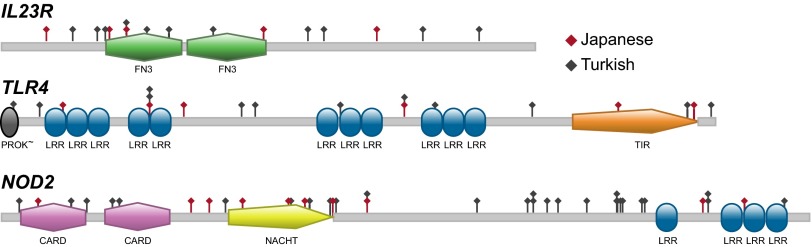
Genome-wide association studies (GWAS) are a powerful means of identifying genes with disease-associated common variants, but they are not well-suited to detecting genes with disease-associated rare and low-frequency variants. In the current study of Behçet disease (BD), nonsynonymous variants (NSVs) identified by deep exonic resequencing of 10 genes found by GWAS (IL10, IL23R, CCR1, STAT4, KLRK1, KLRC1, KLRC2, KLRC3, KLRC4, and ERAP1) and 11 genes selected for their role in innate immunity (IL1B, IL1R1, IL1RN, NLRP3, MEFV, TNFRSF1A, PSTPIP1, CASP1, PYCARD, NOD2, and TLR4) were evaluated for BD association. A differential distribution of the rare and low-frequency NSVs of a gene in 2,461 BD cases compared with 2,458 controls indicated their collective association with disease. By stringent criteria requiring at least a single burden test with study-wide significance and a corroborating test with at least nominal significance, rare and low-frequency NSVs in one GWAS-identified gene, IL23R (P = 6.9 × 10(-5)), and one gene involved in innate immunity, TLR4 (P = 8.0 × 10(-4)), were associated with BD. In addition, damaging or rare damaging NOD2 variants were nominally significant across all three burden tests applied (P = 0.0063-0.045). Furthermore, carriage of the familial Mediterranean fever gene (MEFV) mutation Met694Val, which is known to cause recessively inherited familial Mediterranean fever, conferred BD risk in the Turkish population (OR, 2.65; P = 1.8 × 10(-12)). The disease-associated NSVs in MEFV and TLR4 implicate innate immune and bacterial sensing mechanisms in BD pathogenesis.
Keywords: complex genetics; genetic association.
Conflict of interest statement
The authors declare no conflict of interest.
Figures
References
Publication types
MeSH terms
Substances
Grants and funding
LinkOut - more resources
Full Text Sources
Other Literature Sources
Medical
Miscellaneous
