Human photoreceptor outer segments shorten during light adaptation
- PMID: 23633665
- PMCID: PMC3668803
- DOI: 10.1167/iovs.13-11812
Human photoreceptor outer segments shorten during light adaptation
Abstract
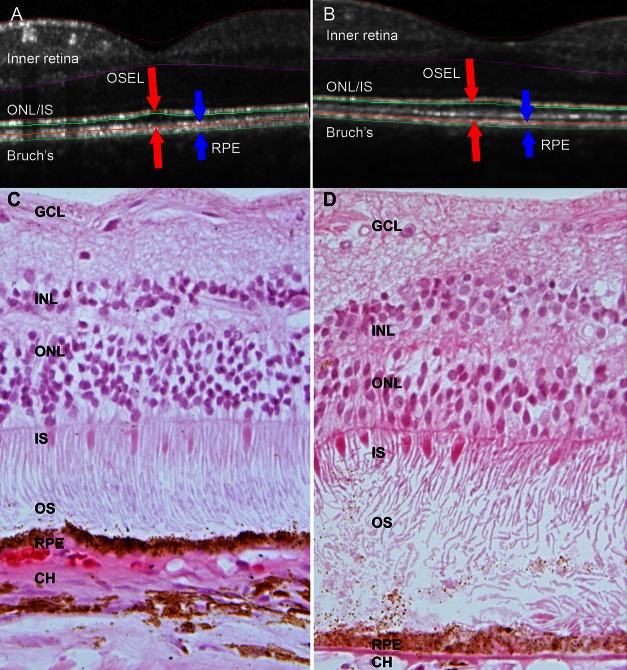
Purpose: Best disease is a macular dystrophy caused by mutations in the BEST1 gene. Affected individuals exhibit a reduced electro-oculographic (EOG) response to changes in light exposure and have significantly longer outer segments (OS) than age-matched controls. The purpose of this study was to investigate the anatomical changes in the outer retina during dark and light adaptation in unaffected and Best disease subjects, and to compare these changes to the EOG.
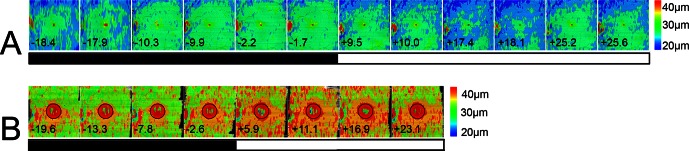
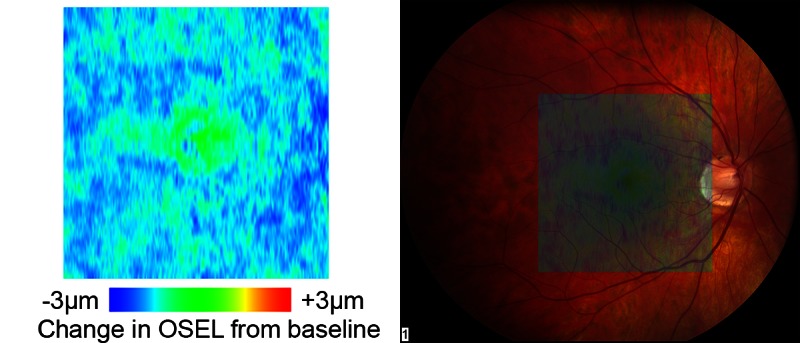
Methods: Unaffected (n = 11) and Best disease patients (n = 7) were imaged at approximately 4-minute intervals during an approximately 40-minute dark-light cycle using spectral domain optical coherence tomography (SD-OCT). EOGs of two subjects were obtained under the same conditions. Automated three-dimensional (3-D) segmentation allowed measurement of light-related changes in the distances between five retinal surfaces.
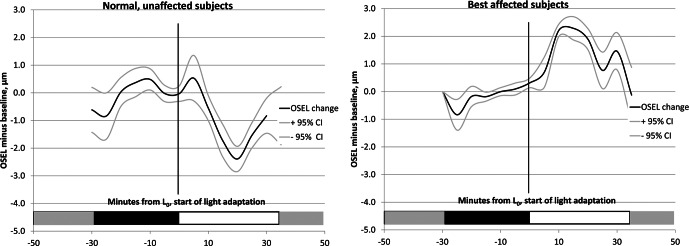
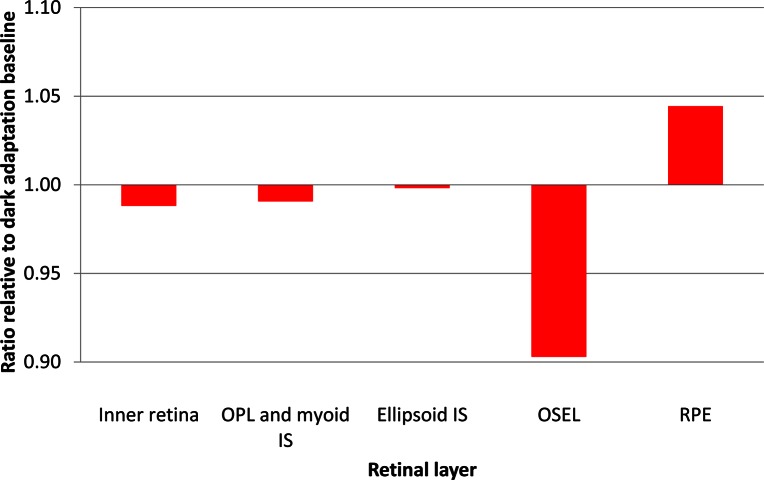
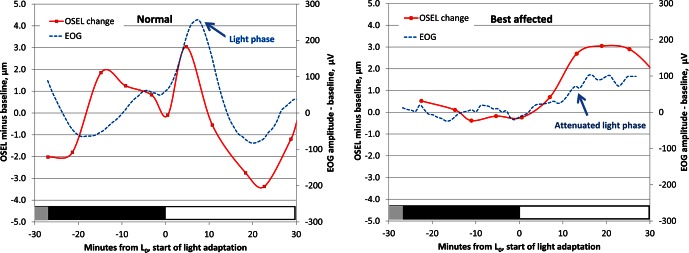
Results: In normal subjects, there was a significant decrease in outer segment equivalent length (OSEL) of -2.14 μm (95% confidence interval [CI], -1.77 to -2.51 μm) 10 to 20 minutes after the start of light adaptation, while Best disease subjects exhibited a significant increase in OSEL of 2.07 μm (95% CI, 1.79-2.36 μm). The time course of the change in OS length corresponded to that of the EOG waveform.
Conclusions: Our results strongly suggest that the light peak phase of the EOG is temporally related to a decreased OSEL in normal subjects, and the lack of a light peak phase in Best disease subjects is associated with an increase in OSEL. One potential role of Bestrophin-1 is to trigger an increase in the standing potential that approximates the OS to the apical surface of the RPE to facilitate phagocytosis.
Keywords: Best disease; OCT; eletro-oculogram; photoreceptor cells.
Figures
References
-
- Best F. II. Über eine hereditäre Maculaaffektion. Ophthalmologica. 1905; 13: 199–212
-
- Stone EM, Nichols BE, Streb LM, Kimura AE, Sheffield VC. Genetic linkage of vitelliform macular degeneration (Best's disease) to chromosome 11q13. Nat Genet. 1992; 1: 246–250 - PubMed
-
- Petrukhin K, Koisti MJ, Bakall B, et al. Identification of the gene responsible for Best macular dystrophy. Nat Genet. 1998; 19: 241–247 - PubMed
-
- Iannaccone A, Kerr NC, Kinnick TR, Calzada JI, Stone EM. Autosomal recessive best vitelliform macular dystrophy: report of a family and management of early-onset neovascular complications. Arch Ophthalmol. 2011; 129: 211–217 - PubMed
-
- Chung MM, Oh KT, Streb LM, Kimura AE, Stone EM. Visual outcome following subretinal hemorrhage in Best disease. Retina. 2001; 21: 575–580 - PubMed
Publication types
MeSH terms
Grants and funding
LinkOut - more resources
Full Text Sources
Other Literature Sources