. 2013 May 1;36(5):689-698G.
doi: 10.5665/sleep.2628.

Caenorhabditis-in-drop array for monitoring C. elegans quiescent behavior

Affiliations

Caenorhabditis-in-drop array for monitoring C. elegans quiescent behavior

Samuel J Belfer et al. Sleep. .

Abstract

Study objectives: To develop a method, called Caenorhabditis-in-Drop (CiD), encapsulating single worms in aqueous drops, for parallel analysis of behavioral quiescence in C. elegans nematodes.

Design: We designed, constructed, and tested a device that houses an array of aqueous droplets laden with individual worms. The droplets are separated and covered by immiscible, biocompatible oil. We modeled gas exchange across the aqueous/oil interface and tested the viability of the encapsulated animals. We studied the behavior of wild-type animals; of animals with a loss of function mutation in the cGMP-dependent protein kinase gene egl-4; of animals with a loss of function mutation in the gene kin-2, which encodes a cAMP-dependent protein kinase A regulatory subunit; of animals with a gain-of-function mutation in the gene acy-1, which encodes an adenylate cyclase; and of animals that express high levels of the EGF protein encoded by lin-3.

Measurements and results: We used CiD to simultaneously monitor the behavior of 24 worms, a nearly 5-fold improvement over the prior best methodology. In support of our gas exchange models, we found that worms remain viable on the chip for 4 days, past the 12-h period needed for observation, but show reduced longevity to that measured on an agar surface. Measurements of duration of lethargus quiescence and total leth-argus quiescence showed reduced amounts as well as reduced variability relative to prior methods. There was reduced lethargus quiescence in animals that were mutant for kin-2 and for acy-1, supporting a wake-promoting effect of PKA in C. elegans, but no change in lethargus quiescence in egl-4 mutants. There was increased quiescence in animals that expressed kin-2 in the nervous system or over-expressed EGF.

Conclusions: CiD is useful for the analysis of behavioral quiescence during lethargus as well as during the adult stage C. elegans. The method is expandable to parallel simultaneous monitoring of hundreds of animals and for other studies of long-term behavior. Using this method, we were successful in measuring, for the first time, quiescence in kin-2(ce179) and in acy-2(ce2) mutants, which are hyperactive. Our observations also highlight the impact of environmental conditions on quiescent behavior and show that longevity is reduced in CiD in comparison to agar surfaces.

Keywords: General; drop; elegans; lethargus; microfluidics; quiescence.


Figures
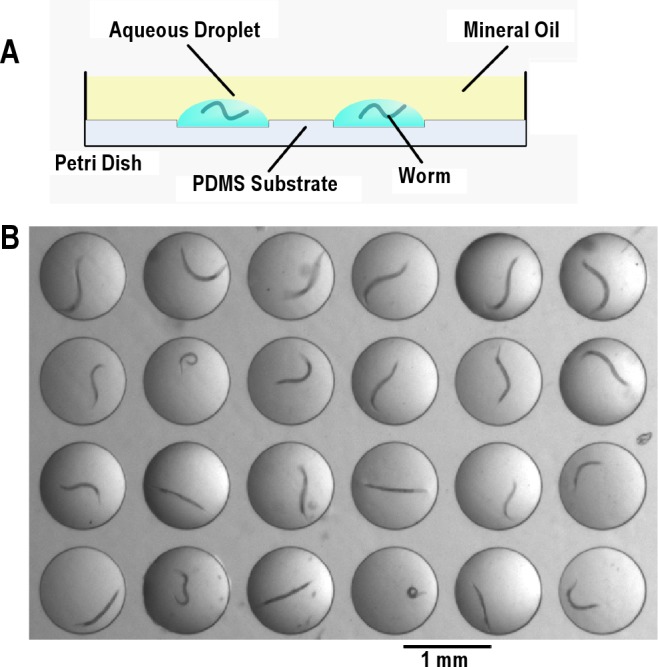
Figure 1
Figure 1
Experimental set up. (A) Cross-section schematic of microfluidic chip. (B) Top view of the image of 24 worms. Shown is a picture of 24 L4 worms, each in an individual droplet on a microfluidic chip. The mineral oil on top of the droplets is transparent.
Figure 2
Figure 2
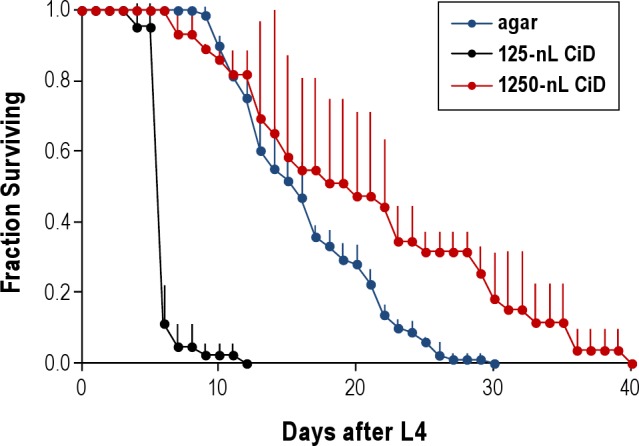
Survival of worms in the CiD device. Shown is the fraction of worms alive as a function of the day after the L4 stage. Time Zero corresponds to the middle of the L4 stage. Survival on agar was assessed on 3 separate Petri dishes, each housing 24-30 worms. Survival in 125 nL in the CiD device was assessed on 2 separate chips, each housing 21-28 worms. Survival in 1,250 nL in the CiD device was assessed in 3 separate chips, each housing 8-11 worms. Error bars denote standard deviation.
Figure 3
Figure 3
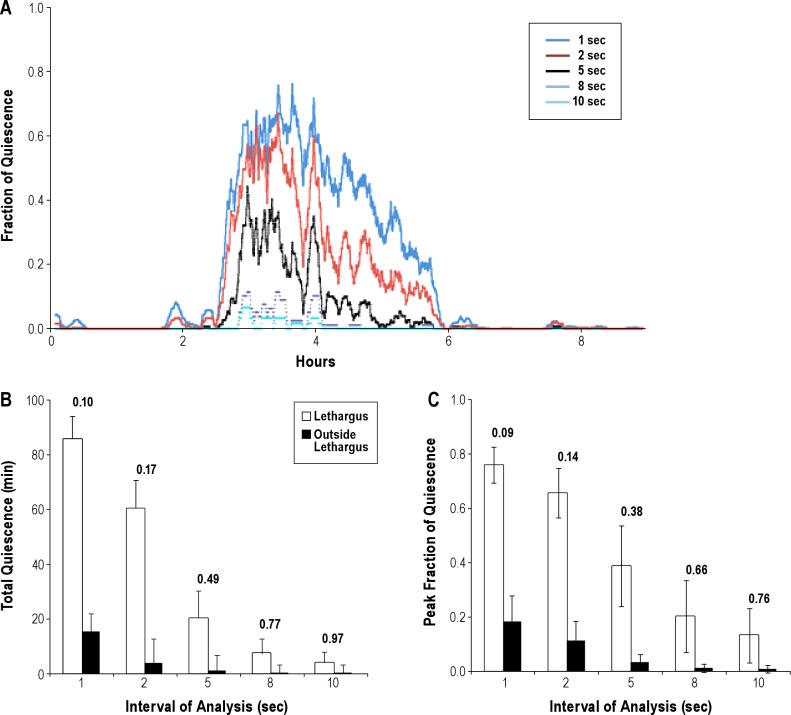
The effect of interval of frame subtraction on quiescence. (A) Fraction of quiescence in a 10-min moving window of the data from the same worm analyzed at variable intervals of subtraction. (B) Mean total quiescence during lethargus and outside lethargus as a function of different subtraction intervals. Error bars denote standard deviation (SD). N = 19. Values above the bars are the coefficients of variation (CVs). (C) Mean peak fraction of quiescence during lethargus and outside lethargus as a function of different subtraction intervals. Error bars denote SD. N = 19. Values above the bars are the CVs.
Figure 4
Figure 4
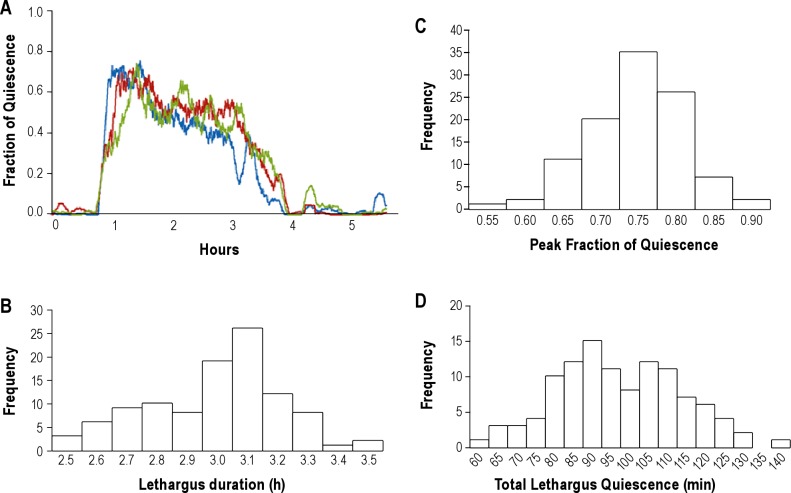
Analysis of data from wild-type animals. (A) Fraction of quiescence in a 10-min moving window of 3 individual wild-type worms using a 1-sec interval of subtraction. The x-axis of the 3 traces was aligned so that the beginning of L4 lethargus was the same for the 3 traces. (B) Distribution of lethargus duration among 104 wild-type worms. The distribution did not deviate from normality (P > 0.05, Shapiro-Wilk Test, with Bonferroni post hoc correction). (C) Distribution of peak fraction of quiescence among 104 wild-type worms. The distribution did not deviate from normality (P > 0.05, Shapiro-Wilk Test, with Bonferroni post hoc correction). (D) Distribution of total quiescence in L4 lethargus among 104 wild-type worms. The distribution did not deviate from normality (P > 0.05, Shapiro-Wilk Test, with Bonferroni post hoc correction).
Figure 5
Figure 5
Effect of food concentration on lethargus quiescence. (A) The effect of food on optical transparency. All images were taken with the same light intensity and same camera exposure time. The concentration of the HB101 bacteria is shown above (1x and 4x) and below (15x and 60x) each of the 4 images. (B) The effect of food concentration on the mean and standard deviation (error bars) of the duration of lethargus. Value of each bar is shown inside the bar. N = 24 for 1X, 4X, and 60X concentrations and = 104 for 15X concentration. (C) The effect of food concentration on the mean and standard deviation (error bars) of the total lethargus quiescence. Value of each bar is shown inside the bar. N = 24 for 1X, 4X, and 60X concentrations and = 104 for 15X concentration. (D) In the absence of food, episodic quiescence outside of lethargus (arrows) is observed.
Figure 6
Figure 6
Analysis of mutants using CiD. (A) Fraction of quiescence in a 10-min moving window of 3 individual worms of each of 3 genotypes using a 1-sec interval of subtraction. The x-axis of each series of 3 traces was aligned so that the beginning of L4 lethargus was the same for all worms. Data for wild-type animals is the same data shown in Figure 4A. (B) Total lethargus quiescence. Each point denotes a value from a single worm. The horizontal bars denote means of the distributions. *denotes significantly different from wild-type at P < 0.001 (2-tailed Wilcoxon rank sum test). N(wild type) = 104, N(egl-4) = 18, N(kin-2) = 24, N(acy-1) = 19. Mean ± SD (wild-type) = 97.9 ± 15.3, mean ± SD (egl-4) = 110.2 ± 25.5, mean ± SD (acy-1) = 36.6 ± 25.5, mean ± SD (kin-2) = 32.9 ± 25.2. (C) Peak fraction of quiescence. Each point denotes a value from a single worm. The horizontal bars denote means of the distribution. There was no significant difference between the mutants and wild-type worms (P > 0.05, 2-tailed Wilcoxon rank sum test). Number of animals is shown in B. Mean ± SD (wild-type) = 0.77 ± 0.07, mean ± SD (egl-4) = 0.83 ± 0.11, mean ± SD (acy-1) = 0.73 ± 0.13, mean ± SD (kin-2) = 0.87 ± 0.16.

References

    1. Singh RN, Sulston JE. Some observations on moulting in Caenorhabditis elegans. Nematologica. 1978;24:63–71.
    1. Raizen DM, Zimmerman JE, Maycock MH, et al. Lethargus is a Caenorhabditis elegans sleep-like state. Nature. 2008;451:569–72. - PubMed
    1. Monsalve GC, Van Buskirk C, Frand AR. LIN-42/PERIOD controls cyclical and developmental progression of C. elegans molts. Curr Biol. 2012;21:2033–45. - PubMed
    1. Van Buskirk C, Sternberg PW. Epidermal growth factor signaling induces behavioral quiescence in Caenorhabditis elegans. Nat Neurosci. 2007;10:1300–7. - PubMed
    1. Singh K, Chao MY, Somers GA, et al. C. elegans Notch signaling regulates adult chemosensory response and larval molting quiescence. Curr Biol. 2011;21:825–34. - PMC - PubMed

Supplementary References

    1. Baltz JM, Biggers JD. Oxygen transport to embryos in microdrop cultures. Mol Reprod Dev. 1991;28:351–5. - PubMed
    1. Suda H, Shouyama T, Yasuda K, Ishii N. Direct measurement of oxygen consumption rate on the nematode Caenorhabditis elegans by using an optical technique. Biochem Biophys Res Commun. 2005;330:839–43. - PubMed
    1. Sharabi K, Hurwitz A, Simon AJ, et al. Elevated CO2 levels affect development, motility, and fertility and extend life span in Caenorhabditis elegans. PNAS. 2009;106:4024–9. - PMC - PubMed
    1. Emsley J. Oxygen. Nature's Building Blocks: An A-Z Guide to the Elements. Oxford, England, UK: Oxford University Press; 2001. pp. 297–304.
    1. Stokes YM. Quantifying oxygen diffusion in paraffin oil used in oocyte and embryo culture. Mol Reprod Dev. 2009;76:1178–87. - PubMed

MeSH terms