. 2013 May 1;36(5):699-708.
doi: 10.5665/sleep.2630.

Sensitization of upper airway mechanoreceptors as a new pharmacologic principle to treat obstructive sleep apnea: investigations with AVE0118 in anesthetized pigs

Affiliations

Sensitization of upper airway mechanoreceptors as a new pharmacologic principle to treat obstructive sleep apnea: investigations with AVE0118 in anesthetized pigs

Klaus J Wirth et al. Sleep. .

Abstract

Study objectives: Drug treatment for obstructive sleep apnea (OSA) is desirable because at least 30% of patients do not tolerate continuous positive airway pressure (CPAP) treatment. The negative pressure reflex (NPR) involving superficially located mechanoreceptors in the upper airway (UA) is an important mechanism for UA patency inhibitable by topical UA anesthesia (lidocaine). The NPR may serve as a target for pharmacological intervention for a topical treatment of OSA. The objective was to determine the effect of pharmacological augmentation of the NPR on UA collapsibility.

Design: We developed a model of UA collapsibility in which application of negative pressures caused UA collapses in spontaneously breathing α-chloralose-urethane anesthetized pigs as indicated by characteristic tracheal pressure and air flow changes.

Setting: N/A.

Patients or participants: N/A.

Interventions: N/A.

Measurements and results: The potassium channel blocker AVE0118 administered topically to the UA in doses of 1, 3, and 10 mg per nostril sensitized the NPR, shifting the mechanoreceptor response threshold for the genioglossus muscle to more positive pressures (P < 0.001; n = 6 per group) and dose-dependently inhibited UA collapsibility. Ten mg of AVE0118 prevented UA collapses against negative pressures of -150 mbar (P < 0.01) for > 4 h in all pigs, while in control pigs the UA collapsed at -50 mbar or less negative pressures. The effect of AVE0118 was abolished by UA lidocaine anesthesia. Acute intravenous administration of naloxone or acetazolamide was ineffective; paroxetine and mirtazepine were weakly effective and fluoxetine was moderately effective in line with reported clinical efficacy.

Conclusion: Topical administration of AVE0118 to the UA is a promising pharmacologic approach for the treatment of OSA.

Keywords: AVE0118; Animal model; mechanoreceptors; negative pressure reflex; obstructive sleep apnea.


Figures
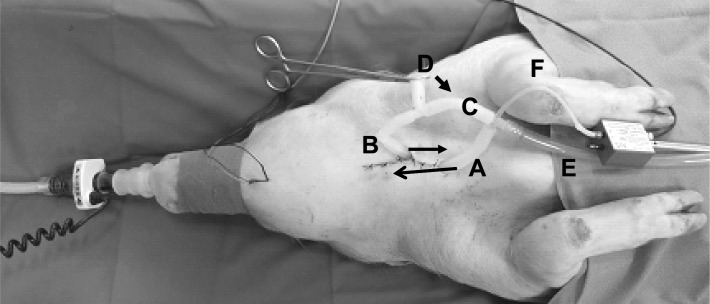
Figure 1
Figure 1
Breathing circuits in the anesthetized pig. A, rostral tracheal tube; B, caudal tracheal tube; C, tube connecting rostral and caudal trachea; D, tube to atmosphere for tracheal breathing in the open state; E, tube to negative pressure device; F, thin tube for the registration of sublaryngeal pressure that was advanced into the rostral tracheal tube. Arrows on tubes A and B show the direction of the tubes in the trachea. In the setting illustrated in the figure the pig is in a situation of nasal breathing, with the clamp closing the tube to atmosphere. Removing the clamp from position D and putting it onto the connecting tube between rostral and caudal trachael tubes (C, arrow) leads to tracheal breathing, a situation in which actuation of the negative pressure device for the collapsibility test directs the negative pressure to the upper airway in an inspiratory direction via tube E.
Figure 2
Figure 2
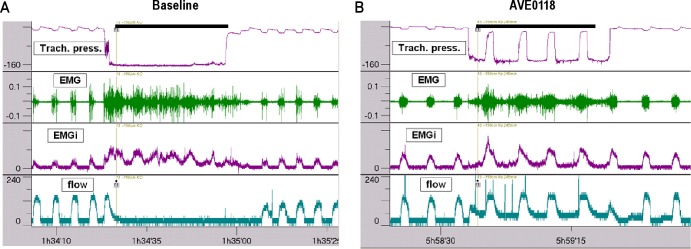
Tracings illustrating a collapsibility test in an anesthetized pig before (A) and after nasal administration of AVE0118, 10 mg per nostril (B). Upper airway (UA) collapse (A) is indicated by an interruption of flow (lowest tracing) and a sublaryngeal pressure close to the negative device pressure (upper tracing) during both the inspiratory and expiratory phase. Second and third tracing, genioglossus (GG) raw electromyogram (EMG) and integrated EMG, respectively. After AVE0118 the UA is open (B) during the inspiratory phase as indicated by flow to the negative pressure device and sublaryngeal pressure approaching atmospheric pressure. Time of application of negative pressure is labeled by a black line. Airflow during this period is directed to the negative pressure device. EMG activity is given in arbitrary units, tracheal pressure in mbar, and airflow in mL/sec.
Figure 3
Figure 3
Effect of nasal administration of AVE0118 given at time point 0 min on upper airway collapsibility at different levels of negative pressure and on the mechanoreceptor activation pressure threshold (right lower panel) in anesthetized pigs. Percentages of pigs (n = 6 per group) with collapse or mechanosensor activation thresholds (mbar) are given for vehicle (control), 1, 3, and 10 mg per nostril of AVE0118. Results for mechanoreceptor threshold after AVE0118 are significantly different versus vehicle for all doses and timepoints (P < 0.001). Results for collapsibility are significant versus vehicle group for time points > 30-60 min (P < 0.01) for all doses and pressures. At 1-mg duration of inhibition of collapsibility versus control group is 180, 120, and 75 min (medians; P < 0.01) at -50, -100, and -150 mbar, respectively.
Figure 4
Figure 4
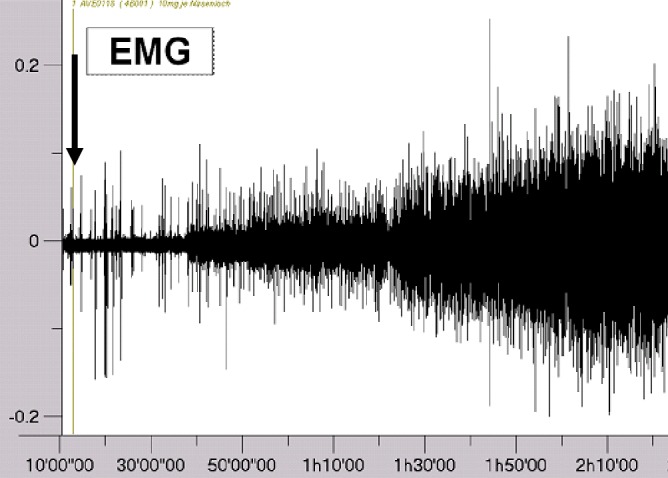
Tracing illustrating the development of raw genioglossus (GG) electromyogram (EMG) activity in a pig after administration of 10 mg of AVE0118 to each nostril (vertical arrow). The onset of action of the nasal formulation is delayed by approximately 30 min in line with the onset of inhibition of collapsibility (see Figure 3). EMG activity is given in arbitrary units.
Figure 5
Figure 5
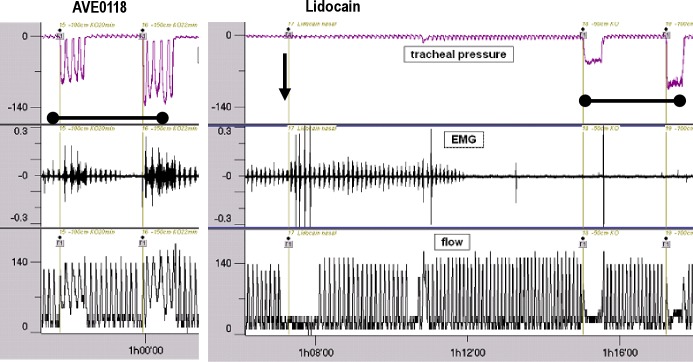
Tracings illustrating the effect of topical upper airway (UA) anesthesia with lidocaine in a pig that had received nasal AVE0118, 10 mg per nostril. Before lidocaine genioglossus (GG) electromyogram (EMG) activity was present and collapsibility was inhibited by AVE0118 during application of -100 and -150 mbar negative pressure (left tracings, labeled by a black line). Approximately 5 min after lidocaine administration (vertical arrow) GG EMG activity disappeared and collapsibility returned at negative pressure challenges of -50 and -100 mbar labeled by a black line (right tracings). Note that inspiratory tracheal pressure became more negative after lidocaine administration after GG EMG activity had disappeared (from -5 mbar to -9 mbar) and that even during application of negative pressure GG EMG activity does not appear any more. Airflow measurement is interrupted during the nasal application of lidocaine. EMG activity is given in arbitrary units, tracheal pressure in mbar, and airflow in mL/sec.
Figure 6
Figure 6
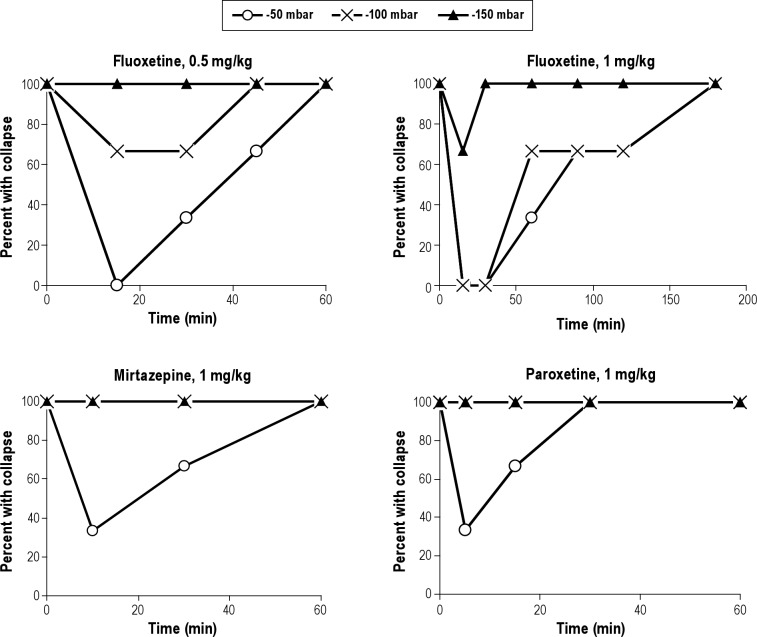
Effect of fluoxetine at 0.5 and 1 mg/kg, and mirtazepine and paroxetine at 1 mg/kg on upper airway collapsibility at different levels of negative pressure in anesthetized pigs. Percentage of pigs with collapse is shown (n = 3 for each drug and dose).

Comment in

References

    1. Young T, Peppard PE, Gottlieb DJ. Epidemiology of obstructive sleep apnea: a population health perspective. Am J Respir Crit Care Med. 2002;165:1217–39. - PubMed
    1. Resnick HE, Redline S, Shahar E, et al. Diabetes and sleep disturbances: findings from the Sleep Heart Health Study. Diabetes Care. 2003;26:702–9. - PubMed
    1. Baguet JP, Barone-Rochette G, Pepin JL. Hypertension and obstructive sleep apnoea syndrome: current perspectives. J Hum Hypertens. 2009;23:431–43. - PubMed
    1. Kohler M, Smith D, Tippett V, Stradling JR. Predictors of long-term compliance with continuous positive airway pressure. Thorax. 2010;65:829–32. - PubMed
    1. Hedner J, Grote L, Zou D. Pharmacological treatment of sleep apnea: current situation and future strategies. Sleep Med Rev. 2008;12:33–47. - PubMed

MeSH terms