Tooth loss, chewing ability and quality of life
- PMID: 23633796
- PMCID: PMC3636836
- DOI: 10.4103/0976-237X.107424
Tooth loss, chewing ability and quality of life
Abstract
Objectives: The aim of this study was to observe the tooth loss over age in a sample of Brazilian patients and analyze their ability to chew, relating it to how much is the loss of oral function impact over the quality of life (QoL).
Materials and methods: This is a single center, observational study and the data were collected through clinical examination followed of questionnaires to obtain sociodemographic information, the ability to chew (through the index of chewing ability [ICA]) and QoL (through Oral Health Impact Profile, OHIP-14).
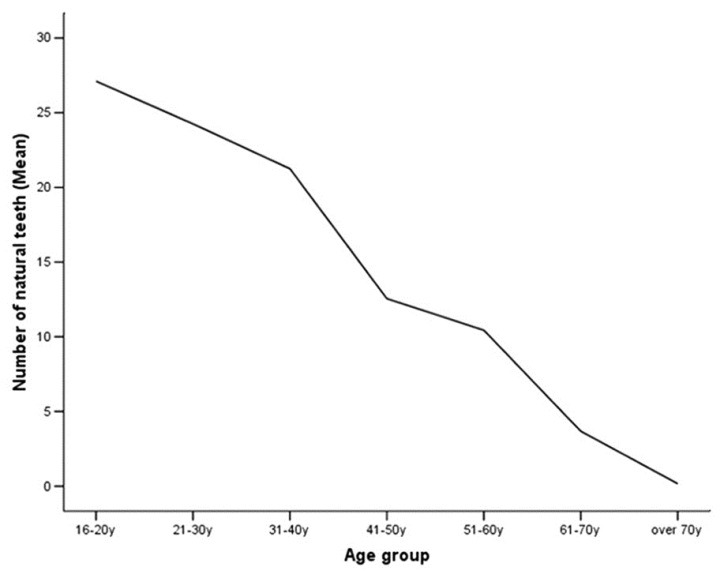
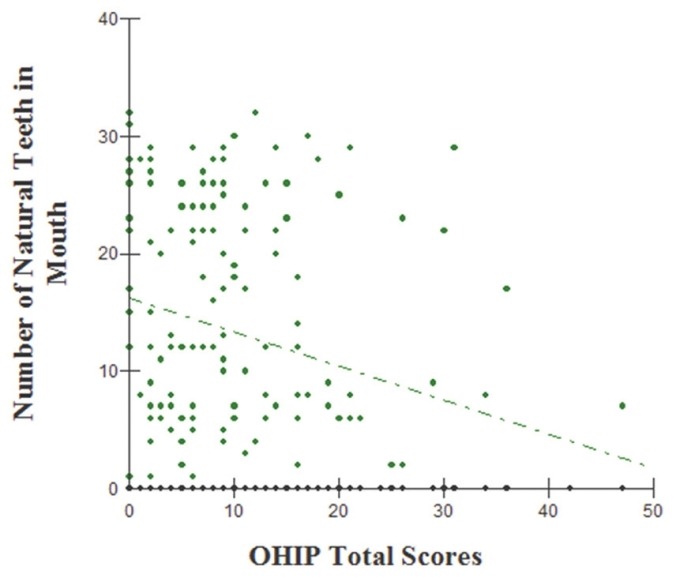
Results: The sample was composed by 171 random volunteers with mean age of 47 (SD 15.2). Low number of natural teeth was associated with an increase of age (Spearman's rho correlation coefficient-0.7, P < 0.001, 2-tailed) and chew disability (ICA: chew's ability vs. disability) (Mann-Whitney U-Test, P < 0.001). Chew disability showed a negative impact over the QoL (overall OHIP; Mann-Whitney U Test P < 0.001) and in five of seven OHIP domains (Functional Limitation, Physical Pain, Psychological Discomfort, Physical Disability, Psychological Disability). Age over than 40 years, was also associated with chewing disability (Pearson Chi-Square P < 0.001) and poorer QoL (Mann-Whitney U test P = 0.01).
Conclusion: This study observed that the chewing disability produces a significant and negative impact over oral-health related QoL and both, poor QoL and chewing disability are related with the decrease of the number of natural teeth.
Keywords: Chew's ability; oral health impact profile-14; oral health-related quality of life; quality of life; tooth loss.
Conflict of interest statement
Figures
References
-
- Study protocol for the World Health Organization project to develop a quality of life assessment instrument (WHOQOL) Qual Life Res. 1993;2:153–9. - PubMed
-
- Slade GD, Spencer AJ. Development and evaluation of the oral health impact profile. Community Dent Health. 1994;11:3–11. - PubMed
-
- Slade GD. Derivation and validation of a short-form oral health impact profile. Community Dent Oral Epidemiol. 1997;25:284–90. - PubMed
-
- Fontijn-Tekamp FA, Slagter AP, Van Der Bilt A, Van 'T Hof MA, Witter DJ, Kalk W, et al. Biting and chewing in overdentures, full dentures, and natural dentitions. J Dent Res. 2000;79:1519–24. - PubMed
LinkOut - more resources
Full Text Sources
Miscellaneous