. 2011 Dec;1(1):24-33.
doi: 10.1212/CPJ.0b013e31823d07b6.

The evaluation of a patient with dizziness

Affiliations

The evaluation of a patient with dizziness

Kevin A Kerber et al. Neurol Clin Pract. 2011 Dec.

Abstract

Dizziness is the quintessential symptom presentation in all of clinical medicine. It can stem from a disturbance in nearly any system of the body. Patient descriptions of the symptom are often vague and inconsistent, so careful probing is essential. The physical examination is performed by observing the patient at rest and following simple movements or bedside tests. In general, no special tools are required. The causes of dizziness range from benign to life-threatening disorders, and features that distinguish among these may be subtle. When diagnostic testing is considered, parsimony should be the rule. Identifying common peripheral vestibular disorders is a priority. Picking this "low hanging fruit" can be the key component to excluding more serious central causes of dizziness.


Figures
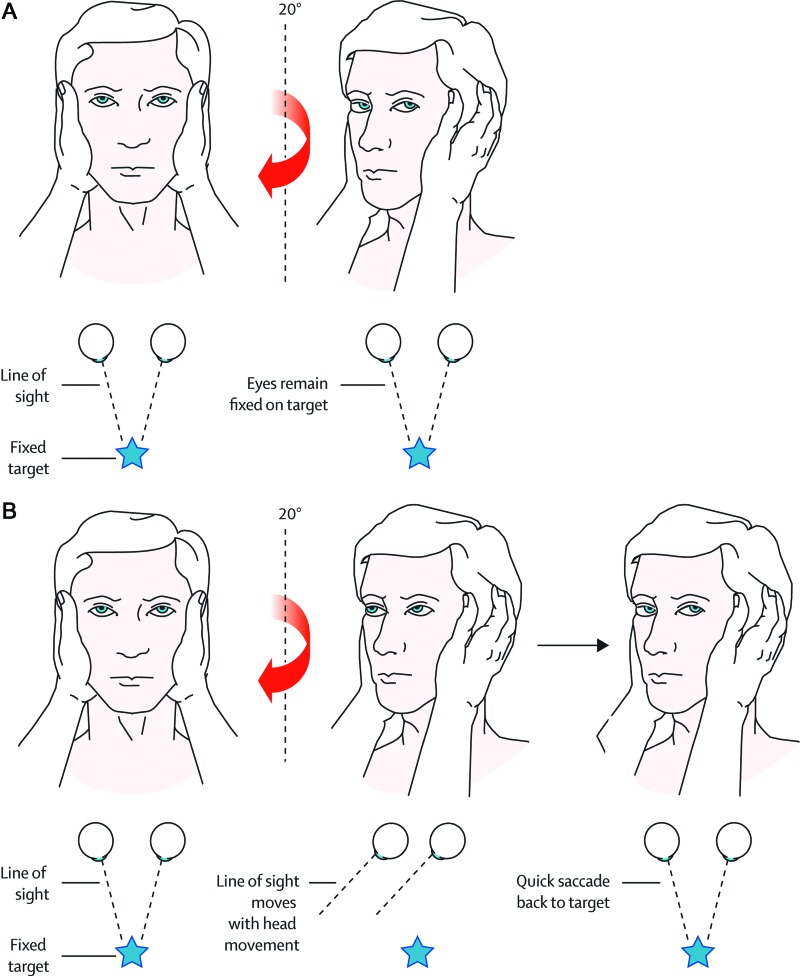
Figure 1
Figure 1. The head thrust test
The head thrust test is a test of vestibular function that is performed as part of the bedside examination. This maneuver tests the vestibulo-ocular reflex (VOR). The patient sits in front of the examiner and the examiner holds the patient's head steady in the midline. The patient is instructed to maintain gaze on the nose of the examiner. The examiner then quickly turns the patient's head about 10–15 degrees to one side and observes the ability of the patient to keep the eyes locked on the examiner's nose. Note that the test can also be performed by starting with the head turned to the side, and then making the quick movement back to the midline. If the patient's eyes stay locked on the examiner's nose (i.e., no corrective saccade) (A), then the peripheral vestibular system is assumed to be intact. Thus in a patient with acute dizziness, the absence of a corrective saccade suggests a CNS localization. If, however, the patient's eyes move with the head (B) and then the patient makes a voluntary eye movement back to the examiner's nose (i.e., corrective saccade), then this suggests a lesion of the peripheral vestibular system and not the CNS. When a patient presents with the acute vestibular syndrome, the test result shown in A would suggest a CNS lesion, whereas the test result in B would suggest a peripheral vestibular lesion (thus, vestibular neuritis). From: Edlow JA, Newman-Toker DE, Savitz SI. Diagnosis and initial management of cerebellar infarction. Lancet Neurol 2008;7:951–964.
Figure 2
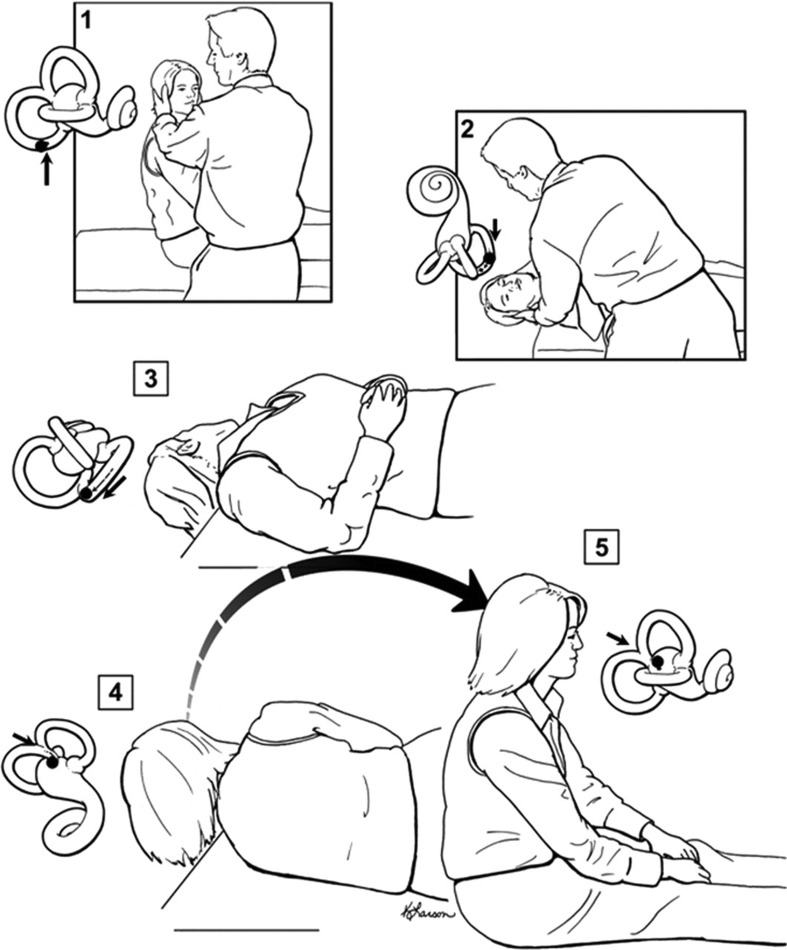
Figure 2. The Dix-Hallpike test and the canalith repositioning maneuver
The Dix-Hallpike test is performed by turning the patient's head about 45 degrees toward the side to be tested (step 1) and then laying the patient down quickly (step 2). If BPPV is present, nystagmus ensues usually within seconds. The patient is held in the right head-hanging position (step 2) for 20 to 30 seconds, and then the remaining steps of the canalith repositioning maneuver can be performed (steps 3–5). In step 3, the head is turned 90 degrees toward the unaffected side. Step 3 is held for 20 to 30 seconds before turning the head another 90 degrees (step 4) so the head is nearly in the face-down position. Step 4 is held for 20 to 30 seconds, and then the patient is brought quickly back up to the sitting up position. The movement of the otolith material within the labyrinth is depicted with each step, showing how otoliths are moved from the posterior semicircular canal to the vestibule. From: Fife T, Iverson T, Lempert J, et al. Practice parameter: therapies for benign paroxysmal positional vertigo. Neurology 2008;70:2067–2074.
None

References

    1. Eagles D, Stiell IG, Clement CM, et al. International survey of emergency physicians' priorities for clinical decision rules. Acad Emerg Med 2008;15:177–182 - PubMed
    1. Newman-Toker DE, Cannon LM, Stofferahn ME, Rothman RE, Hsieh YH, Zee DS. Imprecision in patient reports of dizziness symptom quality: a cross-sectional study conducted in an acute care setting. Mayo Clin Proc 2007;82:1329–1340 - PubMed
    1. Kerber KA, Brown DL, Lisabeth LD, Smith MA, Morgenstern LB. Stroke among patients with dizziness, vertigo, and imbalance in the emergency department: a population-based study. Stroke 2006;37:2484–2487 - PMC - PubMed
    1. Kattah JC, Talkad AV, Wang DZ, Hsieh YH, Newman-Toker DE. HINTS to diagnose stroke in the acute vestibular syndrome: three-step bedside oculomotor examination more sensitive than early MRI diffusion-weighted imaging. Stroke 2009;40:3504–510 - PMC - PubMed
    1. Neuhauser H, Lempert T. Vestibular migraine. Neurol Clin 2009;27:379–391 - PubMed