


Motivated behaviors and levels of 3α,5α-THP in the midbrain are attenuated by knocking down expression of pregnane xenobiotic receptor in the midbrain ventral tegmental area of proestrous rats
- PMID: 23634744
- PMCID: PMC3700579
- DOI: 10.1111/jsm.12173
Motivated behaviors and levels of 3α,5α-THP in the midbrain are attenuated by knocking down expression of pregnane xenobiotic receptor in the midbrain ventral tegmental area of proestrous rats
Abstract
Introduction: Progesterone (P4 ) and its product, 5α-pregnan-3α-ol-20-one (3α,5α-THP), act in the midbrain ventral tegmental area (VTA) to alter motivated behaviors, such as mating, and motor and anxiety behavior. Of interest is whether 3α,5α-THP formation requires the pregnane xenobiotic receptor (PXR), which is expressed in the midbrain of rats.
Aim: The role of PXR in the midbrain for 3α,5α-THP formation, which precedes modulation of motivated behaviors, was investigated.
Methods: Rats had estrous cycle phase determined and were assessed when they were in diestrus or proestrus. Diestrous and proestrous rats were infused with control or antisense oligodeoxyribonucleotides (AS-ODNs) targeted against PXR to the VTA.
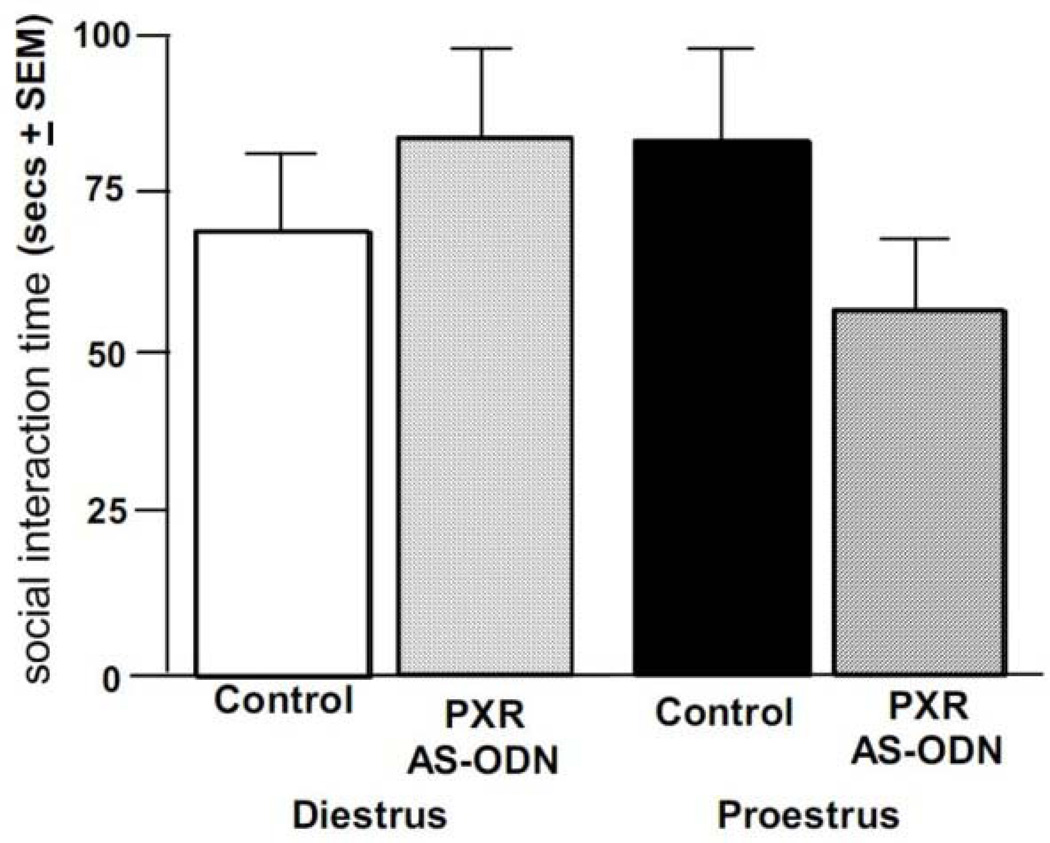
Main outcome measures: In pilot studies, PXR gene and protein expression in the midbrain were determined with quantitative reverse transcriptase polymerase chain reaction and Western blotting, respectively. Diestrous and proestrous rats infused with control or AS-ODNs to the VTA were tested for anxiety (open field and plus maze), social (social interaction), and sexual (paced mating) behavior. Expression of PXR in the midbrain was verified with Western blotting. Plasma estradiol, P4 , dihydroprogesterone (DHP), and 3α,5α-THP levels, and brain P4 , DHP, and 3α,5α-THP levels were measured. We predicted that proestrous rats infused with PXR AS-ODNs would have decreased anti-anxiety, social, and sexual behavior, lower midbrain expression of PXR, and lower midbrain levels of 3α,5α-THP compared with controls.
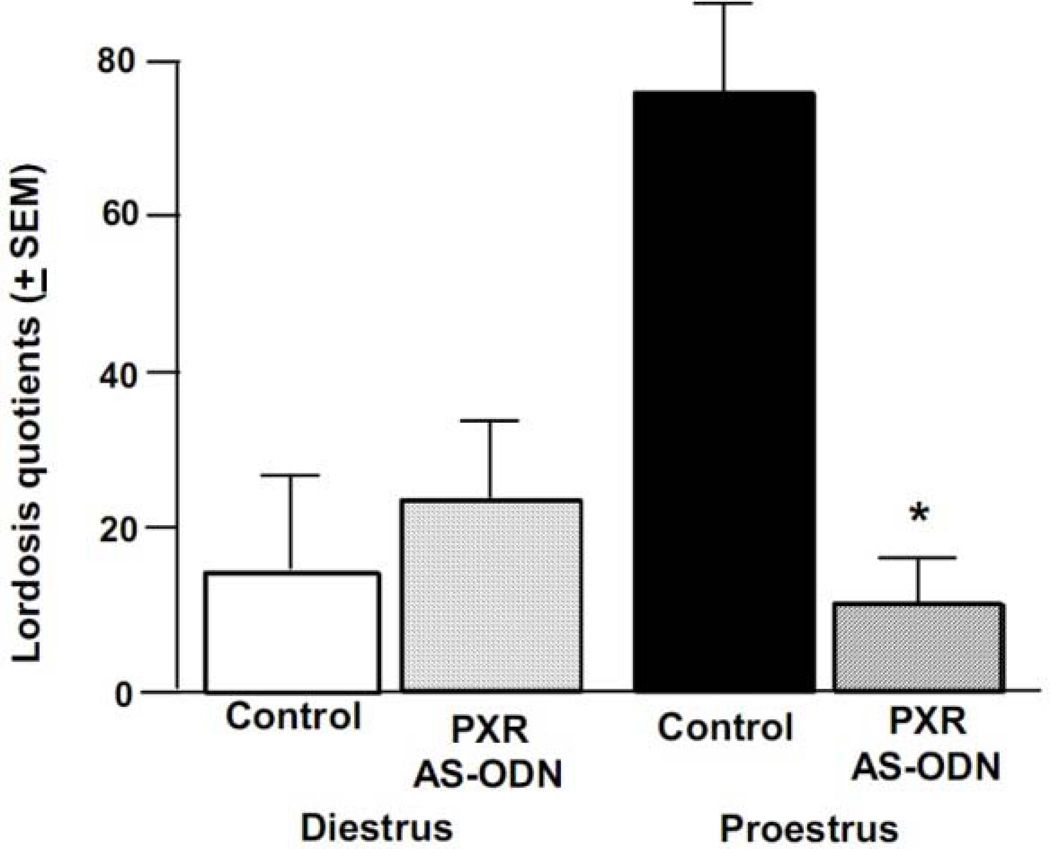
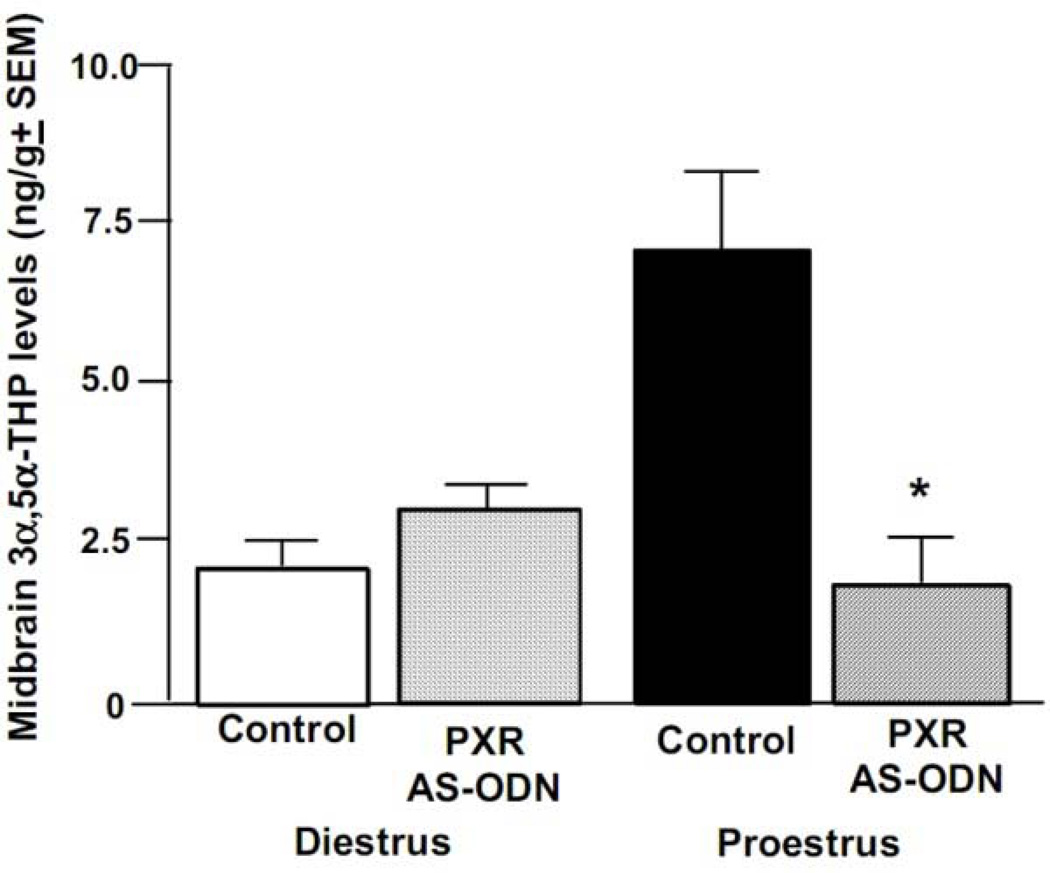
Results: Results supported the hypothesis that formation of 3α,5α-THP requires PXR and may be important for motivated behaviors. PXR AS-ODN, compared with control, infusions to the VTA reduced PXR expression and 3α,5α-THP levels in the midbrain and attenuated sexual receptivity of proestrous rats.
Conclusions: Knockdown of PXR in the midbrain reduces 3α,5α-THP levels and sexual receptivity of proestrous rats. Thus, PXR in the midbrain may be required for the observed increase in 3α-5α-THP during proestrus, which has subsequent effects on motivated, reproductive behaviors.
Keywords: Allopregnanolone; Lordosis; Mating; Neurosteroids; Progesterone; Receptivity.
© 2013 International Society for Sexual Medicine.
Conflict of interest statement
Figures
References
-
- Frye CA. Neurosteroids-From Basic Research to Clinical Perspectives. In: Rubin Robert T, Pfaff Donald W., editors. Hormones/Behavior Relations of Clinical Importance. San Diego: Academic Press; 2009. pp. 395–416.
-
- Frye CA, Bayon LE, Pursnani NK, Purdy RH. The neurosteroids, progesterone and 3α,5α-THP, enhance sexual motivation, receptivity, and proceptivity in female rats. Brain Res. 1998;808:72–83. - PubMed
-
- Frye CA, Petralia SM, Rhodes ME. Estrous cycle and sex differences in performance on anxiety tasks coincide with increases in hippocampal progesterone and 3α,5α-THP. Pharmacol Biochem Behav. 2000;67:587–596. - PubMed
-
- Holzbauer M. Physiological variations in the ovarian production of 5α-pregnane derivatives with sedative properties in the rat. J Steroid Biochem. 1975;6:1307–1310. - PubMed
Publication types
MeSH terms
Substances
Grants and funding
LinkOut - more resources
Full Text Sources
Other Literature Sources
Research Materials
