


Can we detect oceanic biodiversity hotspots from space?
- PMID: 23635866
- PMCID: PMC3965306
- DOI: 10.1038/ismej.2013.72
Can we detect oceanic biodiversity hotspots from space?
Abstract
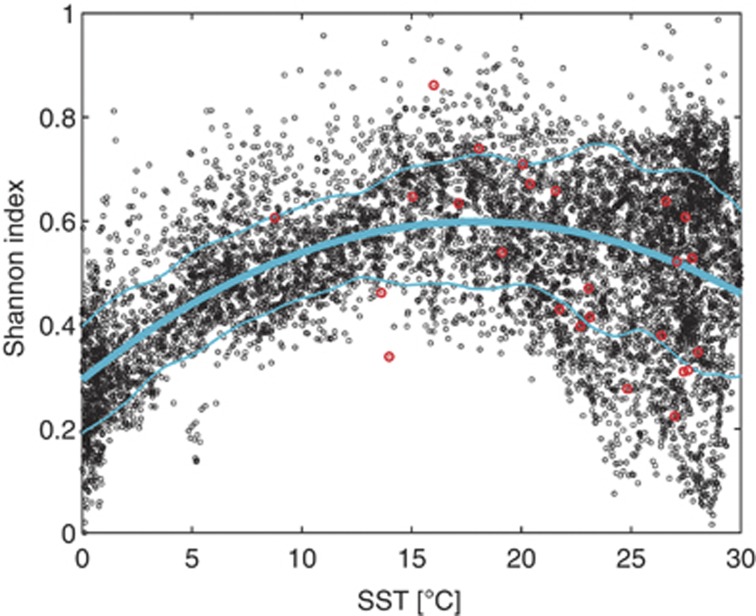
Understanding the variability of marine biodiversity is a central issue in microbiology. Current observational programs are based on in situ studies, but their implementation at the global scale is particularly challenging, owing to the ocean extent, its temporal variability and the heterogeneity of the data sources on which compilations are built. Here, we explore the possibility of identifying phytoplanktonic biodiversity hotspots from satellite. We define a Shannon entropy index based on patchiness in ocean color bio-optical anomalies. This index provides a high resolution (1 degree) global coverage. It shows a relation to temperature and mid-latitude maxima in accordance with those previously evidenced in microbiological biodiversity model and observational studies. Regional maxima are in remarkable agreement with several known biodiversity hotspots for plankton organisms and even for higher levels of the marine trophic chain, as well as with some in situ planktonic biodiversity estimates (from Atlantic Meridional Transect cruise). These results encourage to explore marine biodiversity with a coordinated effort of the molecular, ecological and remote sensing communities.
Figures

References
-
- Alvain S, Moulin C, Dandonneau Y, Loisel H. Seasonal distribution and succession of dominant phytoplankton groups in the global ocean: a satellite view. Global Biogeochem Cy. 2008;22:GB3001.
-
- Barton AD, Dutkiewicz S, Flierl G, Bragg J, Follows MJ. Patterns of diversity in marine phytoplankton. Science. 2010;327:1509–1511. - PubMed
-
- Block BA, Jonsen ID, Jorgensen SJ, Winship AJ, Shaffer SA, Bograd SJ, et al. Tracking apex marine predator movements in a dynamic ocean. Nature. 2011;475:86–90. - PubMed
-
- Cermeño P, Marañón E, Harbour D, Figueiras GF, Crespo GB, Huete-Ortega M, et al. Resource levels, allometric scaling of population abundance, and marine phytoplankton diversity. Limnol Oceanogr. 2008;53:312–318.
Publication types
MeSH terms
LinkOut - more resources
Full Text Sources
Other Literature Sources
