


Review
doi: 10.1038/nrn3494.
Epub 2013 May 2.
Sleep and the single neuron: the role of global slow oscillations in individual cell rest
Affiliations
- PMID: 23635871
- PMCID: PMC3972489
- DOI: 10.1038/nrn3494
Item in Clipboard
Review
Sleep and the single neuron: the role of global slow oscillations in individual cell rest
Nat Rev Neurosci.
2013 Jun.
Abstract
Sleep is universal in animals, but its specific functions remain elusive. We propose that sleep's primary function is to allow individual neurons to perform prophylactic cellular maintenance. Just as muscle cells must rest after strenuous exercise to prevent long-term damage, brain cells must rest after intense synaptic activity. We suggest that periods of reduced synaptic input ('off periods' or 'down states') are necessary for such maintenance. This in turn requires a state of globally synchronized neuronal activity, reduced sensory input and behavioural immobility - the well-known manifestations of sleep.
Conflict of interest statement
The authors declare no competing financial interests.
Figures
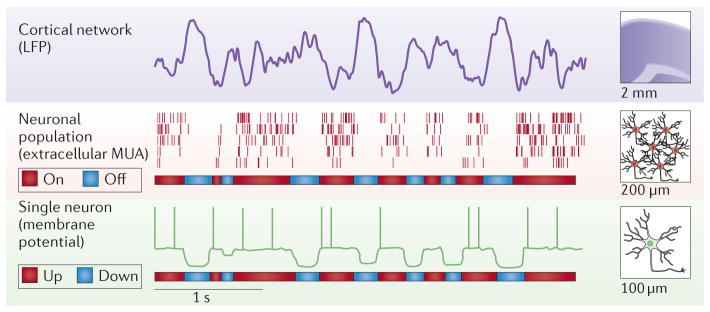
A schematic depiction of the local field potential (LFP) recorded from deep cortical layers during spontaneous non-rapid eye movement sleep in a rat (top row), and a raster plot of the corresponding neuronal spiking activity of five individual neurons (middle row) are shown. Note that LFP slow waves are associated with generalized population silence (off periods), which alternates with periods of raised spiking activity (on periods), each of which lasts several hundred milliseconds. The bottom row shows a schematic representation of a membrane potential expected in one individual neuron within this network. Note that LFP slow waves and extracellular off periods are associated with a prominent membrane hyperpolarization (down state), which alternate regularly with periods of depolarization, when spiking propensity is increased (up state). MUA, multi-unit activity.
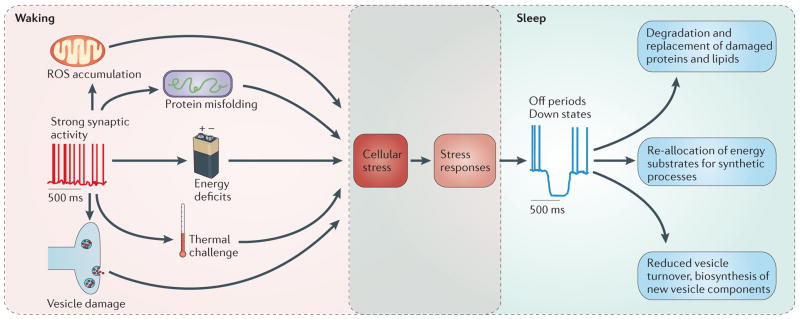
We propose that the intense synaptic activity that is typical of active waking eventually leads to irreversible cellular damage if it is not compensated by intermittent periods of rest. This damage could occur through multiple pathways, including the accumulation of reactive oxygen species (ROS), repeated vesicle turnover, insufficient energy substrates for synthetic processes, increased brain temperature and accumulation of misfolded proteins in the endoplasmic reticulum lumen. These challenges trigger various stress responses that allow the cell to restore homeostasis. We suggest that a key effect of these stress responses is to produce ‘neuronal fatigue’ that reduces electrical excitability, promoting local or global off periods of generalized neuronal silence. These in turn reduce neuronal energy expenditure and lower the need to replace structures such as synaptic vesicles, allowing cells to perform essential maintenance before damage becomes irreversible.
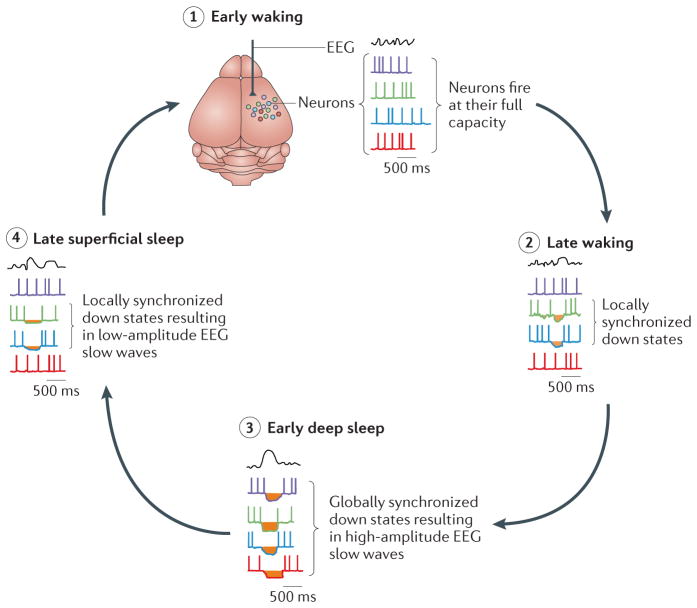
In early waking (stage 1), neurons can fire at their full capacity. As waking time progresses (stage 2), the need for cellular maintenance builds up as a result of prolonged synaptic and spiking activity. The resulting down states are short, localized and easily interrupted by inputs arising from distal neurons during waking. Although they may fulfil the prophylactic function of preventing permanent damage, this comes at a cost of reduced cognitive performance. During early deep sleep (stage 3), sustained uninterrupted down states occur across large cortical neuronal populations, efficiently providing cellular rest to a large number of neurons. Synchronized occurrence of down states results in the high-amplitude electroencephalogram (EEG) slow waves that are typical of early non-rapid eye movement sleep. As individual neurons obtain the necessary amount of rest (stage 4) they resume firing, and progressively smaller neuronal populations engage in synchronized down states. This results in the low-amplitude EEG slow waves that are typical of later sleep.
References
-
- Tobler I. In: Principles and Practice of Sleep Medicine. Kryger MH, Roth T, Dement WC, editors. Saunders; 2005. pp. 77–90.
-
- Van Dongen HP, Maislin G, Mullington JM, Dinges DF. The cumulative cost of additional wakefulness: dose-response effects on neurobehavioral functions and sleep physiology from chronic sleep restriction and total sleep deprivation. Sleep. 2003;26:117–126. - PubMed
-
- Killgore WD. Effects of sleep deprivation on cognition. Prog Brain Res. 2010;185:105–129. - PubMed
Publication types
MeSH terms
Grants and funding
LinkOut - more resources
Full Text Sources
Other Literature Sources
Medical
