


Genome-wide meta-analysis of observational studies shows common genetic variants associated with macronutrient intake
- PMID: 23636237
- PMCID: PMC3652928
- DOI: 10.3945/ajcn.112.052183
Genome-wide meta-analysis of observational studies shows common genetic variants associated with macronutrient intake
Abstract
Background: Macronutrient intake varies substantially between individuals, and there is evidence that this variation is partly accounted for by genetic variants.
Objective: The objective of the study was to identify common genetic variants that are associated with macronutrient intake.
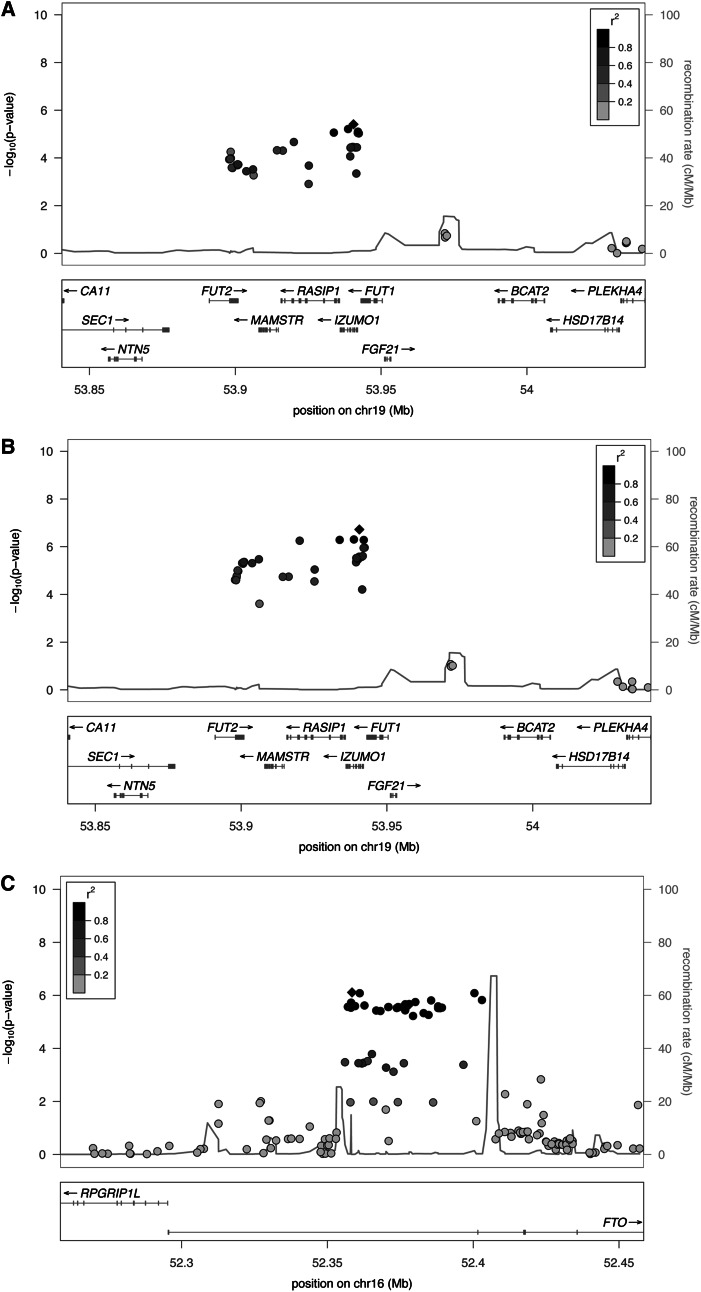
Design: We performed 2-stage genome-wide association (GWA) meta-analysis of macronutrient intake in populations of European descent. Macronutrients were assessed by using food-frequency questionnaires and analyzed as percentages of total energy consumption from total fat, protein, and carbohydrate. From the discovery GWA (n = 38,360), 35 independent loci associated with macronutrient intake at P < 5 × 10(-6) were identified and taken forward to replication in 3 additional cohorts (n = 33,533) from the DietGen Consortium. For one locus, fat mass obesity-associated protein (FTO), cohorts with Illumina MetaboChip genotype data (n = 7724) provided additional replication data.
Results: A variant in the chromosome 19 locus (rs838145) was associated with higher carbohydrate (β ± SE: 0.25 ± 0.04%; P = 1.68 × 10(-8)) and lower fat (β ± SE: -0.21 ± 0.04%; P = 1.57 × 10(-9)) consumption. A candidate gene in this region, fibroblast growth factor 21 (FGF21), encodes a fibroblast growth factor involved in glucose and lipid metabolism. The variants in this locus were associated with circulating FGF21 protein concentrations (P < 0.05) but not mRNA concentrations in blood or brain. The body mass index (BMI)-increasing allele of the FTO variant (rs1421085) was associated with higher protein intake (β ± SE: 0.10 ± 0.02%; P = 9.96 × 10(-10)), independent of BMI (after adjustment for BMI, β ± SE: 0.08 ± 0.02%; P = 3.15 × 10(-7)).
Conclusion: Our results indicate that variants in genes involved in nutrient metabolism and obesity are associated with macronutrient consumption in humans. Trials related to this study were registered at clinicaltrials.gov as NCT00005131 (Atherosclerosis Risk in Communities), NCT00005133 (Cardiovascular Health Study), NCT00005136 (Family Heart Study), NCT00005121 (Framingham Heart Study), NCT00083369 (Genetic and Environmental Determinants of Triglycerides), NCT01331512 (InCHIANTI Study), and NCT00005487 (Multi-Ethnic Study of Atherosclerosis).
Figures
References
-
- Rankinen T, Bouchard C. Genetics of food intake and eating behavior phenotypes in humans. Annu Rev Nutr 2006;26:413–34 - PubMed
-
- Collaku A, Rankinen T, Rice T, Leon AS, Rao DC, Skinner JS, Wilmore JH, Bouchard C. A genome-wide linkage scan for dietary energy and nutrient intakes: the Health, Risk Factors, Exercise Training, and Genetics (HERITAGE) Family Study. Am J Clin Nutr 2004;79:881–6 - PubMed
-
- Choquette AC, Lemieux S, Tremblay A, Chagnon YC, Bouchard C, Vohl MC, Perusse L. Evidence of a quantitative trait locus for energy and macronutrient intakes on chromosome 3q27.3: the Quebec Family Study. Am J Clin Nutr 2008;88:1142–8 - PubMed
-
- Cai G, Cole SA, Bastarrachea RA, Maccluer JW, Blangero J, Comuzzie AG. Quantitative trait locus determining dietary macronutrient intakes is located on human chromosome 2p22. Am J Clin Nutr 2004;80:1410–4 - PubMed
-
- Cai G, Cole SA, Butte N, Bacino C, Diego V, Tan K, Goring HH, O'Rahilly S, Farooqi IS, Comuzzie AG. A quantitative trait locus on chromosome 18q for physical activity and dietary intake in Hispanic children. Obesity (Silver Spring) 2006;14:1596–604 - PubMed
Publication types
MeSH terms
Substances
Associated data
Grants and funding
- R01 AG027012/AG/NIA NIH HHS/United States
- MC_UP_A100_1003/MRC_/Medical Research Council/United Kingdom
- CAPMC/ CIHR/Canada
- R01 HL091357/HL/NHLBI NIH HHS/United States
- T32 HL007575/HL/NHLBI NIH HHS/United States
- R01 DK091718/DK/NIDDK NIH HHS/United States
- G1000143/MRC_/Medical Research Council/United Kingdom
- UL1 TR000124/TR/NCATS NIH HHS/United States
- R01 HL105756/HL/NHLBI NIH HHS/United States
- MC_U106179471/MRC_/Medical Research Council/United Kingdom
- G0401527/MRC_/Medical Research Council/United Kingdom
- MC_UU_12015/5/MRC_/Medical Research Council/United Kingdom
- P30 DK063491/DK/NIDDK NIH HHS/United States
- U01 HL072524/HL/NHLBI NIH HHS/United States
- 14136/CRUK_/Cancer Research UK/United Kingdom
- WT_/Wellcome Trust/United Kingdom
- MC_U106188470/MRC_/Medical Research Council/United Kingdom
- R01 HL087700/HL/NHLBI NIH HHS/United States
LinkOut - more resources
Full Text Sources
Other Literature Sources
Medical
Molecular Biology Databases
