


doi: 10.1038/nature11909.
Using membrane transporters to improve crops for sustainable food production
Affiliations
- PMID: 23636397
- PMCID: PMC3954111
- DOI: 10.1038/nature11909
Item in Clipboard
Using membrane transporters to improve crops for sustainable food production
Nature.
.
Abstract
With the global population predicted to grow by at least 25 per cent by 2050, the need for sustainable production of nutritious foods is critical for human and environmental health. Recent advances show that specialized plant membrane transporters can be used to enhance yields of staple crops, increase nutrient content and increase resistance to key stresses, including salinity, pathogens and aluminium toxicity, which in turn could expand available arable land.
Figures
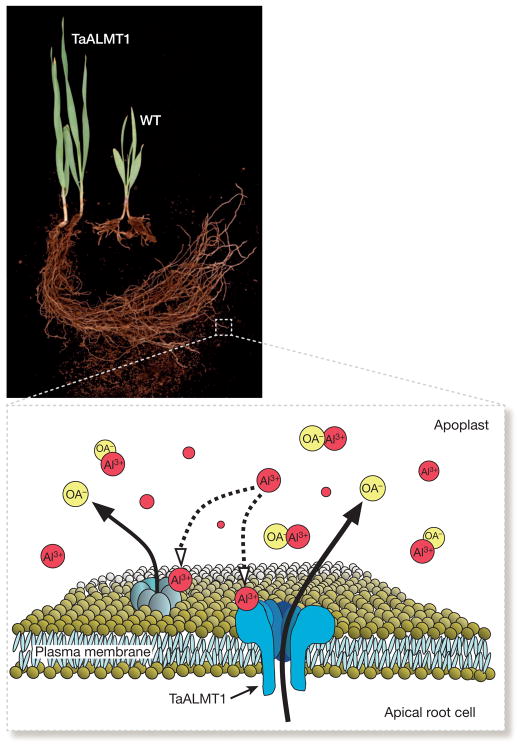
The photograph shows barley seedlings grown on an acid soil that contains high concentrations of toxic Al3+. One seedling has been genetically engineered with an Al3+-tolerance transporter gene from wheat (TaALMT1), whereas the other seedling is the non-transgenic parental line (wild type, WT). The diagram shows the TaALMT1 anion channel (blue structure) embedded within the plasma membrane of apical root cells. In acid soils, Al3+ activates TaALMT1 (dashed line) resulting in malate efflux into the apoplast (cell wall) external to the cytoplasm. Malate molecules (OA−, yellow circles) bind Al3+ in the apoplast to protect cells from aluminium toxicity at the root apex. The diagram is modified from figure 2 in ref. .
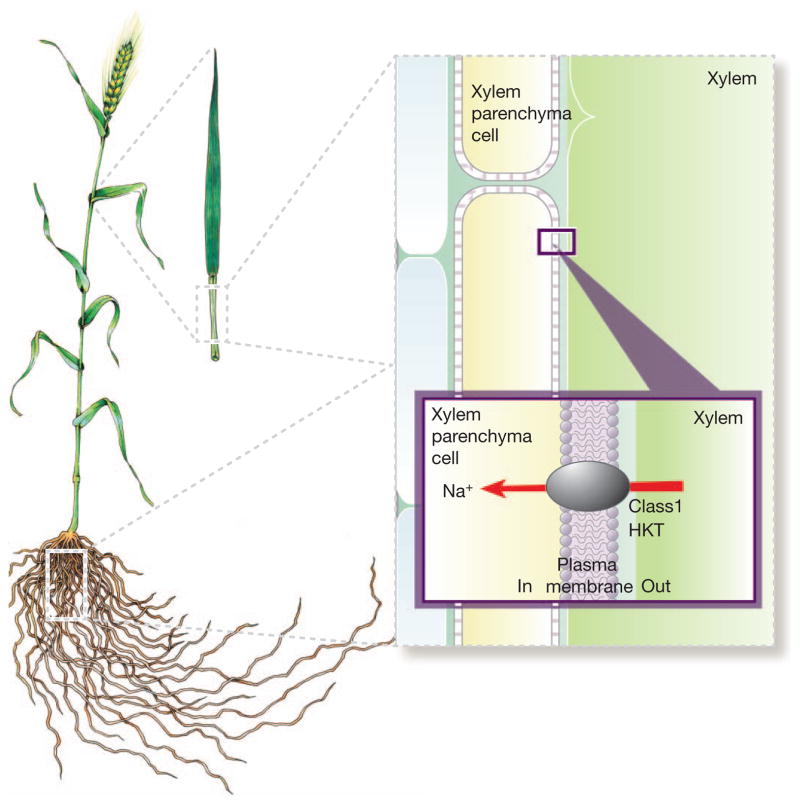
The drawing illustrates the function of class I HKT transporters in protecting plants from salinity stress. These HKT transporters mediate Na+ unloading from the xylem under salinity stress, which prevents Na+ over-accumulation in leaves, thereby protecting photosynthetic organs. An example of this mechanism in wheat plants is shown.
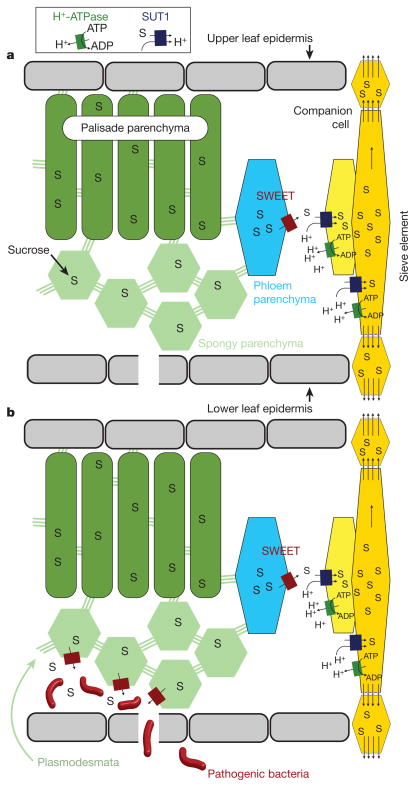
a, SWEETs (red) localized in the phloem parenchyma (a cell type of the plant vasculature), export sucrose produced by photosynthesis into the cell wall, from where it is loaded actively, with the help of the transporter SUT1 and energized by H+-ATPases into the actual conduits, the sieve element companion cell complex for translocation to seeds. Photosynthesis mainly occurs in the palisade parenchyma. b, The role of SWEETs as the ‘Achilles’ heel’ (susceptibility factors) of host plants during pathogen infection. SWEETs are induced directly as a consequence of the injection of transcriptional-activator-like effectors from pathogens via type III secretion systems into the infected plant cell, leading to release of sugars as a critical source of nutrition for the pathogens.
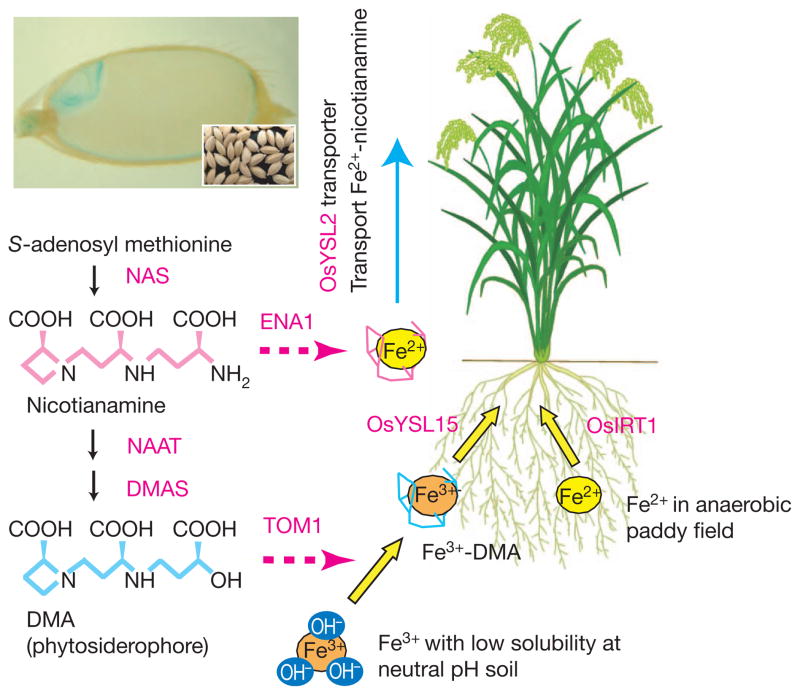
Rice takes up iron from the soil as Fe3+ deoxymugineic acid (DMA) by the OsYSL15 transporter. Rice also uses the OsIRT1 transporter to take up Fe2+, which is abundant in submerged and anaerobic conditions. DMA, which is the primary phytosiderophore that aids in iron transport, is synthesized from S-adenosyl methionine through three sequential enzymatic reactions mediated by nicotianamine synthase (NAS), nicotianamine aminotransferase (NAAT), and DMA synthase (DMAS), and then secreted by the efflux transporter TOM1 to solubilize iron in the soil. Nicotianamine, which is the biosynthetic precursor of DMA, is a chelator of divalent metals and plays a part in translocation of metals within plants. Nicotianamine is secreted into the cell wall by the nicotianamine efflux transporter ENA1. The iron–nicotianamine transporter OsYSL2 mediates iron influx into rice grains. The photograph shows iron staining (blue coloration) of a rice seed (inset shows rice seeds). Iron is mainly localized to the embryo and the outer layers of the grain.
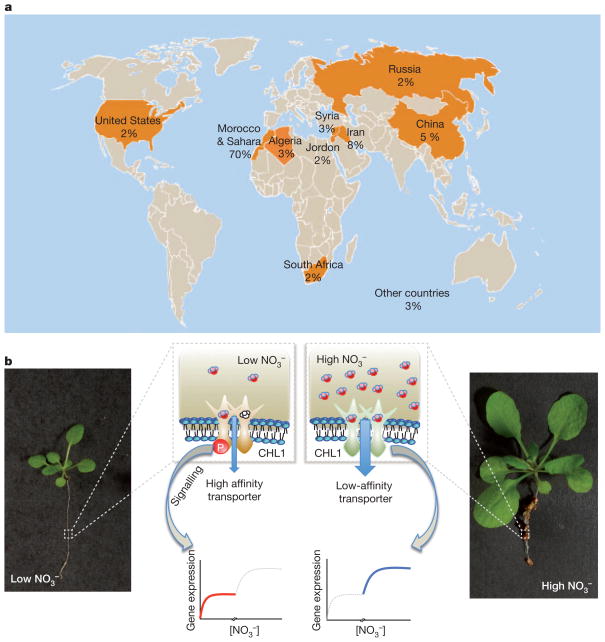
a, Global distribution map of reserves of rock phosphate. The percentage of effective reserves is illustrated (data from ref. 93). b, Dual functions of the nitrate transporter and nitrate sensor, CHL1, in nitrate uptake and sensing. Photographs show Arabidopsis seedlings at low (left) and high (right) nitrate. At low nitrate, CHL1 is phosphorylated at a specific amino acid, T101, converting it to a high-affinity nitrate uptake transporter, enabling nitrate accumulation at limiting soil nitrate concentrations. At high nitrate, the T101 amino acid is not phosphorylated, and CHL1 functions as a low-affinity transporter.
References
-
- The Food and Agriculture Organization of the United Nations. The State of Food Insecurity in the World 2010. FAO; 2010. pp. 8–11.
-
- The World Bank. Repositioning Nutrition as Central to Development: A Strategy for Large-Scale Action. Vol. 2. The International Bank for Reconstruction and Development/The World Bank; 2006. pp. 42–61. http://siteresources.worldbank.org/NUTRITION/Resources/281846-1131636806....
-
- World Health Organization/FAO. Diet, Nutrition and the Prevention of Chronic Diseases. 2003:4–12. http://whqlibdoc.who.int/trs/who_trs_916.pdf. - PubMed
-
- Foresight The Future of Food and Farming: Final Project Report. The Government Office for Science; 2011. pp. 49–74. http://www.bis.gov.uk/assets/foresight/docs/food-and-farming/11-546-futu....
-
- Rockström J, et al. A safe operating space for humanity. Nature. 2009;461:472–475. - PubMed
