


Neuropathy-inducing effects of eribulin mesylate versus paclitaxel in mice with preexisting neuropathy
- PMID: 23637052
- PMCID: PMC4073636
- DOI: 10.1007/s12640-013-9394-3
Neuropathy-inducing effects of eribulin mesylate versus paclitaxel in mice with preexisting neuropathy
Abstract
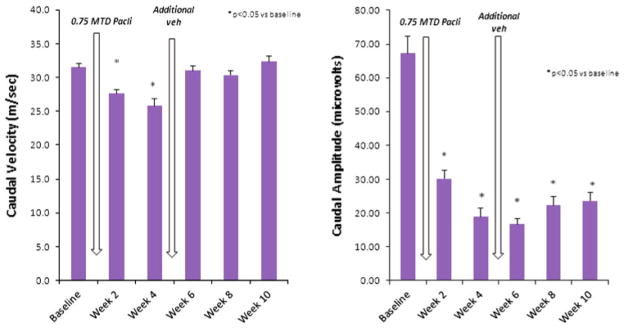
Eribulin mesylate (E7389, INN:eribulin mesilate Halaven(®)) is a non-taxane microtubule dynamics inhibitor currently in clinical use for advanced breast cancer. Other microtubule-targeting agents for breast cancer, including paclitaxel and ixabepilone, display a common treatment dose-limiting toxicity of peripheral neuropathy (PN). In an earlier study, we found eribulin mesylate had a lower propensity to induce PN in mice than either paclitaxel or ixabepilone. In the current study, we compared additional PN induced by paclitaxel versus eribulin mesylate when administered to mice with preexisting paclitaxel-induced PN. Initially, paclitaxel at 0.75 × its maximum tolerated dose (MTD; 22.5 mg/kg) was given on a Q2Dx3 regimen for 2 weeks. The second chemotherapy was 0.5 MTD eribulin mesylate (0.875 mg/kg) or paclitaxel (15 mg/kg) on a similar regimen, starting 2 weeks after the first. Initial paclitaxel treatment produced significant decreases in caudal nerve conduction velocity (NCV; averaging 19.5 ± 1 and 22.2 ± 1.3 %, p < 0.001) and amplitude (averaging 53.2 ± 2.6 and 72.4 ± 2.1 %, p < 0.001) versus vehicle when measured 24 h or 2 weeks after dosing cessation, respectively. Additional 0.5 MTD paclitaxel further reduced caudal NCV and amplitude relative to immediately before initiation of the second regimen (by 11 ± 2.1 and 59.2 ± 5 %, p < 0.01, respectively). In contrast, 0.5 MTD eribulin mesylate caused no further decrease in caudal NCV. In conclusion, unlike additional paclitaxel treatment, eribulin mesylate administered to mice with preexisting paclitaxel-induced PN had limited additional deleterious effects at 6 weeks. These preclinical data suggest that eribulin mesylate may have reduced tendency to exacerbate preexisting paclitaxel-induced PN in clinical settings.
Figures

References
-
- Apfel SC, Lipton RB, Arezzo JC, Kessler JA. Nerve growth factor prevents toxic neuropathy in mice. Ann Neurol. 1991;29:87–90. - PubMed
-
- Authier N, Gillet JP, Fialip J, Eschalier A, Coudore F. Description of a short-term taxol-induced nociceptive neuropathy in rats. Brain Res. 2000;887:239–249. - PubMed
-
- Boyle FM, Wheeler HR, Shenfield GM. Amelioration of experimental cisplatin and paclitaxel neuropathy with glutamate. J Neurooncol. 1999;41:107–116. - PubMed
-
- Cavaletti G, Bogliun G, Marzorati L, Zincone A, Marzola M, Colombo N, Tredici G. Peripheral neurotoxicity of taxol in patients previously treated with cisplatin. Cancer. 1995a;75:1141–1150. - PubMed
Publication types
MeSH terms
Substances
Grants and funding
LinkOut - more resources
Full Text Sources
Other Literature Sources
Medical
