


High prevalence of adverse reactions to metal debris in small-headed ASR™ hips
- PMID: 23637059
- PMCID: PMC3734395
- DOI: 10.1007/s11999-013-3023-6
High prevalence of adverse reactions to metal debris in small-headed ASR™ hips
Abstract
Background: There has been increasing concern of metal-on-metal (MOM) hip replacements regarding adverse reactions to metal debris. Information regarding prevalence and risk factors for these adverse reactions is scarce.
Questions/purposes: The primary purposes of our study were to determine (1) the prevalence of adverse reactions to metal debris among patients who received small-headed (< 50 mm) Articular Surface Replacement (ASR™) prostheses in hip resurfacing procedures or the ASR™ XL prostheses during THAs at our institution, and (2) the risk factors for adverse reactions to metal debris and if they are different in hip resurfacing replacements compared with THAs?
Methods: Small-headed ASR™ prostheses were used in 482 operations (424 patients) at our institution. After the recall of ASR™ prostheses, we established a systematic screening program to find patients with adverse reactions to metal debris. At a mean of 4.9 years (range, 0.2-8.1 years) postoperatively, 379 patients (435 hips) attended a screening program, which consisted of clinical evaluation, whole blood cobalt and chromium measurements, and cross-sectional imaging.
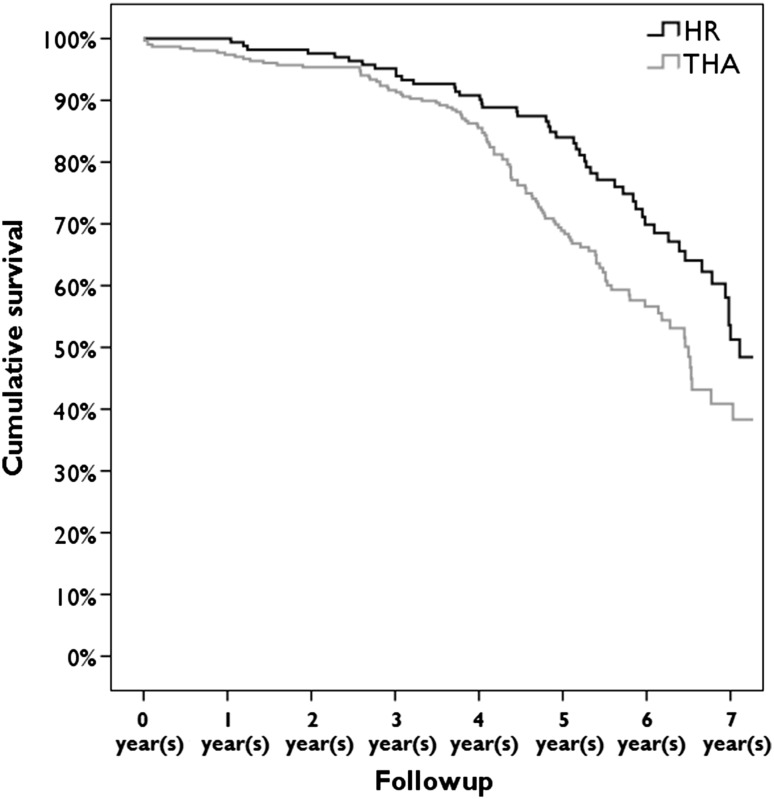
Results: At followup, 162 hips (34%) have been revised. The majority (85%) were revised owing to causes related to adverse reactions to metal debris. The 7-year survivorship was 51% for the ASR™ hip replacement cohort and 38% for the ASR™ XL THA cohort, respectively. Reduced cup coverage was an independent risk factor for adverse reactions to metal debris in both cohorts. High preoperative ROM, use of the Corail(®) stem, and female gender were associated with an increased risk of adverse reactions to metal debris only in patients undergoing THA.
Conclusions: Adverse reactions to metal debris are common with small-headed ASR™ prostheses. Risk factors for these adverse reactions differ between hip resurfacing procedures and THAs. Our results suggest a more complicated failure mechanism in THAs than in hip resurfacing procedures.
Figures

Comment in
-
CORR Insights ®: High prevalence of adverse reactions to metal debris in small-headed ASR™ hips.Clin Orthop Relat Res. 2013 Sep;471(9):2962-3. doi: 10.1007/s11999-013-3110-8. Epub 2013 Jun 21. Clin Orthop Relat Res. 2013. PMID: 23793737 Free PMC article. No abstract available.
References
-
- Amstutz HC, Le Duff MJ, Campbell PA, Wisk LE, Takamura KM. Complications after metal-on-metal hip resurfacing arthroplasty. Orthop Clin North Am. 2011;42:207–230, viii. - PubMed
-
- Australian Orthopaedic Association National Joint Replacement Registry. Annual report 2012. Available at: https://aoanjrr.dmac.adelaide.edu.au/annual-reports-2012. Accessed January 12, 2012.
-
- Bosker BH, Ettema HB, Boomsma MF, Kollen BJ, Maas M, Verheyen CC. High incidence of pseudotumour formation after large-diameter metal-on-metal total hip replacement: a prospective cohort study. J Bone Joint Surg Br. 2012;94:755–761. - PubMed
-
- Dawson J, Fitzpatrick R, Carr A, Murray D. Questionnaire on the perceptions of patients about total hip replacement. J Bone Joint Surg Br. 1996;78:185–190. - PubMed
MeSH terms
Substances
LinkOut - more resources
Full Text Sources
Other Literature Sources
Medical
