. 2013 May 1;33(18):7654-66.
doi: 10.1523/JNEUROSCI.0091-13.2013.

Maternal immune activation during gestation interacts with Disc1 point mutation to exacerbate schizophrenia-related behaviors in mice

Affiliations

Maternal immune activation during gestation interacts with Disc1 point mutation to exacerbate schizophrenia-related behaviors in mice

Tatiana V Lipina et al. J Neurosci. .

Abstract

Schizophrenia is thought to result from interactions between susceptible genotypes and environmental risk factors. DISC1 is an important gene for schizophrenia and mood disorders based on both human and animal studies. In the present study we sought to investigate interactions between two distinct point mutations in the mouse Disc1 gene (L100P and Q31L) and maternal immune activation (MIA) during pregnancy with polyinosinic:polycytidylic acid (polyI:C). PolyI:C given at 5 mg/kg impaired cognitive and social behavior in both wild-type (WT) and Disc1-Q31L(+/-) offspring, and reduced prepulse inhibition at 16 but not 8 weeks of age. Disc1-L100P(+/-) mutants were more sensitive to MIA than WT or Disc1-Q31L(+/-) mice. Interleukin-6 (IL-6) is a critical cytokine for mediating the behavioral and transcriptional effects of polyI:C. We found a more pronounced increase of IL-6 in response to polyI:C in fetal brain in Disc1-L100P(+/-) mice compared with WT or Disc1-Q31L(+/-) mice. Coadministration of an anti-IL-6 antibody with polyI:C reversed schizophrenia-related behavioral phenotypes in Disc1-L100P(+/-) mice. In summary, we found specific interactions between discrete genetic (Disc1-L100P(+/-)) and environmental factors (MIA) that exacerbate schizophrenia-related phenotypes. IL-6 may be important in the pathophysiology of this interaction.


Figures
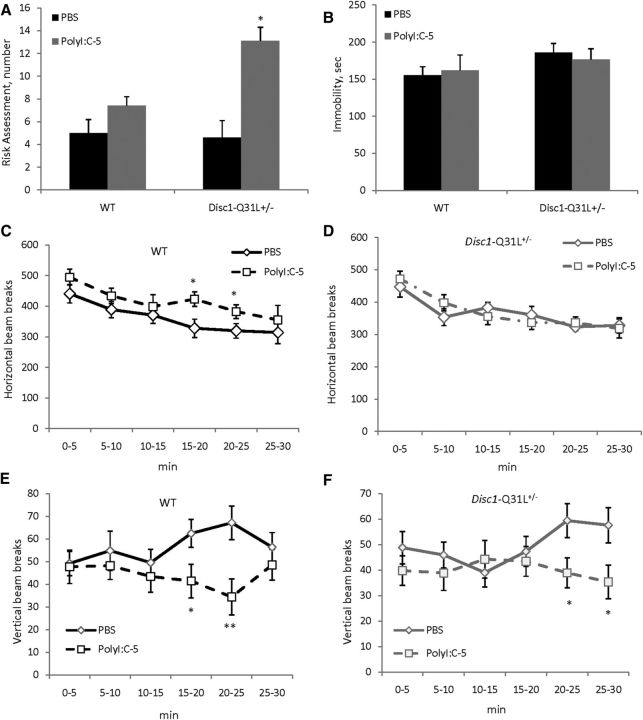
Figure 1.
Figure 1.
The effects of prenatal immune activation by 5 mg/kg of polyI:C on anxiety (A), behavioral despair (B), and horizontal (C, D) and vertical activity (E, F) in WT and Disc1-Q31L+/− mice. A, Adult Disc1-Q31L+/− offspring born to mothers injected with 5 mg/kg of polyI:C showed more frequent risk assessment in the EPM task (n = 7–12 per each group) compared with WT mice, with no effect on the duration of floating in the FST (B) (n = 7–17 per each group). Mice of both genotypes born to polyI:C-treated mothers showed a significant deficit in exploration, assessed as vertical activity in the OF (E, F), with mild effect on horizontal activity in WT offspring (C) and no effect on Disc1-Q31L+/− mice (D) (n = 10–17 per each group). *p < 0.05; **p < 0.01 in comparison with control (offspring born to PBS-treated mothers) within each genotype.
Figure 2.
Figure 2.
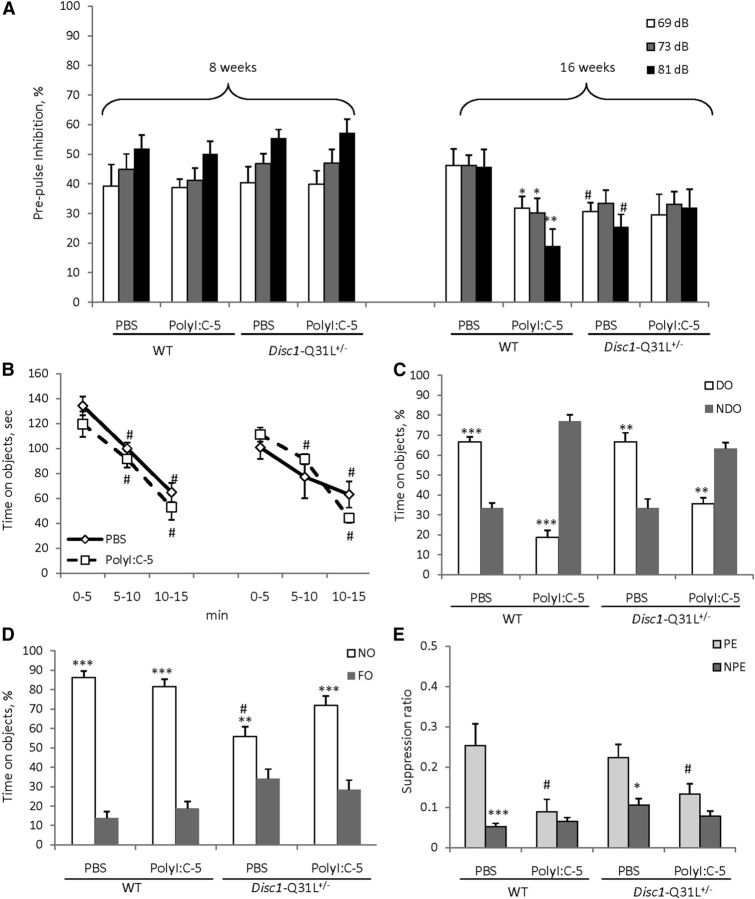
The effects of prenatal immune activation on PPI (A), object recognition (B–D), and LI (E) in WT and Disc1-Q31L+/− mice. Adult WT offspring of both genotypes born to mothers injected with 5 mg/kg of polyI:C expressed PPI deficits at 16 weeks but not at 8 weeks of age (A) (n = 8–19 per each group). Adult Disc1-Q31L+/− offspring born to mothers either treated by polyI:C or PBS showed PPI deficits (n = 9–17 per each group). *p < 0.05; **p < 0.01, in comparison with control mice; #p < 0.05, in comparison with WT offspring born to PBS-treated dams. B, Adult mice of all experimental groups showed similar habituation to objects but immune-challenged offspring of both genotypes had spatial object recognition deficits; #p < 0.001, in comparison with the first time interval of the habituation within each experimental group (C). Mice of all experimental groups showed comparable novel object recognition (D). N = 6–12 per each group; **p < 0.01; ***p < 0.001, compared with the time spent on either NDO or FO within each experimental group; #p < 0.01, compared with WT offspring born to PBS-treated dams. E, MIA by 5 mg/kg of polyI:C disrupted LI in both WT and Disc1-Q31L+/− offspring. Mean suppression ratios of the PE and NPE mice conditioned with two conditioned stimulus—unconditioned stimulus trials and given 40 pre-exposures (N = 6–7 per each group). *p < 0.05; ***p < 0.001, in comparison with PE within each experimental group; #p < 0.05, in comparison with PE control mice for each genotype.
Figure 3.
Figure 3.
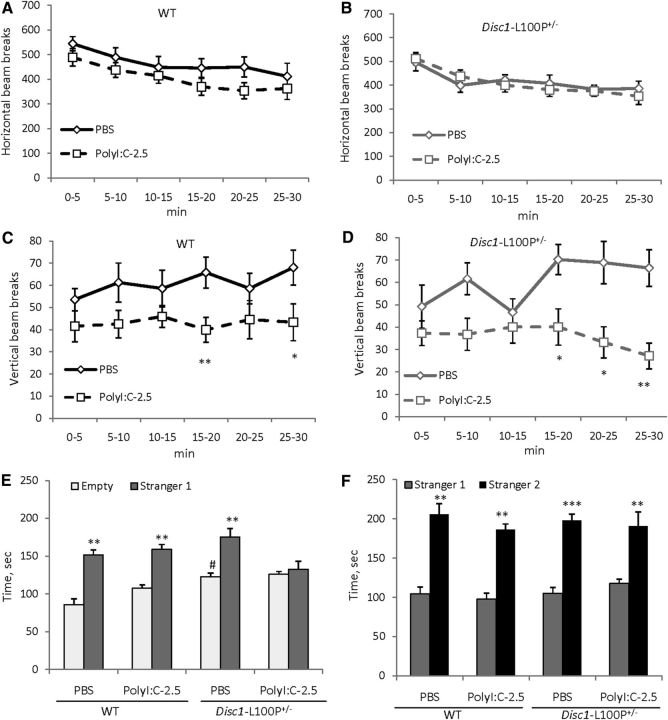
The effects of prenatal immune activation by 2.5 mg/kg of polyI:C on horizontal (A, B) and vertical activity (C, D), social affiliation (E), and social recognition (F) in WT and Disc1-L100P+/− mice. Adult mice of both genotypes born to polyI:C-treated mothers showed significantly reduced vertical activity in the OF (C, D), with no difference in horizontal activity (A, B) (N = 6–14 per each group). *p < 0.05; **p < 0.01, in comparison with control (offspring born to PBS-treated mothers) within each genotype. E, Mean time spent near empty cylinder or unfamiliar mouse (stranger 1). MIA abolished social motivation specifically in Disc1-L100P+/− offspring but not in WT mice. F, Mice of all experimental groups showed intact social memory as they spent more time with a new, unfamiliar mouse (stranger 2). **p < 0.01; ***p < 0.001, in comparison with time spent near the empty cylinder (E) or stranger 1 (F) within each experimental group; #p < 0.01, in comparison with PBS/WT mice. N = 8–12 per each group.
Figure 4.
Figure 4.
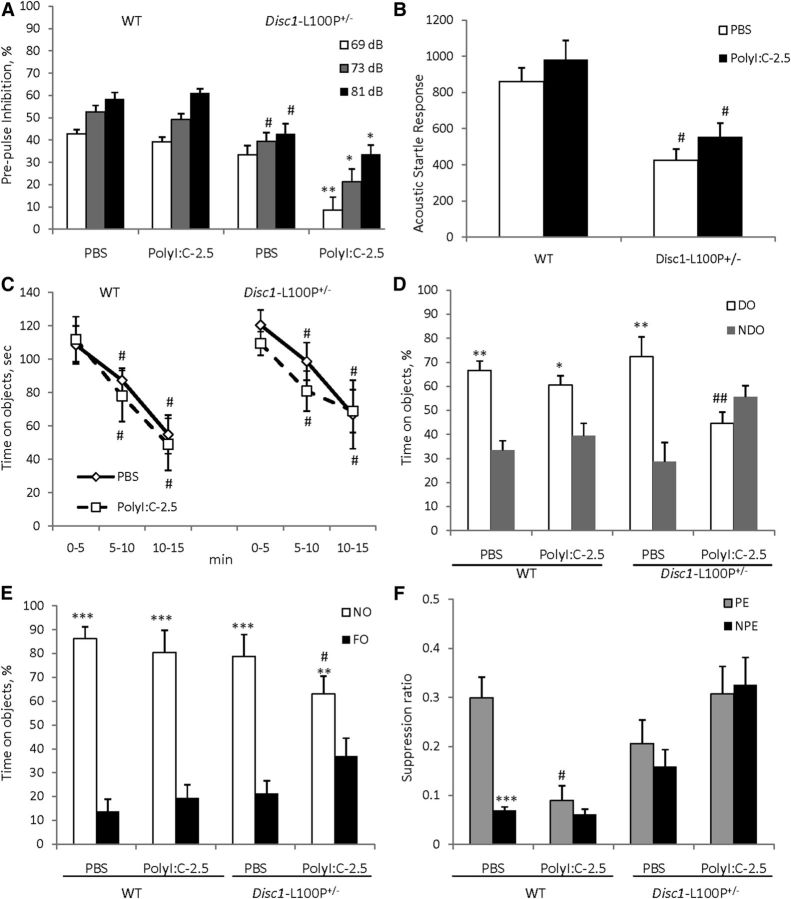
The effects of prenatal immune activation by 2.5 mg/kg of polyI:C on PPI (A), ASR (B), object recognition (C–E), and LI (F) in WT and Disc1-L100P+/− mice. A, Only DISC1–L100P+/− offspring born to mothers injected with 2.5 mg/kg of polyI:C showed a PPI deficit, with no effect on MIA on the startle response (B) (N = 7–16 per each group). Mice of all experimental groups showed comparable habituation to objects (C), but immune-challenged Disc1-L100P+/− offspring showed a spatial object recognition deficit (D), equally preferring NDO and DO objects; #p < 0.01, in comparison with the first time interval during habituation within each experimental group. Mice of all experimental groups showed comparable novel object recognition (E). N = 8–11 per group; *p < 0.05; **p < 0.01; ***p < 0.001, compared with the time spent on either NDO or FO within each experimental group; #p ≤ 0.05; ##p < 0.01, in comparison with PBS/Disc1-L100P+/− mice. F, MIA with 2.5 mg/kg of polyI:C disrupted LI in both WT and Disc1-L100P+/− offspring. Mean suppression ratios of the PE and NPE mice conditioned with two conditioned stimulus—unconditioned stimulus trials and given 40 pre-exposures (N = 6–12 per each group). ***p < 0.001, in comparison with PE within PBS-WT experimental group; #p < 0.05, in comparison with PE PBS-WT control mice.
Figure 5.
Figure 5.
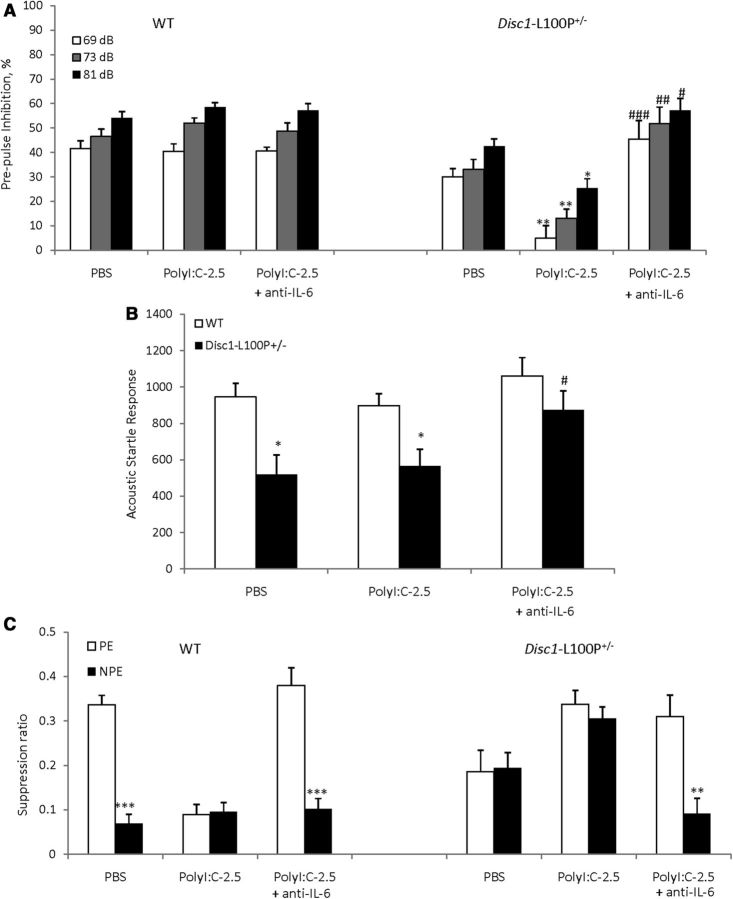
The PPI and LI deficits triggered in Disc1-L100P+/− offspring by mild MIA were prevented by coadministration of anti-IL-6 with polyI:C. A, Disc1-L100P+/− offspring born to mothers injected with 2.5 mg/kg of polyI:C had a PPI deficit. Coadministration of anti-IL-6 with polyI:C blocked PPI impairment, with a mild increase of startle response (B). *p < 0.05; **p < 0.01, in comparison with Disc1-L100P+/− offspring born to PBS-treated females. N = 8–9 per group (C). Mean suppression ratios of the PE and NPE mice conditioned with two conditioned stimulus—unconditioned stimulus trials and given 40 pre-exposures (N = 6–9 per each group). **p < 0.01; ***p < 0.001, in comparison with PE within each experimental group.

References

    1. Abazyan B, Nomura J, Kannan G, Ishizuka K, Tamashiro KL, Nucifora F, Pogorelov V, Ladenheim B, Yang C, Krasnova IN, Cadet JL, Pardo C, Mori S, Kamiya A, Vogel MW, Sawa A, Ross CA, Pletnikov MV. Prenatal interaction of mutant DISC1 and immune activation produces adult psychopathology. Biol Psychiatry. 2010;68:1172–1181. doi: 10.1016/j.biopsych.2010.09.022. - DOI - PMC - PubMed
    1. Benveniste EN. Cytokine actions in the central nervous system. Cytokine Growth Factor Rev. 1998;9:259–275. doi: 10.1016/S1359-6101(98)00015-X. - DOI - PubMed
    1. Bettelli E, Carrier Y, Gao W, Korn T, Strom TB, Oukka M, Weiner HL, Kuchroo VK. Reciprocal developmental pathways for the generation of pathogenic effector TH17 and regulatory T cells. Nature. 2006;441:235–238. doi: 10.1038/nature04753. - DOI - PubMed
    1. Borrell J, Vela JM, Arévalo-Martin A, Molina-Holgado E, Guaza C. Prenatal immune challenge disrupts sensorimotor gating in adult rats. Implications for the etiopathogenesis of schizophrenia. Neuropsychopharmacology. 2002;26:204–215. doi: 10.1016/S0893-133X(01)00360-8. - DOI - PubMed
    1. Brandon NJ, Sawa A. Linking neurodevelopmental and synaptic theories of mental illness through DISC1. Nat Rev Neurosci. 2011;12:707–722. doi: 10.1038/nrn3120. - DOI - PMC - PubMed

Publication types

MeSH terms