


Time profile of viral DNA in aqueous humor samples of patients treated for varicella-zoster virus acute retinal necrosis by use of quantitative real-time PCR
- PMID: 23637296
- PMCID: PMC3697691
- DOI: 10.1128/JCM.00294-13
Time profile of viral DNA in aqueous humor samples of patients treated for varicella-zoster virus acute retinal necrosis by use of quantitative real-time PCR
Abstract
The objective of this study was to evaluate the kinetics of varicella-zoster virus (VZV) loads using quantitative PCR (qPCR) in patients treated for acute retinal necrosis (ARN). Six patients (52 ± 13 years old) with ARN syndrome were consecutively studied. Aqueous humor (AH) was sampled from both eyes of all patients for qPCR evaluation. The patients were treated with intravenous acyclovir and intravitreal injections of antiviral drugs. The mean follow-up time was 17.6 ± 16.4 months. Main outcome measures were the numbers of viral genome copies in the AH, assessed using real-time qPCR with hydrolysis probe technology with a threshold of detection of 200 copies/ml. Two main portions of the viral load curves were observed for each patient: a plateau phase (27.8 ± 24.9 days) and a decrease in the number of viral genome copies. The mean baseline viral load was 3.4 × 10(7) ± 4.45 × 10(7) copies/ml (6 × 10(6) to 1.2 × 10(8) copies/ml). The viral load decreased according to a logarithmic model, with a 50% reduction obtained in 3 ± 0.7 days. There was a significant viral load (>102 copies/ml) at 50 days after the onset of treatment, despite antiviral drugs. qPCR use demonstrated reproducible VZV DNA kinetics with a two-phase evolution: a plateau followed by a logarithmic decrease. These data suggest that high-dosage antiviral therapy administered for the conventional 10-day duration is insufficient for most patients. This series of patients responded with a similar decrease in viral load once treatment was initiated, and the data from these patients may be used to predict the responses of future patients.
Figures
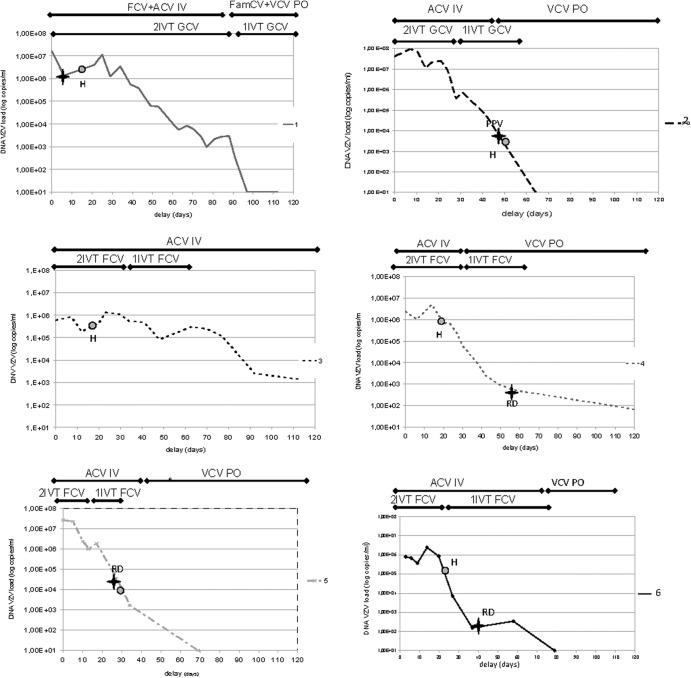
 H, healing; ✦ RD, retinal detachment; ■—■ treatment; ACV, aciclovir; VCV, valaciclovir; FCV, foscarnet sodium; GCV, ganciclovir; FamCV, famciclovir; PO, per os treatment; IV, intravitreous treatment; 1IVT, one intravitreal injection per week; 2IVT, two intravitreal injections per week.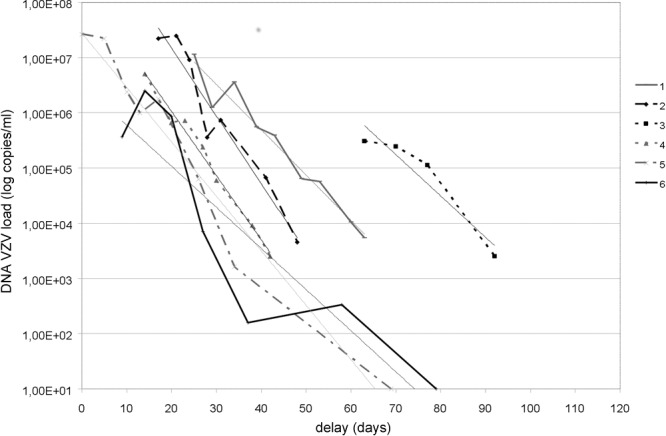
References
-
- Walters G, James TE. 2001. Viral causes of the acute retinal necrosis syndrome. Curr. Opin. Ophthalmol. 12:191–195 - PubMed
-
- Dworkin LL, Gibler TM, Van Gelder RN. 2002. Real-time quantitative polymerase chain reaction diagnosis of infectious posterior uveitis. Arch. Ophthalmol. 120:1534–1539 - PubMed
-
- Blumenkranz MS, Culbertson WW, Clarkson JG, Dix R. 1986. Treatment of the acute retinal necrosis syndrome with intravenous acyclovir. Ophthalmology 93:296–300 - PubMed
MeSH terms
Substances
LinkOut - more resources
Full Text Sources
Other Literature Sources
Medical
