


Role of baseline antral follicle count and anti-Mullerian hormone in prediction of cumulative live birth in the first in vitro fertilisation cycle: a retrospective cohort analysis
- PMID: 23637787
- PMCID: PMC3634063
- DOI: 10.1371/journal.pone.0061095
Role of baseline antral follicle count and anti-Mullerian hormone in prediction of cumulative live birth in the first in vitro fertilisation cycle: a retrospective cohort analysis
Abstract
Objective: This retrospective study determined for the first time the role of baseline antral follicle count (AFC) and serum anti-Mullerian hormone (AMH) level in the first in-vitro fertilisation (IVF) cycle in predicting cumulative live birth from one stimulation cycle.
Methods: We studied 1,156 women (median age 35 years) undergoing the first IVF cycle. Baseline AFC and AMH level on the day before ovarian stimulation were analysed. The main outcome measure was cumulative live birth in the fresh plus all the frozen embryo transfers after the same stimulation cycle.
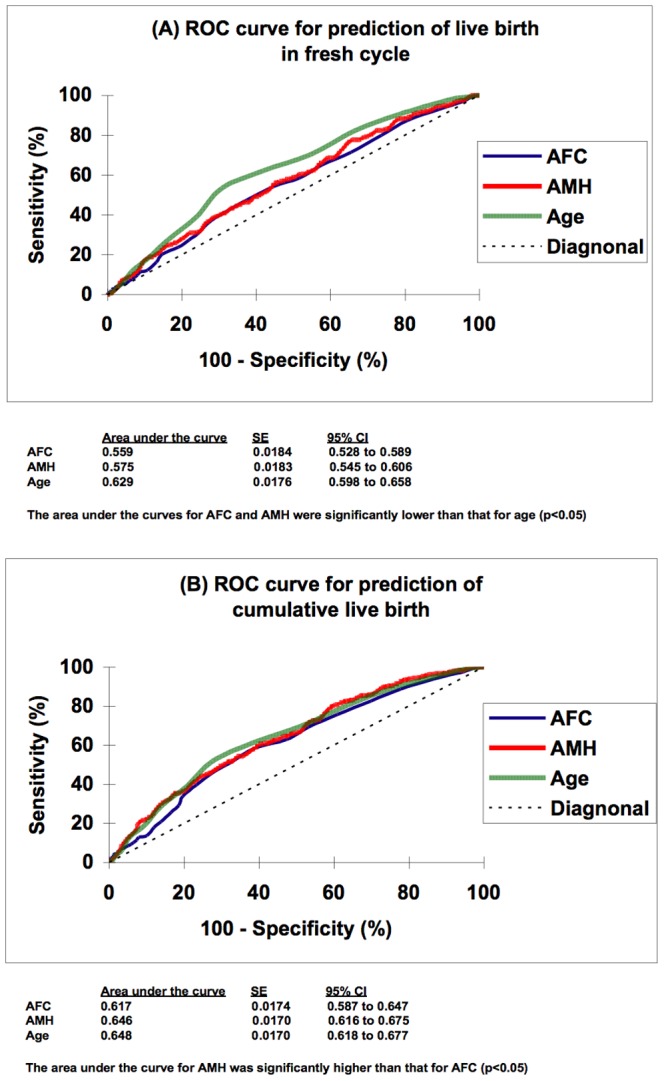
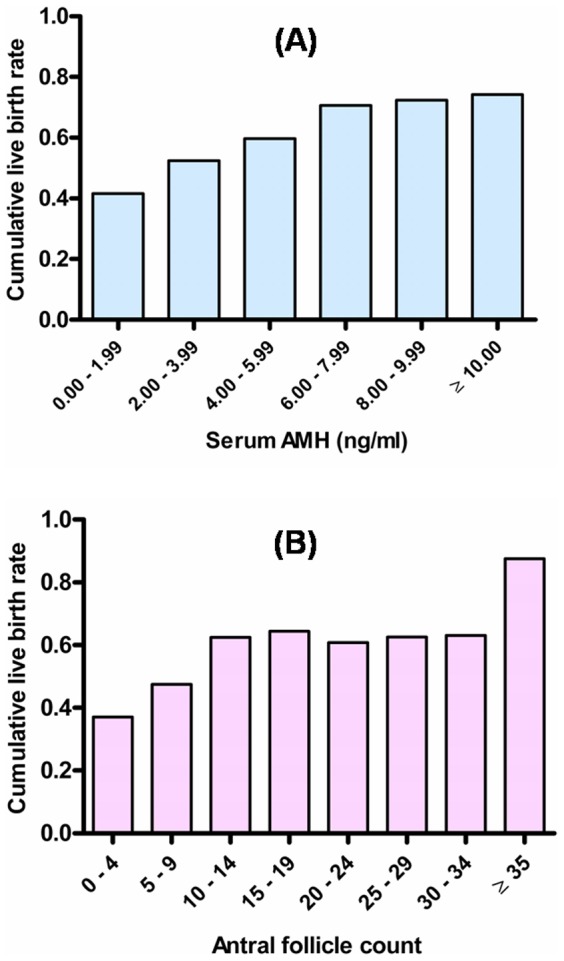
Results: Serum AMH was significantly correlated with AFC. Both AMH and AFC showed significant correlation with age and ovarian response in the stimulated cycle and total number of transferrable embryos. Baseline AFC and serum AMH were significantly higher in subjects attaining a live birth than those who did not in the fresh stimulated cycle, as well as those attaining cumulative live birth. There was a significant trend of higher cumulative live birth rate in women with higher AMH or AFC. However, logistic regression revealed that both AMH and AFC were not significant predictors of cumulative live birth after adjusting for age and number of embryos available for transfer. Considering only one single predictor, the areas under the ROC curves for AMH (0.646, 95% CI 0.616-0.675) and age (0.648, 95% CI 0.618-0.677) were slightly higher than that for AFC (0.617, 95% CI 0.587-0.647) in predicting cumulative live birth. However, a model combining AMH (with or without AFC) and age of the women only classified an addition of less than 2% of subjects correctly compared to the model with age alone.
Conclusion: Baseline AFC and serum AMH have only modest predictive performance on the occurrence of cumulative live birth, and may not give additional value on top of the women's age.
Conflict of interest statement
Figures
References
-
- Nelson SM, Yates RW, Fleming R (2007) Serum anti-Mullerian hormone and FSH: prediction of live birth and extremes of response in stimulated cycles-implications for individualization of therapy. Hum Reprod 22(9): 2414–2421. - PubMed
-
- Nelson SM, Anderson RA, Broekmans FJ, Raine-Fenning N, Fleming R, et al. (2012) Anti-Mullerian hormone: clairvoyance or crystal clear? Hum Reprod 27(3): 631–636. - PubMed
-
- Broekmans FJ, Kwee J, Hendriks DJ, Mol BW, Lambalk CB (2006) A systematic review of tests predicting ovarian reserve and IVF outcome. Hum Reprod Update 12: 685–718. - PubMed
-
- Broer SL, Mol BWJ, Hendriks D, Broekmans FJM (2009) The role of antimullerian hormone in prediction of outcome after IVF: comparison with the antral follicle count. Fertil Steril 91(3): 705–714. - PubMed
-
- Broer SL, Dolleman M, Opmeer BC, Fauser BC, Mol BW, et al. (2011) AMH and AFC as predictors of excessive response in controlled ovarian hyperstimulation: a meta-analysis. Hum Reprod Update 17(1): 46–54. - PubMed
Publication types
MeSH terms
Substances
LinkOut - more resources
Full Text Sources
Other Literature Sources
