. 2013 Apr 25;8(4):e62174.
doi: 10.1371/journal.pone.0062174. Print 2013.

Earliest archaeological evidence of persistent hominin carnivory

Affiliations

Earliest archaeological evidence of persistent hominin carnivory

Joseph V Ferraro et al. PLoS One. .

Abstract

The emergence of lithic technology by ≈ 2.6 million years ago (Ma) is often interpreted as a correlate of increasingly recurrent hominin acquisition and consumption of animal remains. Associated faunal evidence, however, is poorly preserved prior to ≈ 1.8 Ma, limiting our understanding of early archaeological (Oldowan) hominin carnivory. Here, we detail three large well-preserved zooarchaeological assemblages from Kanjera South, Kenya. The assemblages date to 2.0 Ma, pre-dating all previously published archaeofaunas of appreciable size. At Kanjera, there is clear evidence that Oldowan hominins acquired and processed numerous, relatively complete, small ungulate carcasses. Moreover, they had at least occasional access to the fleshed remains of larger, wildebeest-sized animals. The overall record of hominin activities is consistent through the stratified sequence - spanning hundreds to thousands of years - and provides the earliest archaeological evidence of sustained hominin involvement with fleshed animal remains (i.e., persistent carnivory), a foraging adaptation central to many models of hominin evolution.


Conflict of interest statement

Competing Interests: The authors have declared that no competing interests exist.

Figures

Figure 1
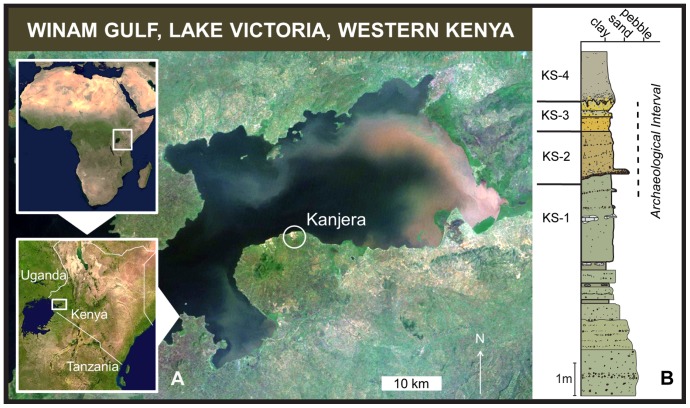
Figure 1. Location of Kanjera along the modern shoreline of Lake Victoria, East Africa.
(A) Kanjera lies to the immediate northeast of Homa Mountain, a volcanic complex active from the middle Miocene to the Pleistocene. The Winam Gulf fills the western end of the Nyanza Rift, an E-W graben with origins in the early Miocene. (B) Beds KS-1 through KS-3 of the Kanjera Formation (Southern Member) sample floodplain and low-aspect channel contexts originally deposited between the mountain and the nearby shores of a shallow lake . Satellite imagery from USGS and NASA.
Figure 2
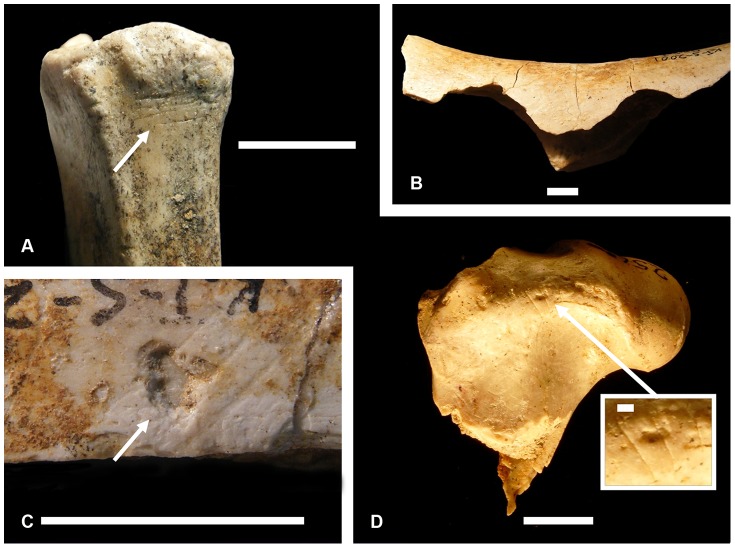
Figure 2. Bone surface modifications.
(A) KJS 7472, a small bovid metatarsal from KS-2 bearing cut marks; (B) KJS 7379, a medium-sized bovid humerus from KS3 bearing pair of hammerstone notches, the specimen is also cut-marked (not figured); (C) KJS 5447, a mammal limb bone shaft fragment from KS-2 with percussion pit and striae, the specimen is also cut-marked (not figured); (D) KJS 2565, a small bovid femur from KS-2 with numerous cut marks. Scale is 1 cm in panels (A-D); 1 mm in the panel (D) close-up. Specimen numbers are field designations, not KNM accession numbers.
Figure 3
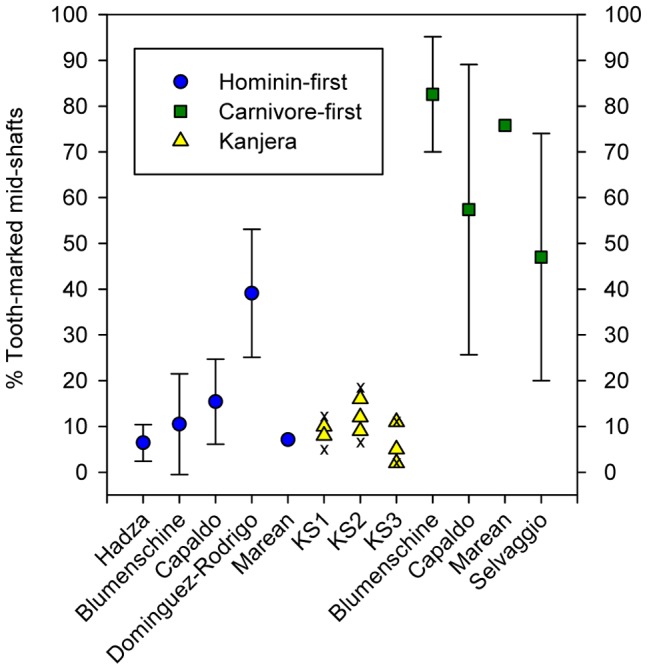
Figure 3. Tooth-marked mid-shaft fragments: results from experimental assemblages and excavations at KJS.
Figure follows a published model . Hominin-first assemblages refer to remains initially defleshed and demarrowed by hominins, then subsequently exposed to large-bodied carnivores (primarily hyenas). Carnivore-first assemblages refer to remains initially defleshed and/or demarrowed by large-bodied carnivores (primarily hyenas and/or lions). Data for body sizes 1–4 . Modern data (with single standard deviations where available) derived from the literature –, –. KJS frequencies are from Table 2 and Table S1. Multiple symbols for KJS indicate the results of multiple analysts. X’s indicate minimum and maximum estimates of damage (see Table S1).
Figure 4
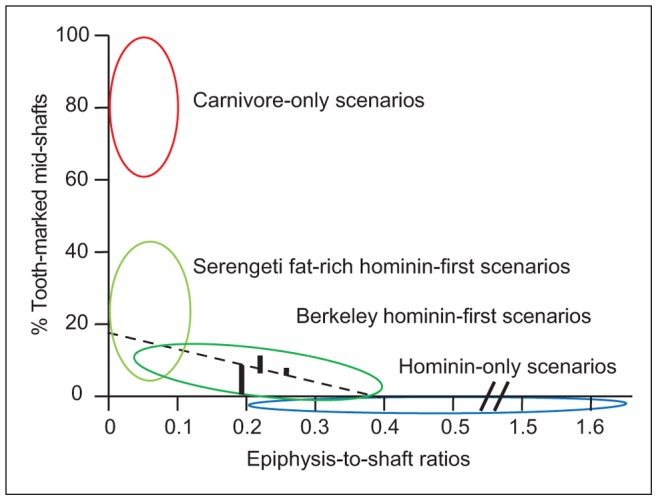
Figure 4. Tooth-mark frequencies and long bone portion representation: results from modern experiments and excavations at KJS.
Portions defined in Table 2 and Table S1. ‘Shafts’ include both near-epiphyseal and mid-shaft specimens. Complete bones are not included in epiphysis-to-shaft calculations (number of complete bones = 2, 7, and 1; beds KS-1 through KS-3, respectively). Ellipses outline the range of results in experimental feeding scenarios involving: carnivores-only, hominins-only, or a sequence of hominins-then-carnivores (i.e., ‘hominin-first’). The dashed line is a published least-squares regression for hominin-first scenarios . Hominin-only scenarios have no tooth marks, hence the placement of the ellipse beneath the x-axis. KJS data from Table 2 are for summed body sizes. KJS epiphysis-to-shaft ratios: 0.26, 0.22, and 0.19 for beds KS-1 though KS-3 respectively. KJS tooth-mark data displayed as solid vertical bars, with bars representing the range of analysts’ results. Results from Kanjera are consistent with hominin-first contexts.
Figure 5
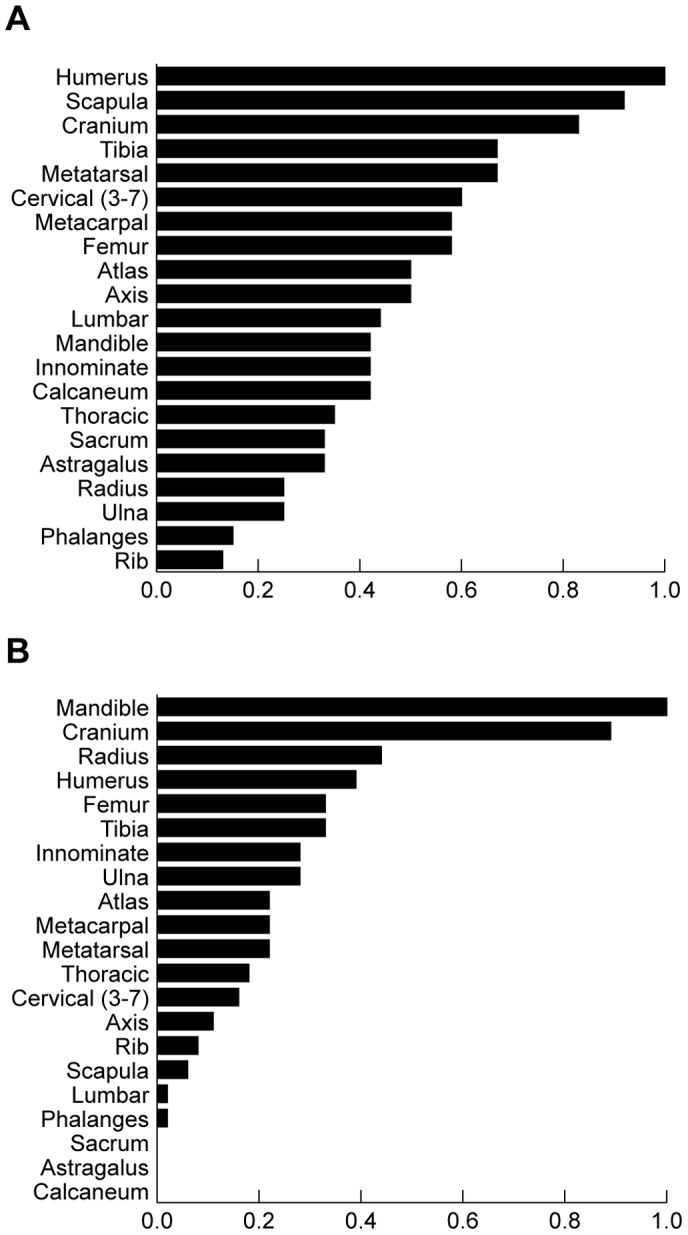
Figure 5. Skeletal element representation for (A) small and (B) medium-sized bovids, Bed KS-1.
Abundance data presented as percent minimum animal units (%MAU), calculated following the literature . KJS data derived from Table S3. 100% MAU = 6 for small bovids, 9 for medium-sized bovids. Similar patterns of skeletal element representation are present in Beds KS-2 and KS-3.

References

    1. Aiello LC, Wheeler P (1995) The expensive-tissue hypothesis: the brain and the digestive system in human and primate evolution. Curr Anthropol 36: 199–221 Available: http://www.jstor.org/stable/2744104.
    1. Milton K (1999) A hypothesis to explain the role of meat-eating in human evolution. Evol Anthropol 8: 11–21 doi:10.1002/(SICI)1520–6505(1999). - DOI
    1. Foley R (2001) The evolutionary consequences of increased carnivory in hominids. In: Stanford CB, Bunn HT, editors. Meat-Eating and Human Evolution. Oxford: Oxford University Press. 305–331.
    1. Kaplan H, Hill K, Lancaster J, Hurtado M (2000) A theory of human life history evolution: diet, intelligence, and longevity. Evol Anthropol 9: 156–185 doi: 10.1002/1520–6505 (2000).
    1. Leonard WR, Snodgrass JJ, Robertson ML (2007) Effects of brain evolution on human nutrition and metabolism. Annu Rev Nutr 27: 311–327 doi: 10.1146/annurev.nutr.27.061406.093659. - DOI - PubMed

Publication types

LinkOut - more resources