


Twin and sibling studies using health insurance data: the example of attention deficit/hyperactivity disorder (ADHD)
- PMID: 23637997
- PMCID: PMC3634807
- DOI: 10.1371/journal.pone.0062177
Twin and sibling studies using health insurance data: the example of attention deficit/hyperactivity disorder (ADHD)
Abstract
Background and aims: Twin studies are used to assess the contribution of genetic factors to the aetiology of diseases. To show the feasibility of such research on the basis of health insurance data, we analysed twin and sibling data on the attention deficit/hyperactivity disorder (ADHD) in the German Pharmacoepidemiological Research Database (GePaRD).
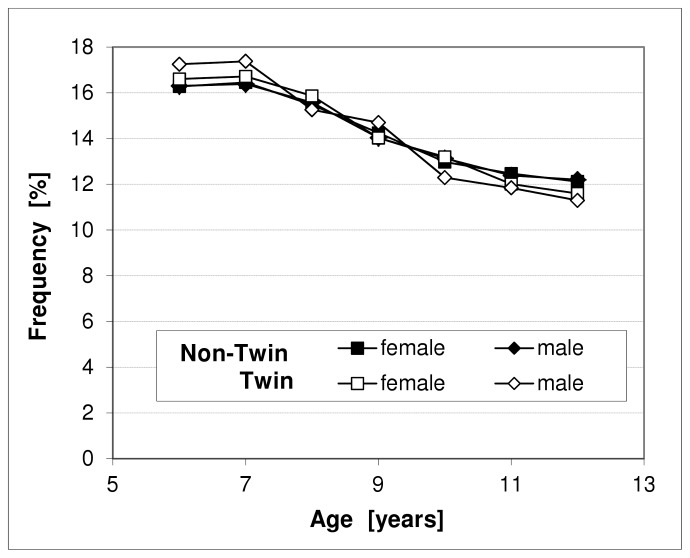
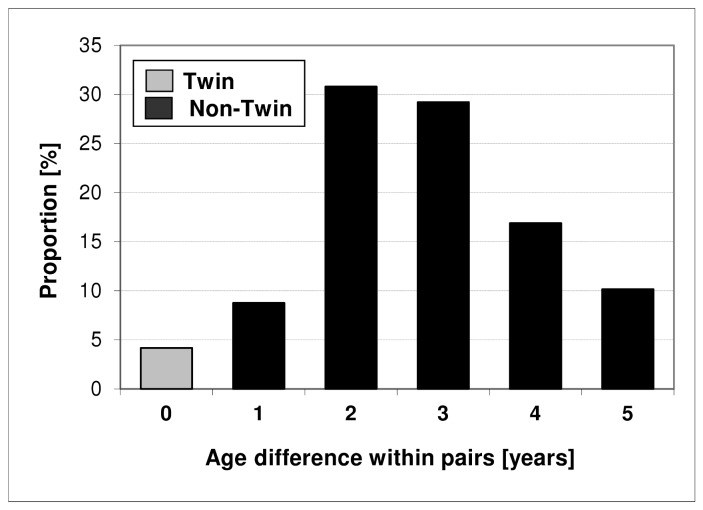
Methods: The GePaRD consists of data from four statutory health insurances, including around 17% of the total population of Germany. Among those insured in 2005, we identified 286,653 non-twin sibling pairs and 12,486 twin pairs. Each pair consisted of an index child (6 to 12 years old) and a co-sibling of equal age or up to five years older. ADHD cases were identified by hospital or ambulatory ICD-10 diagnoses (F90.0 or F90.1) and prescriptions. We estimated tetrachoric correlations, percentage of concordant pairs, concordance rates, and heritability. Weighted estimates for the indirect assessment of mono- and dizygotic pairs were derived.
Results: TETRACHORIC CORRELATIONS WERE HIGHEST FOR TWIN PAIRS OF THE SAME SEX (MALES: 0.85, 95% CI 0.81-0.89; females: 0.81, 95% CI 0.73-0.88) and lowest for opposite-sex non-twin sibling pairs (0.43, 95% CI 0.41-0.45). Heritability estimates were 0.88 (95% CI: 0.79-0.97) for males and 0.77 (95% CI: 0.60-0.95) for females.
Conclusions: The study clearly reproduced the well-known strong genetic component in the aetiology of ADHD. This approach could be used for further assessments of genetic components in other diseases.
Conflict of interest statement
Figures
References
-
- Kaprio J, Silventoinen K (2011) Advanced methods in twin studies. Methods Mol Biol 713: 143–152. - PubMed
-
- Bergem AL (2002) Norwegian Twin Registers and Norwegian twin studies–an overview. Twin Res 5: 407–414. - PubMed
-
- Kieseppä T, Partonen T, Haukka J, Kaprio J, Lönnqvist J (2004) High concordance of bipolar I disorder in a nationwide sample of twins. Am J Psychiatry 161: 1814–1821. - PubMed
-
- Mogensen N, Larsson H, Lundholm C, Almqvist C (2011) Association between childhood asthma and ADHD symptoms in adolescence – a prospective population-based twin study. Allergy 66: 1224–1230. - PubMed
Publication types
MeSH terms
LinkOut - more resources
Full Text Sources
Other Literature Sources
Medical
Research Materials
