


Inefficient TLR4/MD-2 heterotetramerization by monophosphoryl lipid A
- PMID: 23638128
- PMCID: PMC3637451
- DOI: 10.1371/journal.pone.0062622
Inefficient TLR4/MD-2 heterotetramerization by monophosphoryl lipid A
Abstract
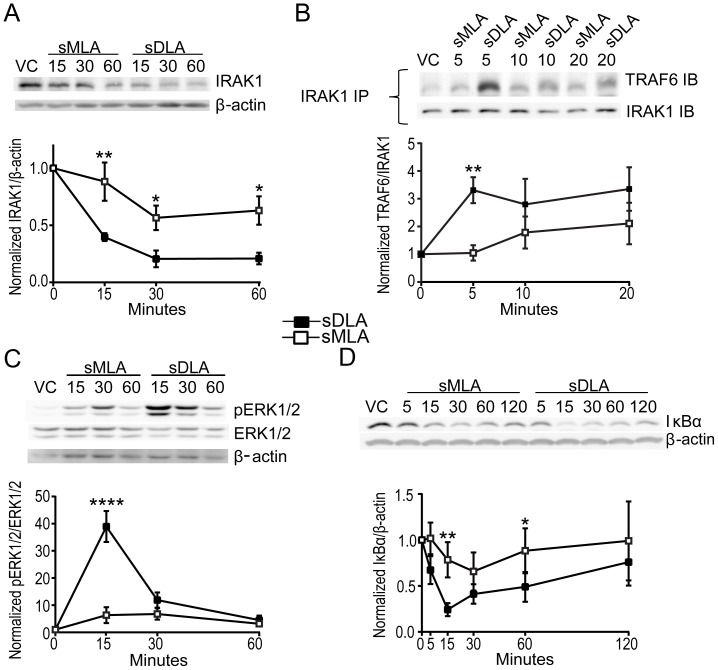
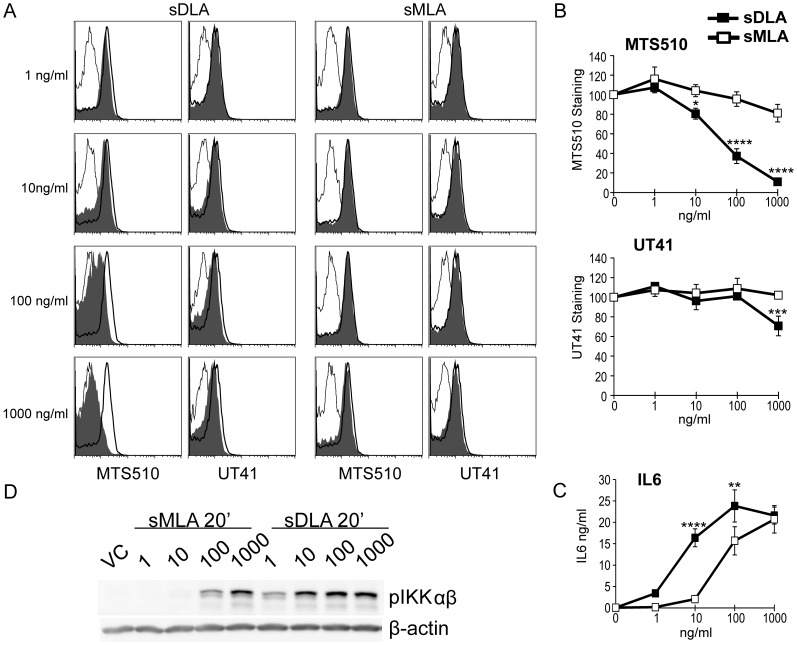
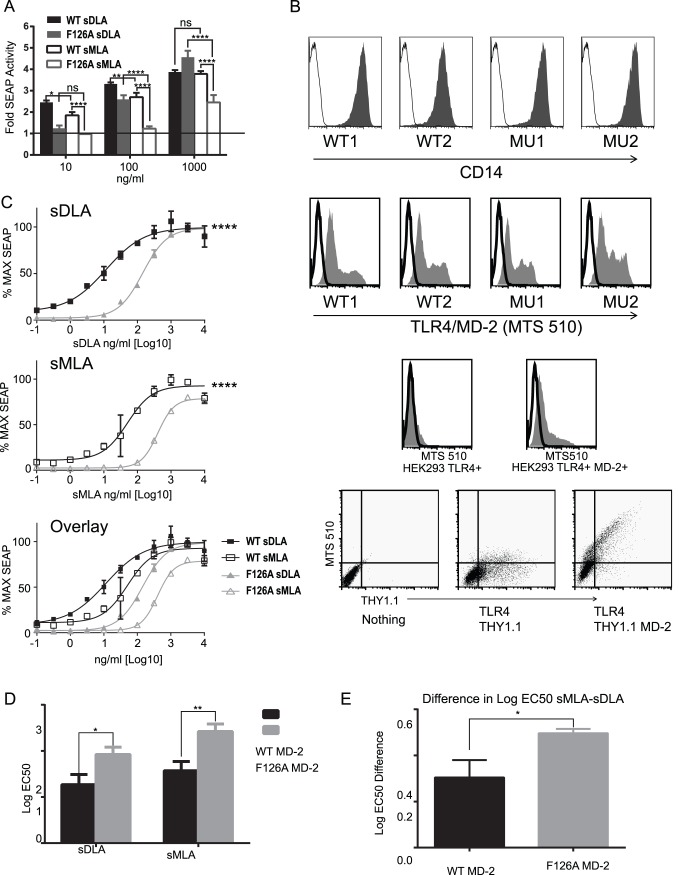
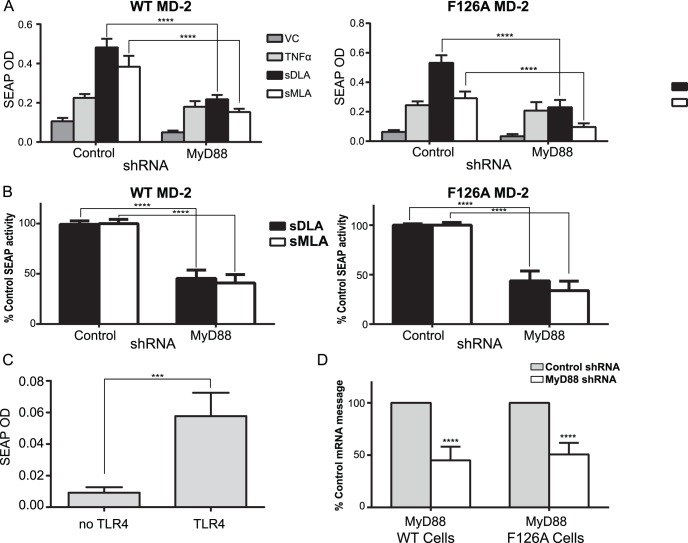
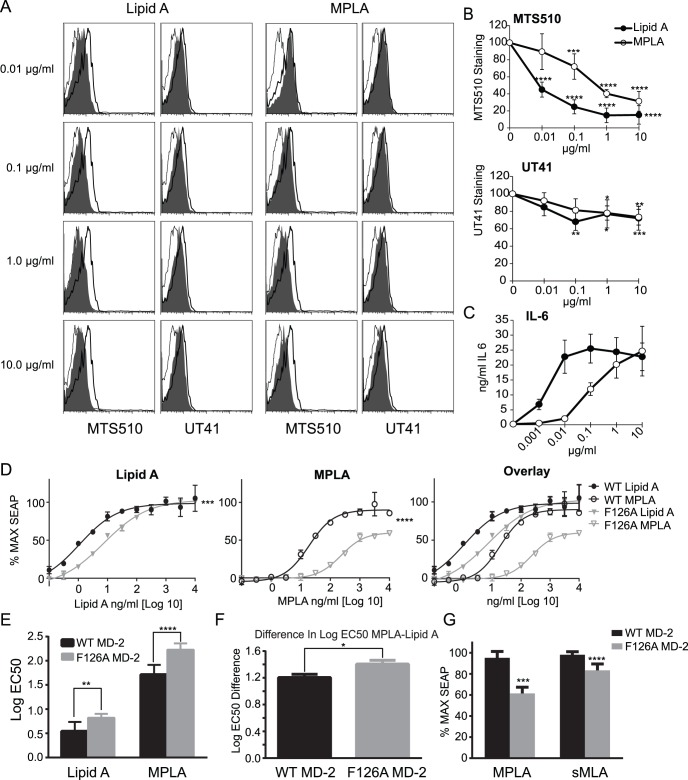
Synthetic forms of E. coli monophosphoryl lipid A (sMLA) weakly activate the MyD88 (myeloid differentiation primary response protein) branch of the bifurcated TLR4 (Toll-like receptor 4) signaling pathway, in contrast to diphosphoryl lipid A (sDLA), which is a strong activator of both branches of TLR4. sMLA's weak MyD88 signaling activity is apparent downstream of TLR4/MyD88 signaling as we show that sMLA, unlike sDLA, is unable to efficiently recruit the TNF receptor-associated factor 6 (TRAF6) to the Interleukin-1 receptor-associated kinase 1 (IRAK1). This reduced recruitment of TRAF6 explains MLA's lower MAPK (Mitogen Activated Protein Kinase) and NF-κB activity. As further tests of sMLA's ability to activate TLR4/Myeloid differentiation factor 2 (MD-2), we used the antibody MTS510 as an indicator for TLR4/MD-2 heterotetramer formation. Staining patterns with this antibody indicated that sMLA does not effectively drive heterotetramerization of TLR4/MD-2 when compared to sDLA. However, a F126A mutant of MD-2, which allows lipid A binding but interferes with TLR4/MD-2 heterotetramerization, revealed that while sMLA is unable to efficiently form TLR4/MD-2 heterotetramers, it still needs heterotetramer formation for the full extent of signaling it is able to achieve. Monophosphoryl lipid A's weak ability to form TLR4/MD-2 heterotetramers was not restricted to synthetic E. coli type because cells exposed to a biological preparation of S. minnesota monophosphoryl lipid A (MPLA) also showed reduced TLR4/MD-2 heterotetramer formation. The low potency with which sMLA and MPLA drive heterotetramerization of TLR4/MD-2 contributes to their weak MyD88 signaling activities.
Conflict of interest statement
Figures
References
-
- Garcon N, Chomez P, Van MM (2007) GlaxoSmithKline Adjuvant Systems in vaccines: concepts, achievements and perspectives 1. Expert Rev Vaccines 6: 723–739. - PubMed
-
- Casella CR, Mitchell TC (2008) Putting endotoxin to work for us: monophosphoryl lipid A as a safe and effective vaccine adjuvant. Cell Mol Life Sci 65: 3231–3240 10.1007/s00018-008-8228-6 [doi]. - DOI - PMC - PubMed
-
- Ribi E, Parker R, Strain SM, Mizuno Y, Nowotny A, et al. (1979) Peptides as requirement for immuno therapy of the guinea-pig line-10 tumor with endotoxins. Cancer Immunol Immunother 7: 43–58.
-
- Mata-Haro V, Cekic C, Martin M, Chilton PM, Casella CR, et al. (2007) The vaccine adjuvant monophosphoryl lipid A as a TRIF-biased agonist of TLR4. Science 316: 1628–1632 316/5831/1628 [pii]; 10.1126/science.1138963 [doi]. - DOI - PubMed
-
- Thompson BS, Chilton PM, Ward JR, Evans JT, Mitchell TC (2005) The low-toxicity versions of LPS, MPL adjuvant and RC529, are efficient adjuvants for CD4+ T cells. J Leukoc Biol 78: 1273–1280 jlb.0305172 [pii]; 10.1189/jlb.0305172 [doi]. - DOI - PubMed
Publication types
MeSH terms
Substances
Grants and funding
LinkOut - more resources
Full Text Sources
Other Literature Sources
Research Materials
