. 2013 Apr 2:5:9.
doi: 10.12703/P5-9. Print 2013.

Counting on co-transcriptional splicing

Affiliations

Counting on co-transcriptional splicing

Mattia Brugiolo et al. F1000Prime Rep. .

Abstract

Splicing is the removal of intron sequences from pre-mRNA by the spliceosome. Researchers working in multiple model organisms - notably yeast, insects and mammalian cells - have shown that pre-mRNA can be spliced during the process of transcription (i.e. co-transcriptionally), as well as after transcription termination (i.e. post-transcriptionally). Co-transcriptional splicing does not assume that transcription and splicing machineries are mechanistically coupled, yet it raises this possibility. Early studies were based on a limited number of genes, which were often chosen because of their experimental accessibility. Since 2010, eight studies have used global datasets as counting tools, in order to quantify co-transcriptional intron removal. The consensus view, based on four organisms, is that the majority of splicing events take place co-transcriptionally in most cells and tissues. Here, we discuss the nature of the various global datasets and how bioinformatic analyses were conducted. Considering the broad differences in experimental approach and analysis, the level of agreement on the prevalence of co-transcriptional splicing is remarkable.


Figures
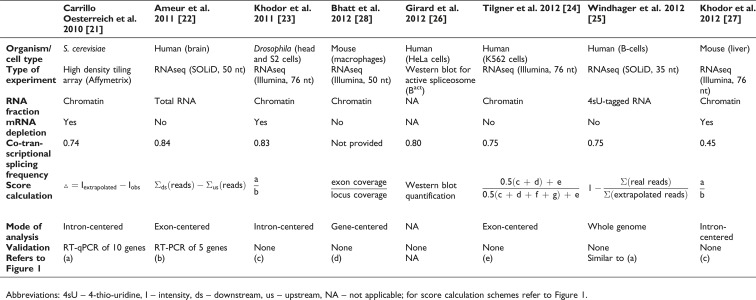
Table 1.
Table 1.. Global studies on co-transcriptional splicing in four different organisms, listed in chronological order of publication
Carrillo Oesterreich et al. 2010 [21], Ameur et al. 2011 [22], Khodor et al. 2011 [23], Bhatt et al. 2012 [28], Girard et al. 2012 [26], Tilgner et al. 2012 [24], Windhager et al. 2012 [25] and Khodor et al. 2012 [27]. Co-transcriptional splicing frequencies are given as a value on the scale 0 to 1 (0% and 100% co-transcriptional splicing, respectively) in form of the median (Carrillo Oesterreich et al. 2010 [21], Khodor et al. 2011 [23] & 2012 [27], Tilgner et al. 2012 [24]), as average value determined by spliceosomal protein quantification in the chromatin fraction compared to nucleoplasm (Girard et al. 2012 [26]) or as fraction of highly expressed exons surrounded by long introns showing high co-transcriptional splicing (Ameur et al. 2011 [22]). Windhager et al. 2012 [25] calculated the co-transcriptional splicing frequency as the ratio of observed reads in the set of analyzed genes to the number of reads calculated when expecting a uniform read distribution without splicing and weighted for the transcript expression.
Figure 1.
Figure 1.. Schematic representations of how co-transcriptional splicing scores are calculated in global studies
(a) Calculation of co-transcriptional splicing frequency () for each intron, by determining the relative difference between observed and extrapolated intronic probe intensities, using high density tiling arrays. (b) Determination of co-transcriptional splicing frequency around a given exon, by subtracting the read coverage over 2kb of the upstream intron (∑us) from read coverage over 2kb of the 5’ end of the downstream intron (∑ds). (c) Determination of co-transcriptional splicing frequency for each intron, by calculating the ratio of reads around the 3’ splice site: read coverage over the last 25 bp of a given intron, a, is divided by read coverage over the first 25 bp of the downstream exon, b. (d) Determination of co-transcriptional splicing frequency for each gene, by dividing the read coverage over exons by the read coverage over the whole locus. (e) Determination of co-transcriptional splicing frequency (completed splicing index, coSI) around a given exon, using exon-intron and exon-exon junction reads; c, d, and e represent exon-exon junctions; f and g represent exon-intron junctions.

References

    1. Nevins J, Darnell JE. Steps in the processing of Ad2 mRNA: Poly(A)+ nuclear sequences are conserved and poly(A) addition precedes splicing. Cell. 1978;15:1477–93. doi: 10.1016/0092-8674(78)90071-5. - DOI - PubMed
    1. Tilghman SM, Curtis PJ, Tiemeier DC, Leder P, Weissmann C. The intervening sequence of a mouse beta-globin gene is transcribed within the 15S beta-globin mRNA precursor. Proc Natl Acad Sci USA. 1978;75:1309–13. doi: 10.1073/pnas.75.3.1309. - DOI - PMC - PubMed
    1. LeMeur M, Glanville N, Mandel JL, Gerlinger P, Palmiter R, Chambon P. The ovalbumin gene family: hormonal control of X and Y gene transcription and mRNA accumulation. Cell. 1981;23:561–71. doi: 10.1016/0092-8674(81)90152-5. - DOI - PubMed
    1. Osheim YN, Miller OL, Beyer AL. RNP particles at splice junction sequences on Drosophila chorion transcripts. Cell. 1985;43:143–51. doi: 10.1016/0092-8674(85)90019-4. - DOI - PubMed
    2. f1000.com/prime/717991036

    1. Beyer AL, Osheim YN. Splice site selection, rate of splicing, and alternative splicing on nascent transcripts. Genes & Development. 1988;2:754–65. doi: 10.1101/gad.2.6.754. - DOI - PubMed
    2. f1000.com/prime/717991038