


Alexithymia, emotional empathy, and self-regulation in anorexia nervosa
- PMID: 23638441
- PMCID: PMC3880788
Alexithymia, emotional empathy, and self-regulation in anorexia nervosa
Abstract
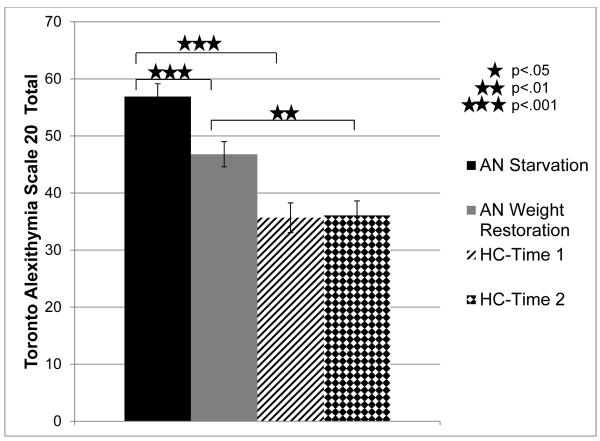
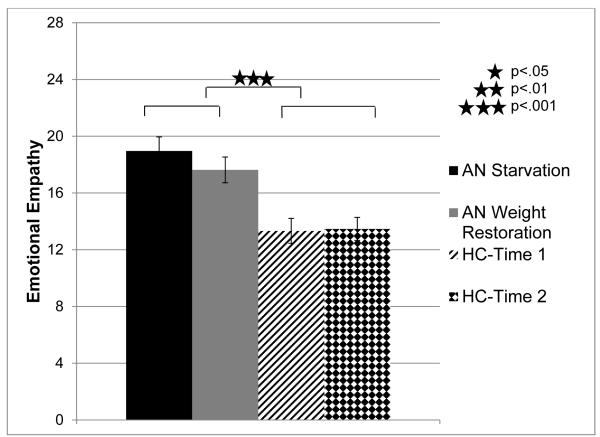
Background: Individuals with anorexia nervosa (AN) who are starved have poor awareness (alexithymia), reduced understanding of others' mental states (cognitive empathy), and difficulty regulating personal emotions (self-regulation). Despite its important role in social interaction, sympathy for others (emotional empathy) has not been measured in AN. Furthermore, it is unknown how restoring weight affects the relationship among alexithymia, empathy, and self-regulation in AN.
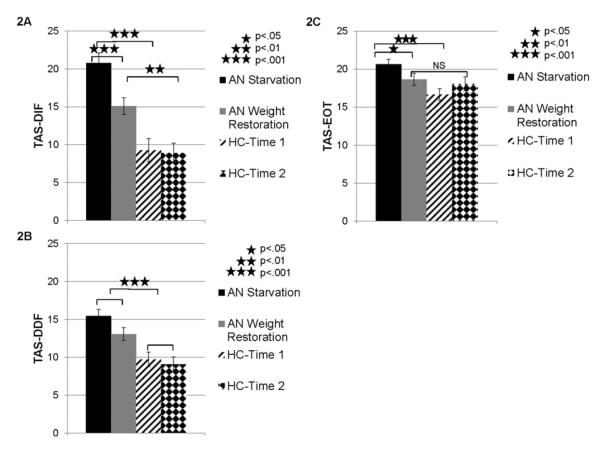
Methods: Women with AN were tested longitudinally during their starvation period (N = 26) and after weight was restored (N = 20) and compared with 16 age-matched healthy women. Alexithymia, empathy, and self-regulation were assessed with the Toronto Alexithymia Scale, the Interpersonal Reactivity Index, and items measuring self-regulation from the Minnesota Multiphasic Personality Inventory-2, respectively.
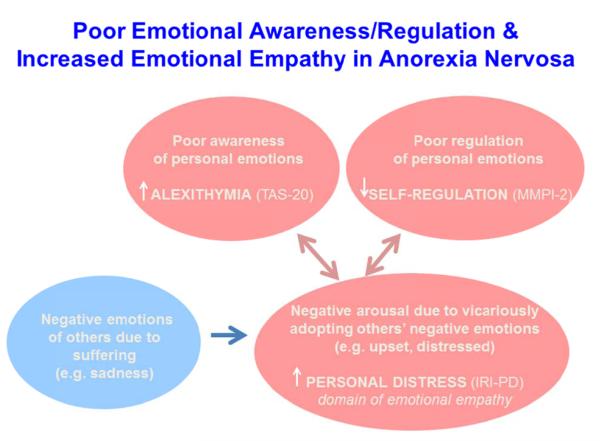
Results: Relative to comparison participants, individuals with AN during both starvation and weight restoration reported greater alexithymia and emotional empathy in one domain, personal distress (vicarious negative arousal to others' suffering). Among AN participants, personal distress was positively correlated with alexithymia and negatively correlated with self-regulation, when accounting for depression.
Conclusions: High levels of alexithymia and personal distress may be persistent features of AN because they do not resolve upon weight restoration. Greater personal distress in AN may be a function of poor emotional awareness and regulation.
Figures
References
-
- Corcos M, Guilbaud O, Speranza M, Paterniti S, Loas G, Stephan P, et al. Alexithymia and depression in eating disorders. Psychiatry Res. 2000 Apr 10;93(3):263–6. - PubMed
-
- Kessler H, Schwarze M, Filipic S, Traue HC, von Wietersheim J. Alexithymia and facial emotion recognition in patients with eating disorders. Int J Eat Disord. 2006 Apr;39(3):245–51. - PubMed
-
- Parling T, Mortazavi M, Ghaderi A. Alexithymia and emotional awareness in anorexia nervosa: Time for a shift in the measurement of the concept? Eat Behav. 2010 Dec;11(4):205–10. - PubMed
-
- Tchanturia K, Davies H, Harrison A, Fox JR, Treasure J, Schmidt U. Altered social hedonic processing in eating disorders. Int J Eat Disord. 2012 Dec;45(8):962–9. - PubMed
-
- Marty P, De Muzan M. Functional aspects of the dream life. “operative thinking”. Rev Fr Psychanal. 1963;27(SUPPL3):45–56. - PubMed
