. 2013 Jul;126(2):223-33.
doi: 10.1111/jnc.12284. Epub 2013 May 20.

Stapling of the botulinum type A protease to growth factors and neuropeptides allows selective targeting of neuroendocrine cells

Affiliations
Free PMC article

Stapling of the botulinum type A protease to growth factors and neuropeptides allows selective targeting of neuroendocrine cells

Jason Arsenault et al. J Neurochem. 2013 Jul.
Free PMC article

Abstract

Precise cellular targeting of macromolecular cargos has important biotechnological and medical implications. Using a recently established 'protein stapling' method, we linked the proteolytic domain of botulinum neurotoxin type A (BoNT/A) to a selection of ligands to target neuroendocrine tumor cells. The botulinum proteolytic domain was chosen because of its well-known potency to block the release of neurotransmitters and hormones. Among nine tested stapled ligands, the epidermal growth factor was able to deliver the botulinum enzyme into pheochromocytoma PC12 and insulinoma Min6 cells; ciliary neurotrophic factor was effective on neuroblastoma SH-SY5Y and Neuro2A cells, whereas corticotropin-releasing hormone was active on pituitary AtT-20 cells and the two neuroblastoma cell lines. In neuronal cultures, the epidermal growth factor- and ciliary neurotrophic factor-directed botulinum enzyme targeted distinct subsets of neurons whereas the whole native neurotoxin targeted the cortical neurons indiscriminately. At nanomolar concentrations, the retargeted botulinum molecules were able to inhibit stimulated release of hormones from tested cell lines suggesting their application for treatments of neuroendocrine disorders.

Keywords: SNAP25; botulinum; growth factor; neuroendocrine tumor; neuropeptide; targeting.


Figures

Fig. 1
Fig. 1
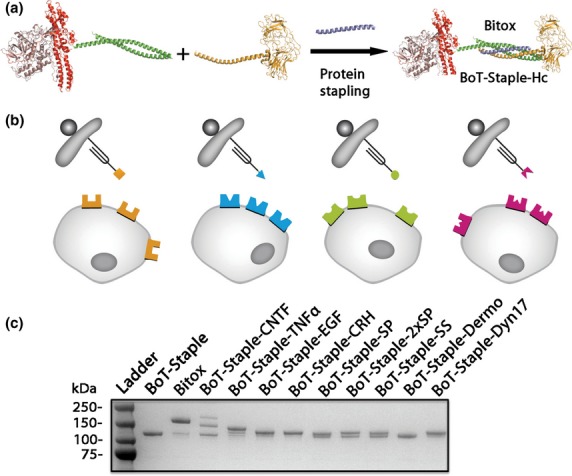
The protein stapling technique used for cell targeting. (a) Schematic representation of protein stapling using the Botulinum enzymatic and translocation domains (BoT) (the protease domain, brown; the translocation domain, red, and a SNAP25 linker, green), the native receptor-binding domain (Hc) (yellow, contains a synaptobrevin linker) and the stapling peptide (syntaxin-derived, blue). Addition of the stapling peptide results in formation of an irreversible botulinum construct (Bitox). (b) A diagram showing the cell targeting approach utilizing a range of ligands. (c) Coomassie-stained sodium dodecyl sulfate–polyacrylamide gel electrophoresis gel showing an array of BoT-Staple-constructs carrying the indicated targeting domains: ciliary neurotrophic factor (CNTF); tumor necrosis factor α (TNF-α); epidermal growth factor (EGF), corticotropin releasing hormone (CRH), substance P (SP), double substance P (2 × SP); somatostatin (SS); dermorphin (Dermo); dynorphin 17 (Dyn17). BoT-Staple is a control construct without a targeting moiety.
Fig. 2
Fig. 2
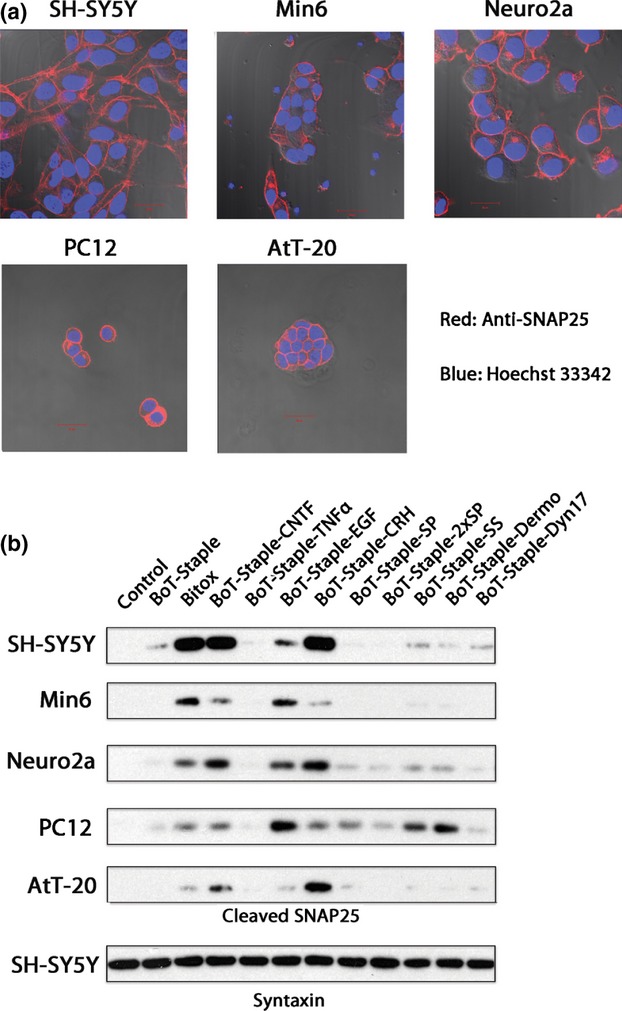
Targeting of neuroendocrine tumor cells using stapled botulinum constructs. (a) SNAP25 expression visualized by immunocytochemistry in the indicated cells: human neuroblastoma SH-SY5Y, mouse insulinoma Min6, mouse neuroblastoma Neuro2a, rat pheochromocytoma PC12, and mouse pituitary adenoma corticotroph AtT-20 cell. (b) Western blotting of the cleaved SNAP25 product in tested cells reveals selective botulinum activity for newly designed constructs. Untargeted Botulinum enzymatic and translocation domains (BoT)-Staple was used as a control, followed by Bitox and ligand-targeted BoTs as indicated in Fig. 1c. Total syntaxin immunoreactivity, shown here for SH-SY5Y cells, was routinely used as a loading control.
Fig. 3
Fig. 3
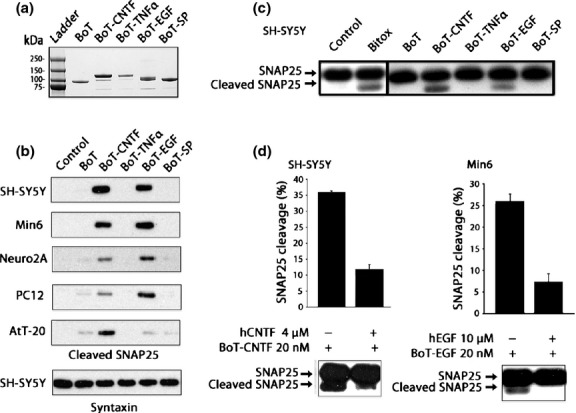
Targeting of neuroendocrine tumor cells using recombinant botulinum constructs. (a) Coomassie-stained sodium dodecyl sulfate–polyacrylamide gel electrophoresis gel showing recombinant proteins consisting of Botulinum enzymatic and translocation domains (BoT) fused directly to the indicated targeting domains: ciliary neurotrophic factor (CNTF); tumor necrosis factor α (TNF-α); epidermal growth factor (EGF), and substance P (SP). BoT is a recombinant protein carrying the botulinum protease and the translocation domain without a targeting moiety. (b) Immunoblot showing the botulinum activity of recombinant botulinum molecules (10 nM) as revealed using the cleaved SNAP25 antibody. Total syntaxin immunoreactivity was used as a loading control. (c) Monoclonal anti-SNAP25 antibody (clone SMI81) was used to confirm specificity of botulinum retargeting using CNTF and EGF to SH-SY5Y cells. (d) Bar charts showing that application of CNTF on SH-SY5Y or EGF on Min6 cells lead to a decrease in cleaved SNAP25 caused by BoT-CNTF and BoT-EGF, respectively (± SD). Representative immunoblots are shown below the bar charts.
Fig. 4
Fig. 4
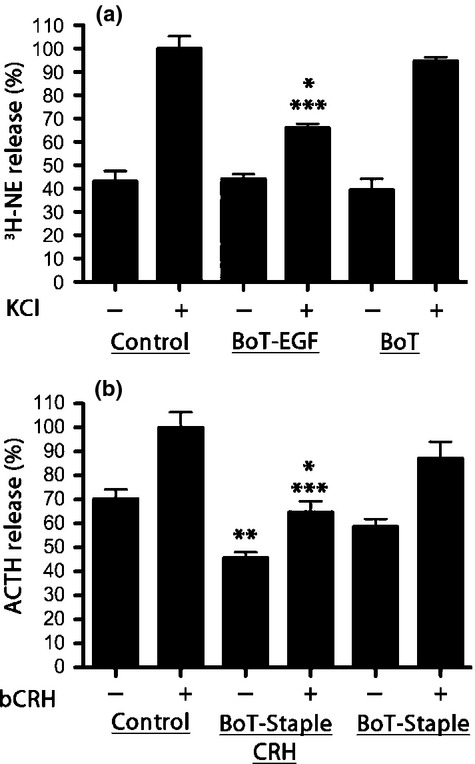
Inhibition of exocytosis using retargeted botulinum molecules. (a) A significant reduction in KCl-stimulated 3H-norepinephrine release was observed when PC12 cells were pre-treated with Botulinum enzymatic and translocation domains (BoT)-epidermal growth factor compared to untreated cells (*p < 0.01) or untargeted BoT (***p < 0.005). (b) A significant reduction in ACTH release was observed when AtT-20 cells were treated with BoT-Staple- corticotropin releasing hormone (CRH) compared to untreated cells both in the case of basal (**p < 0.02) and stimulated secretion (bovine CRH, bCRH; ***p < 0.005). BoT-Staple-CRH caused a significant reduction in ACTH release when compared to the untargeted BoT-Staple in the case of basal (**p < 0.02) and bCRH-stimulated secretion (*p < 0.05).
Fig. 5
Fig. 5
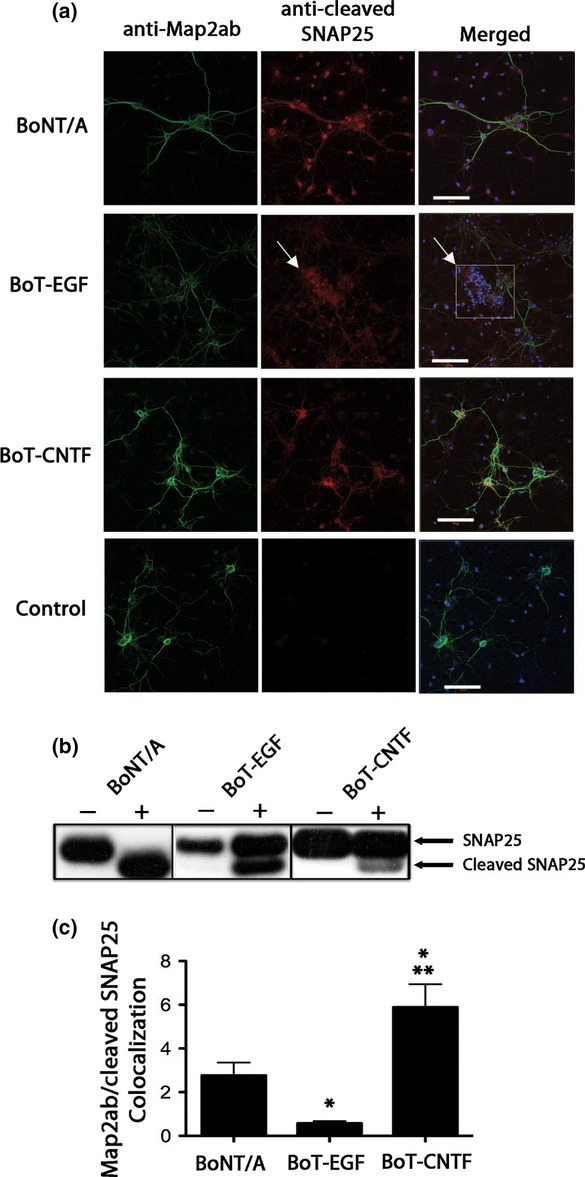
Differential targeting of neuronal populations by epidermal growth factor (EGF)- and ciliary neurotrophic factor (CNTF)-targeted botulinum molecules. (a) Confocal images of E18 rat cortical neurons treated with native BoNT/A, Botulinum enzymatic and translocation domains (BoT)-EGF and BoT-CNTF. The left column shows neurons immunostained with a Map2ab antibody (green), the middle column shows cleaved SNAP25 (red) and the right column shows the merge images, also containing nuclear Hoechst staining (blue). Horizontal bar: 100 μm (b) Immunoblot showing SNAP25 cleavage triggered by native botulinum neurotoxin (BoNT/A) and retargeted recombinant fusions. (c) Bar chart showing relative colocalization of the Map2ab and cleaved SNAP25 elicited by native and retargeted botulinum molecules (correlation coefficient multiplied by the signal intensity; ± SD). Significant differences can be seen between BoNT/A and BoT-EGF (*p < 0.005), BoNT/A and BoT-CNTF (**p < 0.03), as well as BoT-CNTF and BoT-EGF (*p < 0.005). BoT-CNTF preferentially delivers the botulinum protease into mature Map2ab-positive neurons whereas BoT-EGF acts preferentially on Map2ab-negative neuronal precursor cells.

References

    1. Amiche M, Delfour A, Nicolas P. Structural requirements for dermorphin opioid receptor binding. Int. J. Pept. Protein Res. 1988;32:28–34. - PubMed
    1. Antonucci F, Rossi C, Gianfranceschi L, Rossetto O, Caleo M. Long-distance retrograde effects of botulinum neurotoxin A. J. Neurosci. 2008;28:3689–3696. - PMC - PubMed
    1. Arsenault J, Cabana J, Fillion D, Leduc R, Guillemette G, Lavigne P, Escher E. Temperature dependent photolabeling of the human angiotensin II type 1 receptor reveals insights into its conformational landscape and its activation mechanism. Biochem. Pharmacol. 2010;80:990–999. - PubMed
    1. Bajohrs M, Rickman C, Binz T, Davletov B. A molecular basis underlying differences in the toxicity of botulinum serotypes A and E. EMBO Rep. 2004;5:1090–1095. - PMC - PubMed
    1. Bajohrs M, Darios F, Peak-Chew SY, Davletov B. Promiscuous interaction of SNAP-25 with all plasma membrane syntaxins in a neuroendocrine cell. Biochem. J. 2005;392:283–289. - PMC - PubMed

Publication types

MeSH terms