doi: 10.3174/ajnr.A3513.
Epub 2013 May 2.
Optimal timing of cerebral MRI in preterm infants to predict long-term neurodevelopmental outcome: a systematic review
Affiliations
- PMID: 23639558
- PMCID: PMC7964554
- DOI: 10.3174/ajnr.A3513
Item in Clipboard
Optimal timing of cerebral MRI in preterm infants to predict long-term neurodevelopmental outcome: a systematic review
AJNR Am J Neuroradiol.
2014 May.
Abstract
Advances in neonatal neuroimaging have improved detection of preterm brain injury responsible for abnormal neuromotor and cognitive development. Increasingly sophisticated MR imaging setups allow scanning during early preterm life. In this review, we investigated how brain MR imaging in preterm infants should be timed to best predict long-term outcome. Given the strong evidence that structural brain abnormalities are related to long-term neurodevelopment, MR imaging should preferably be performed at term-equivalent age. Early MR imaging is promising because it can guide early intervention studies and is indispensable in research on preterm brain injury.
© 2014 by American Journal of Neuroradiology.
Figures
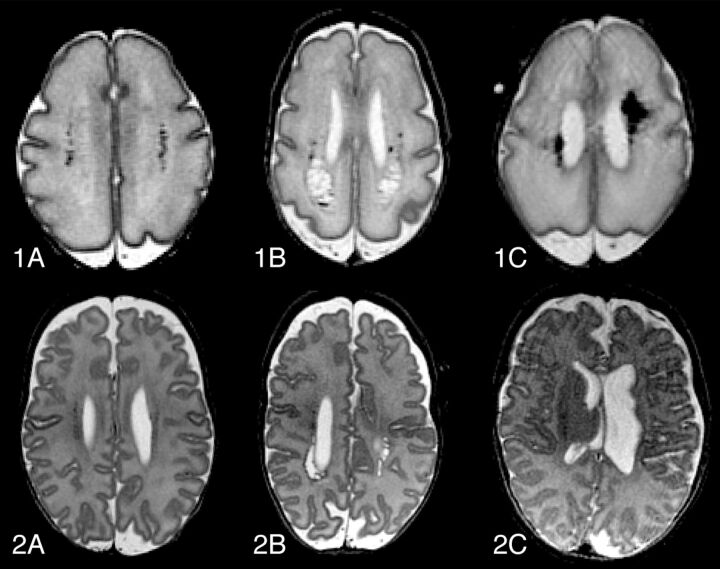
Evolution of common types of preterm brain injury, at 30 weeks' postmenstrual age (1) and at term-equivalent age (2). Transversal T2-FSE images of punctate white matter lesions (A), periventricular leukomalacia (B), and periventricular hemorrhagic venous infarction (C). Note that images 2B and 2C are slightly oblique.
References
-
- Saigal S, Doyle LW. An overview of mortality and sequelae of preterm birth from infancy to adulthood. Lancet 2008;371:261–69 - PubMed
-
- Bhutta AT, Cleves MA, Casey PH, et al. Cognitive and behavioral outcomes of school-aged children who were born preterm: a meta-analysis. JAMA 2002;288:728–37 - PubMed
-
- Larroque B, Ancel PY, Marret S, et al. Neurodevelopmental disabilities and special care of 5-year-old children born before 33 weeks of gestation (the EPIPAGE study): a longitudinal cohort study. Lancet 2008;371:813–20 - PubMed
-
- Marlow N, Wolke D, Bracewell MA, et al. Neurologic and developmental disability at six years of age after extremely preterm birth. N Engl J Med 2005;352:9–19 - PubMed
-
- Williams J, Lee KJ, Anderson PJ. Prevalence of motor-skill impairment in preterm children who do not develop cerebral palsy: a systematic review. Dev Med Child Neurol 2010;52:232–37 - PubMed
Publication types
MeSH terms
LinkOut - more resources
Full Text Sources
Other Literature Sources
Medical