. 2013 Jul;346(1):38-47.
doi: 10.1124/jpet.113.205534. Epub 2013 May 2.

Nitric-oxide synthase knockout modulates Ca²⁺-sensing receptor expression and signaling in mouse mesenteric arteries

Affiliations

Nitric-oxide synthase knockout modulates Ca²⁺-sensing receptor expression and signaling in mouse mesenteric arteries

Emmanuel M Awumey et al. J Pharmacol Exp Ther. 2013 Jul.

Abstract

Extracellular calcium (Ca²⁺(e))-induced relaxation of isolated, phenylephrine (PE)-contracted mesenteric arteries is dependent on an intact perivascular sensory nerve network that expresses the Ca²⁺-sensing receptor (CaSR). Activation of the receptor stimulates an endocannabinoid vasodilator pathway, which is dependent on cytochrome P450 and phospholipase A₂ but largely independent of the endothelium. In the present study, we determined the role of nitric oxide (NO) in perivascular nerve CaSR-mediated relaxation of PE-contracted mesenteric resistance arteries isolated from mice. Using automated wire myography, we studied the effects of NO synthase (NOS) gene knockout (NOS(-/-)) and pharmacologic inhibition of NOS on Ca²⁺(e)-induced relaxation of PE-contracted arteries. Endothelial NOS knockout (eNOS(-/-)) upregulates but neuronal NOS knockout (nNOS(-/-)) downregulates CaSR expression. NOS(-/-) reduced maximum Ca²⁺(e)-induced relaxation with no change in EC₅₀ values, with eNOS(-/-) having the largest effect. The responses of vessels to calindol and Calhex 231 indicate that the CaSR mediates relaxation. L-N⁵-(1-iminoethyl)-ornithine reduced Ca²⁺(e)-induced relaxation of PE-contracted arteries from C57BL/6 control mice by ≈38% but had a smaller effect in vessels from eNOS(-/-) mice. 7-Nitroindazole had no significant effect on relaxation of arteries from NOS(-/-) mice, but both N(G)-nitro-L-arginine methylester and N(G)-monomethyl-L-arginine significantly reduced the relaxation maxima in all groups. Interestingly, the nNOS-selective inhibitor S-methyl-L-thiocitrulline significantly increased the EC₅₀ value by ≈60% in tissues from C57BL/6 mice but reduced the maximum response by ≈80% in those from nNOS(-/-) mice. Ca²⁺-activated big potassium channels play a major role in the process, as demonstrated by the effect of iberiotoxin. We conclude that CaSR signaling in mesenteric arteries stimulates eNOS and NO production that regulates Ca²⁺(e)-induced relaxation.


Figures
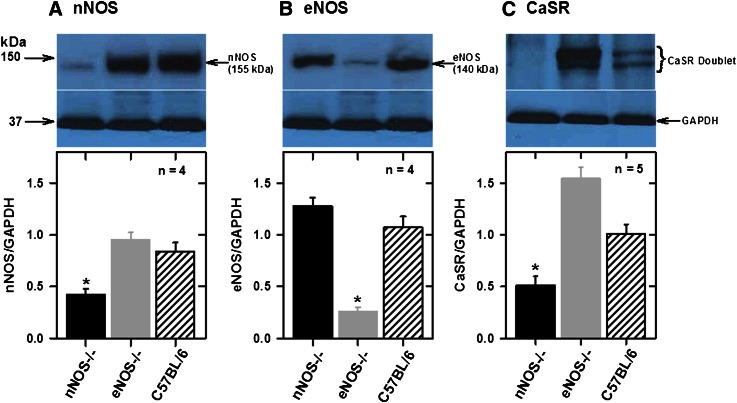
Fig. 1.
Fig. 1.
Analysis of NOS isoforms and CaSR expressions in mesenteric arcades from C57BL/6 (control) and NOS−/− mice. Western blot analysis of nNOS (A), eNOS (B), and CaSR (C) in tissues from control and NOS−/− mice. Bar charts show individual density values of protein bands expressed as ratios of glyceraldehyde-3-phosphate dehydrogenase (GAPDH) expression. nNOS knockout downregulates but eNOS knockout upregulates CaSR expression. *P < 0.001 vs. other groups; one-way analysis of variance (ANOVA).
Fig. 2.
Fig. 2.
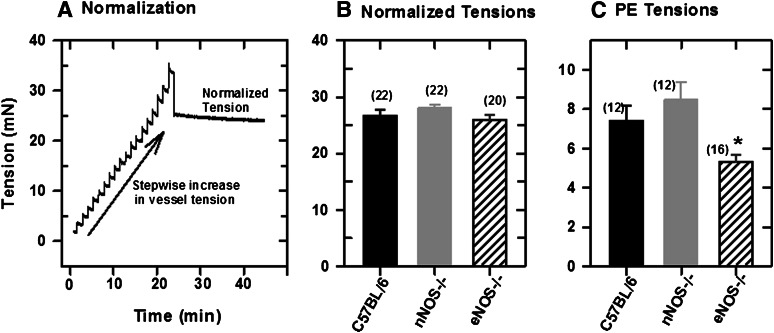
Normalization of a mesenteric artery segment mounted in a wire myograph in PSS with 1 mM CaCl2. (A) Normalization: stepwise increase in vessel tension. (B) Normalized tensions in mesenteric artery segments mounted in the myograph chamber. (C) Tensions in normalized vessel segments following applications of 5 μM PE. Values plotted are means (± S.E.M.). Differences in normalized tensions are statistically significant (*P = 0.05; one-way analysis of variance).
Fig. 3.
Fig. 3.
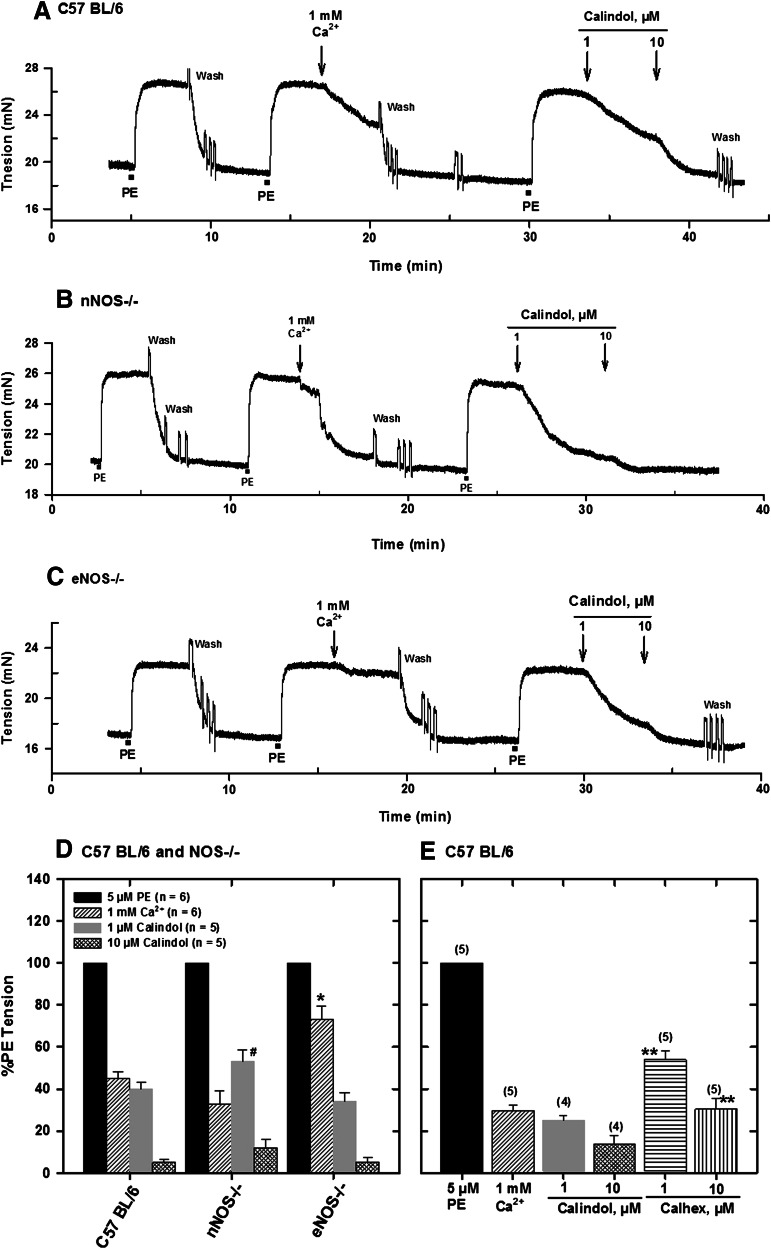
Effect of Ca2+e and the CaSR agonist calindol on relaxation of PE-contracted mesenteric arteries from C57BL/6 (A), nNOS−/− (Β), and eNOS−/− (C) mice mounted in PSS with 1 mM CaCl2. Responses of precontracted arteries to 1 mM Ca2+ and calindol (1 and 10 μM) are shown. (D) Relaxations of precontracted arteries to Ca2+ and calindol. (E) Relaxations of isolated, precontracted arteries from C57BL/6 mice to Ca2+, calindol, and the calcilytic Calhex 231. Values plotted are means (± S.E.) of 4–6 animals. *P < 0.05 vs. C57BL/6 and nNOS−/−; #P < 0.05 vs. C57BL/6 and eNOS−/−; **P < 0.05 vs. calindol responses (analysis of variance).
Fig. 4.
Fig. 4.
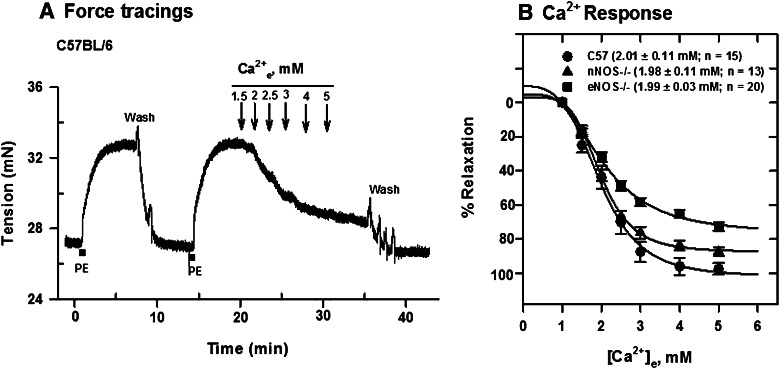
Ca2+e-induced relaxation of PE-contracted mesenteric arteries from C57BL/6, nNOS−/−, and eNOS−/− mice mounted in PSS containing 1 mM CaCl2. (A) Tension changes in an artery segment from C57BL/6 mouse following contraction with 5 μM PE and cumulative additions of Ca2+e. (B) [Ca2+]e-response curves generated from force tracing data obtained in tissues from C57BL/6, nNOS−/−, and eNOS−/− mice. Values plotted are means (± S.E.M.). NOS knockout reduced the maximum on the Ca2+-relaxation curve significantly (P < 0.05; one-way analysis of variance), with no change in EC50 values.
Fig. 5.
Fig. 5.
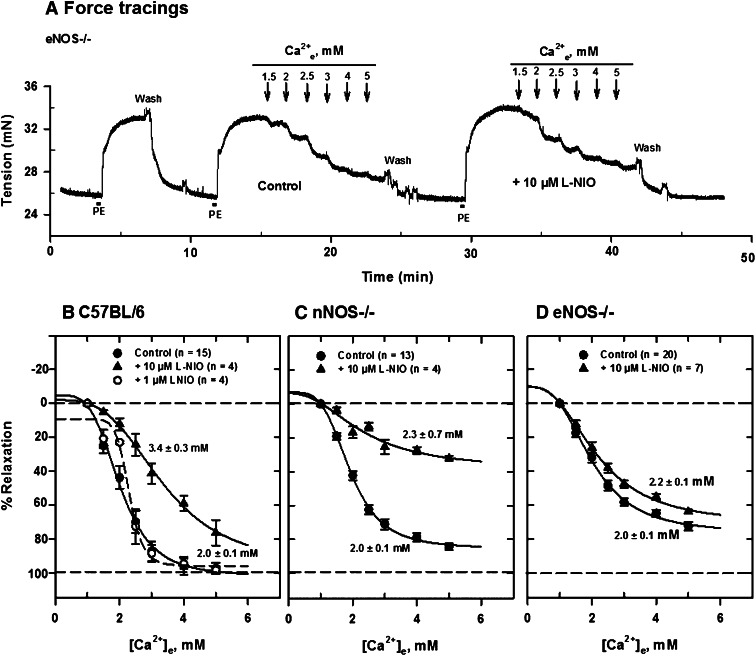
Inhibition of Ca2+e-induced relaxation of PE-contracted mesenteric arteries by l-NIO. (A) Tracings of tension changes in a mesenteric artery segment from an eNOS−/− mouse following contraction with 5 μM PE and cumulative additions of Ca2+e. (B–D) Inhibition of Ca2+e-induced relaxation by 10 μM l-NIO. [Ca2+]e-response curves were generated from tracing data obtained in tissues from C57BL/6 (B), nNOS−/− (C), and eNOS−/− (D) mice mounted in PSS with 1 mM CaCl2. l-NIO had a larger effect in tissues from C57BL/6 and nNOS−/− mice than those from eNOS−/− mice.
Fig. 6.
Fig. 6.
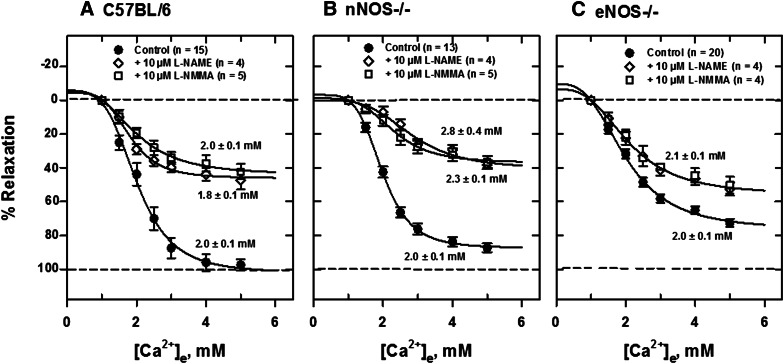
Inhibition of Ca2+e-induced relaxation of PE-contracted mesenteric arteries by l-NAME and l-NMMA. [Ca2+]e-response curves were generated from tracing data obtained in tissues from C57BL/6 (A), nNOS−/− (B), and eNOS−/− (C) mice mounted in PSS with 1 mM CaCl2. A larger component of the relaxation in tissues from eNOS−/− was insensitive to inhibition by both compounds.
Fig. 7.
Fig. 7.
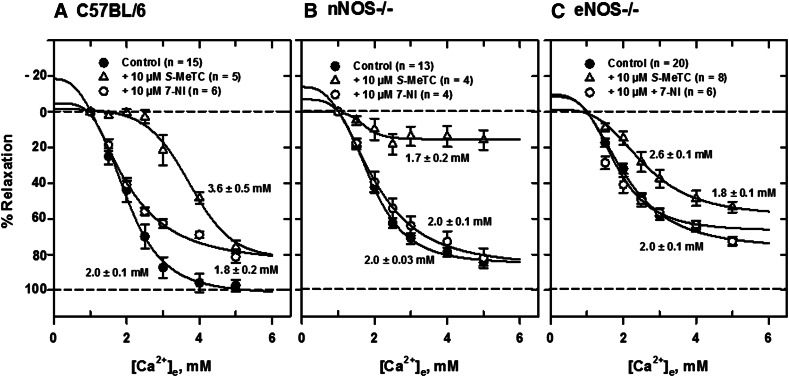
Inhibition of Ca2+e-induced relaxation of PE-contracted mesenteric arteries by S-MeTC and 7-NI. [Ca2+]e-response curves were generated from tracing data obtained in tissues from C57BL/6 (A), nNOS−/− (B), and eNOS−/− (C) mice mounted in PSS with 1 mM CaCl2. The EC50 for Ca2+e-induced relaxation of tissues from C57BL/6 mice was substantially reduced by S-MeTC compared with control (P < 0.05). The EC50 in NOS−/− remained the same but the maximum responses were reduced by about 80% in nNOS−/− and 10% in eNOS−/−. 7-NI had no effect in tissues from NOS−/− mice.
Fig. 8.
Fig. 8.
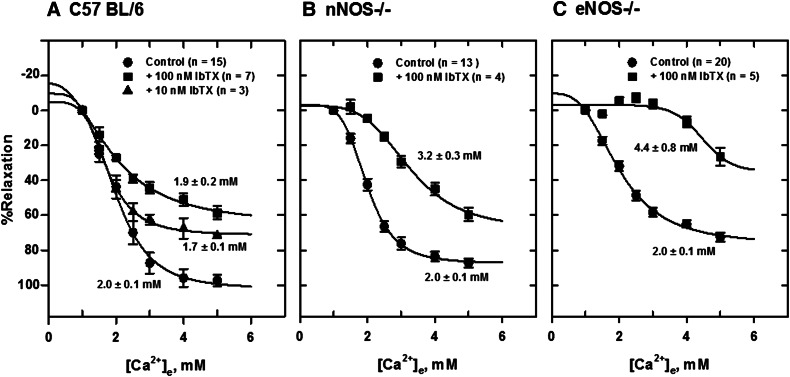
Inhibition of Ca2+-induced relaxation of PE-contracted mesenteric arteries by 100 nM IbTX. [Ca2+]e-response curves were generated from tension data obtained in tissues from C57BL/6 (A), nNOS−/− (B), and eNOS−/− (C) mice mounted in PSS with 1 mM CaCl2. IbTX (100 nM) shifted the [Ca2+]e-response curves to the right. A larger effect of IbTX was observed in tissues from eNOS−/− mice. The EC50 values for Ca2+e-induced relaxation were significantly higher in tissues from nNOS−/− and eNOS−/− mice.
Fig. 9.
Fig. 9.
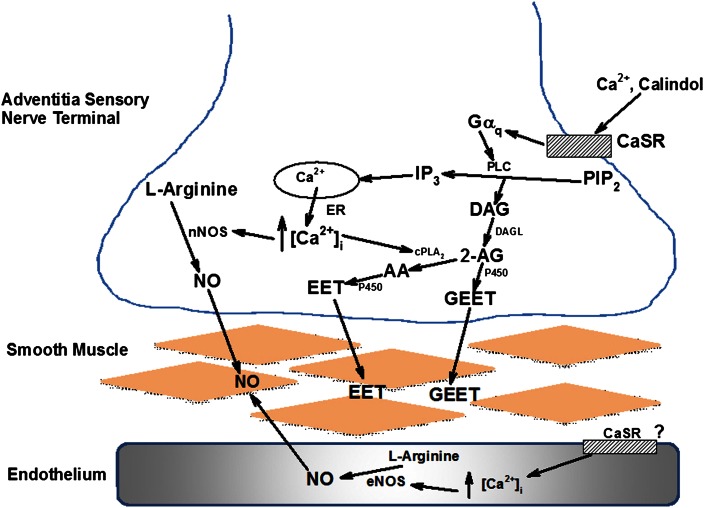
Proposed model for the PvN CaSR-mediated vasodilator release. Activation of the G-protein-coupled CaSR by agonist leads to hydrolysis of phosphatidylinositol 1,2-diphosphate (PIP2) by phospholipase C (PLC). to generate diacylglycerol (DAG) and inositol 1,4,5-trisphosphate (IP3). IP3 releases Ca2+ from endoplasmic reticulum (ER) to activate Ca2+-sensitive nNOS to increase NO synthesis in the nerve terminal. Ca2+ release also activates cytosolic phospholipase A2 (cPLA2), which can metabolize the endocannabinoid 2-arachidonoylglycerol (2-AG) [from DAG following metabolism by diacylglycerol lipase (DAGL)] to arachidonic acid (AA). P450 can then metabolize 2-AG and AA to the vasodilators glycerated epoxyeicosatrienoic acid (GEET) and epoxyeicosatrienoic acid (EET), respectively. GEET and EET can then cross the vascular smooth muscle cell (VSMC) plasma membrane to activate BK channels and cause relaxation.

References

    1. Alam MU, Kirton JP, Wilkinson FL, Towers E, Sinha S, Rouhi M, Vizard TN, Sage AP, Martin D, Ward DT, et al. (2009) Calcification is associated with loss of functional calcium-sensing receptor in vascular smooth muscle cells. Cardiovasc Res 81:260–268 - PubMed
    1. Angus JA, Wright CE. (2000) Techniques to study the pharmacodynamics of isolated large and small blood vessels. J Pharmacol Toxicol Methods 44:395–407 - PubMed
    1. Awumey EM, Hill SK, Diz DI, Bukoski RD. (2008) Cytochrome P-450 metabolites of 2-arachidonoylglycerol play a role in Ca2+-induced relaxation of rat mesenteric arteries. Am J Physiol Heart Circ Physiol 294:H2363–H2370 - PMC - PubMed
    1. Awumey EM, Howlett AC, Putney JW, Jr, Diz DI, Bukoski RD. (2007) Ca(2+) mobilization through dorsal root ganglion Ca(2+)-sensing receptor stably expressed in HEK293 cells. Am J Physiol Cell Physiol 292:C1895–C1905 - PubMed
    1. Bai M, Quinn S, Trivedi S, Kifor O, Pearce SH, Pollak MR, Krapcho K, Hebert SC, Brown EM. (1996) Expression and characterization of inactivating and activating mutations in the human Ca2+o-sensing receptor. J Biol Chem 271:19537–19545 - PubMed

Publication types

MeSH terms

LinkOut - more resources