


Cicletanine stimulates eNOS phosphorylation and NO production via Akt and MAP kinase/Erk signaling in sinusoidal endothelial cells
- PMID: 23639812
- PMCID: PMC3725686
- DOI: 10.1152/ajpgi.00003.2013
Cicletanine stimulates eNOS phosphorylation and NO production via Akt and MAP kinase/Erk signaling in sinusoidal endothelial cells
Erratum in
-
Corrigendum for Liu et al., volume 305, 2013, p. G163-G171.Am J Physiol Gastrointest Liver Physiol. 2022 Apr 1;322(4):G457-G458. doi: 10.1152/ajpgi.00003.2013_COR. Am J Physiol Gastrointest Liver Physiol. 2022. PMID: 35315727 Free PMC article. No abstract available.
Abstract
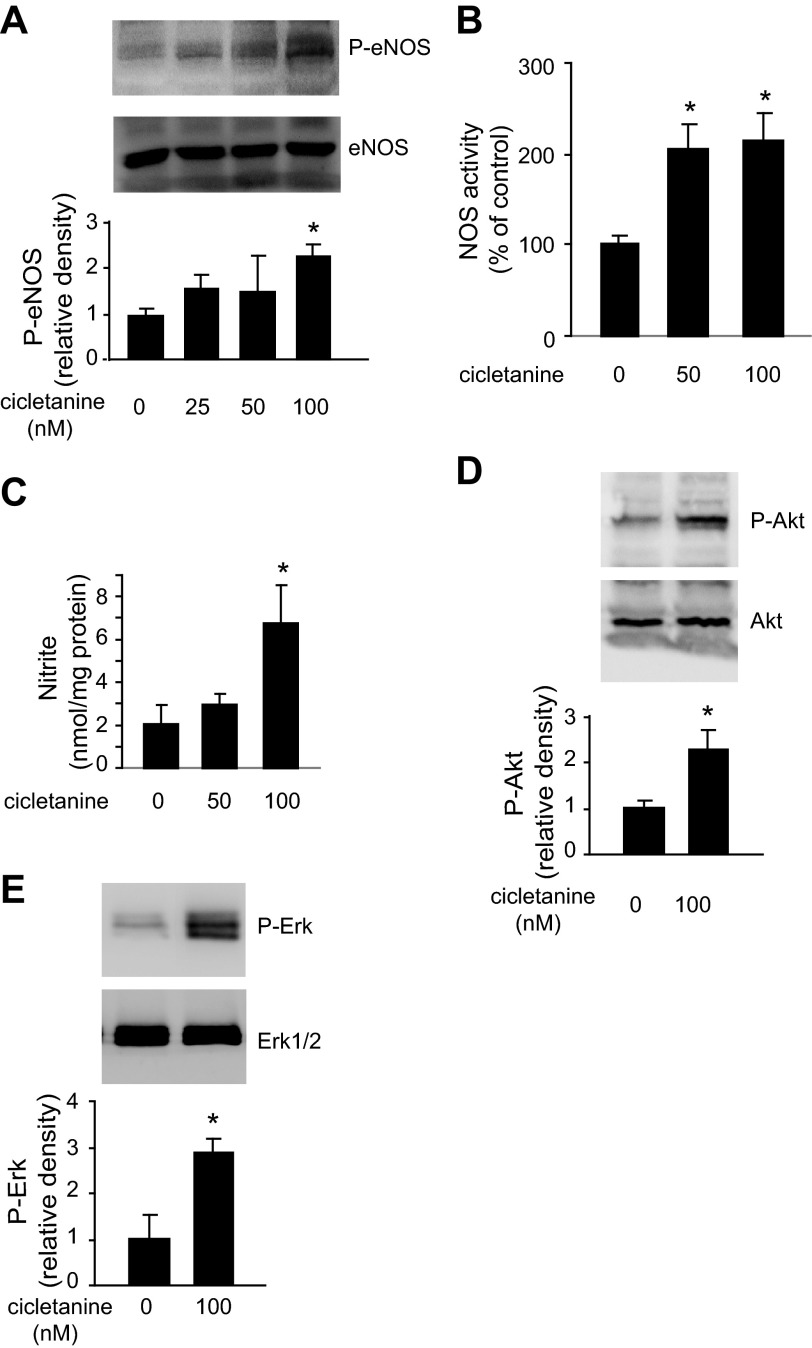
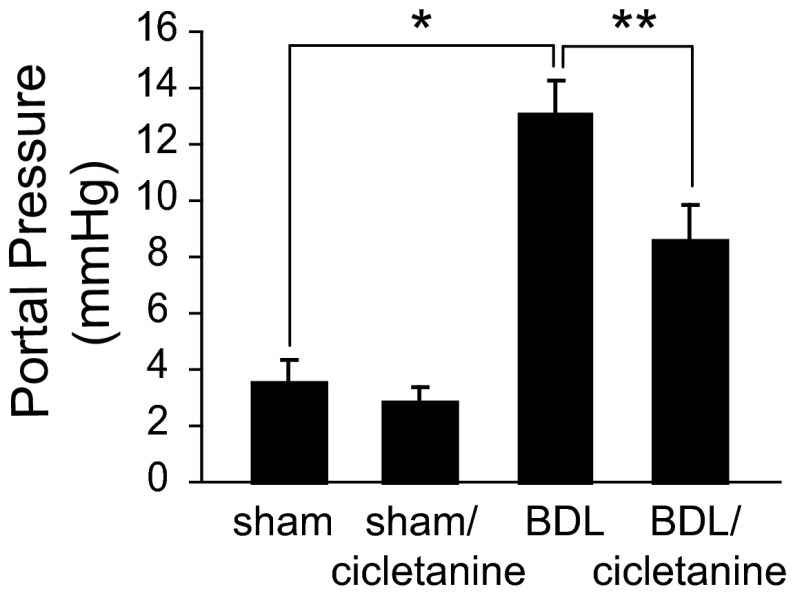
The function of the endothelial isoform of nitric oxide synthase (eNOS) and production of nitric oxide (NO) is altered in a number of disease states. Pharmacological approaches to enhancing NO synthesis and thus perhaps endothelial function could have substantial benefits in patients. We analyzed the effect of cicletanine, a synthetic pyridine with potent vasodilatory characteristics, on eNOS function and NO production in normal (liver) and injured rat sinusoidal endothelial cells, and we studied the effect of cicletanine-induced NO on stellate cell contraction and portal pressure in an in vivo model of liver injury. Sinusoidal endothelial cells were isolated from normal and injured rat livers. After exposure to cicletanine, eNOS phosphorylation, NO synthesis, and the signaling pathway regulating eNOS activation were measured. Cicletanine led to an increase in eNOS (Ser¹¹⁷⁷) phosphorylation, cytochrome c reductase activity, L-arginine conversion to L-citrulline, as well as NO production. The mechanism of the effect of cicletanine appeared to be via the protein kinase B (Akt) and MAP kinase/Erk signaling pathways. Additionally, cicletanine improved NO synthesis in injured sinusoidal endothelial cells. NO production induced by cicletanine in sinusoidal endothelial cells increased protein kinase G (PKG) activity as well as relaxation of stellate cells. Finally, administration of cicletanine to mice with portal hypertension induced by bile duct ligation led to reduction of portal pressure. The data indicate that cicletanine might improve eNOS activity in injured sinusoidal endothelial cells and likely activates hepatic stellate cell NO/PKG signaling. It raises the possibility that cicletanine could improve intrahepatic vascular function in portal hypertensive patients.
Keywords: endothelial isoform of nitric oxide synthase; extracellular/signal-regulated kinase; mitogen-activated protein kinase; portal hypertension; protein kinase B; signaling; stellate cell.
Figures




References
-
- Akamatsu N, Sawada S, Komatsu S, Tamagaki T, Hiranuma O, Kawahara T, Tsuda Y, Kono Y, Higaki T, Tada Y, Yamasaki S, Imamura H, Sato T, Tsuji H, Nakagawa M. Effect of cicletanine on the nitric oxide pathway in human umbilical vein endothelial cells. J Cardiovasc Pharmacol 38: 174–182, 2001 - PubMed
-
- Bernier SG, Haldar S, Michel T. Bradykinin-regulated interactions of the mitogen-activated protein kinase pathway with the endothelial nitric-oxide synthase. J Biol Chem 275: 30707–30715, 2000 - PubMed
-
- Bukoski RD, Bo J, Xue H, Bian K. Antiproliferative and endothelium-dependent vasodilator properties of 1,3-dihydro-3-p-chlorophenyl-7-hydroxy-6-methyl-furo-(3,4c) pyridine hydrochloride (cicletanine). J Pharmacol Exp Ther 265: 30–35, 1993 - PubMed
-
- Busconi L, Michel T. Endothelial nitric oxide synthase. N-terminal myristoylation determines subcellular localization. J Biol Chem 268: 8410–8413, 1993 - PubMed
-
- Calder JA, Schachter M, Sever PS. Interaction between cicletanine and the eicosanoid system in human subcutaneous resistance arteries. J Pharm Pharmacol 44: 574–578, 1992 - PubMed
Publication types
MeSH terms
Substances
Grants and funding
LinkOut - more resources
Full Text Sources
Other Literature Sources
Miscellaneous
