


Regulatory mechanisms for the development of growth plate cartilage
- PMID: 23640571
- PMCID: PMC11113666
- DOI: 10.1007/s00018-013-1346-9
Regulatory mechanisms for the development of growth plate cartilage
Abstract
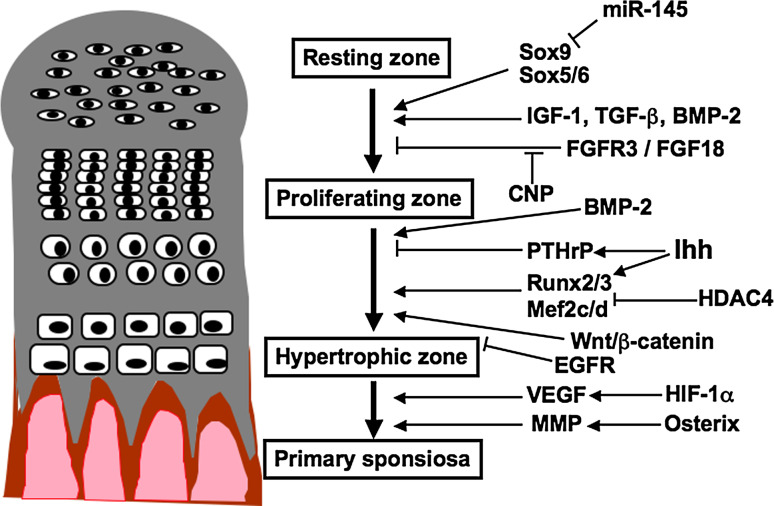
In vertebrates, most of the skeleton is formed through endochondral ossification. Endochondral bone formation is a complex process involving the mesenchymal condensation of undifferentiated cells, the proliferation of chondrocytes and their differentiation into hypertrophic chondrocytes, and mineralization. This process is tightly regulated by various factors including transcription factors, soluble mediators, extracellular matrices, and cell-cell and cell-matrix interactions. Defects of these factors often lead to skeletal dysplasias and short stature. Moreover, there is growing evidence that epigenetic and microRNA-mediated mechanisms also play critical roles in chondrogenesis. This review provides an overview of our current understanding of the regulators for the development of growth plate cartilage and their molecular mechanisms of action. A knowledge of the regulatory mechanisms underlying the proliferation and differentiation of chondrocytes will provide insights into future therapeutic options for skeletal disorders.
Figures
References
-
- Wagner EF, Karsenty G. Genetic control of skeletal development. Curr Opin Genet Dev. 2001;11:527–532. - PubMed
-
- Kronenberg HM. Developmental regulation of the growth plate. Nature. 2003;423:332–336. - PubMed
-
- Beier F. Cell-cycle control and the cartilage growth plate. J Cell Physiol. 2005;202:1–8. - PubMed
-
- Burdan F, Szumilo J, Korobowicz A, Farooquee R, Patel S, Patel A, Dave A, Szumilo M, Solecki M, Klepacz R, Dudka J. Morphology and physiology of the epiphyseal growth plate. Folia Histochem Cytobiol. 2009;47:5–16. - PubMed
Publication types
MeSH terms
Substances
LinkOut - more resources
Full Text Sources
Other Literature Sources
