Regulation of mTORC1 and its impact on gene expression at a glance
- PMID: 23641065
- PMCID: PMC3678406
- DOI: 10.1242/jcs.125773
Regulation of mTORC1 and its impact on gene expression at a glance
Abstract
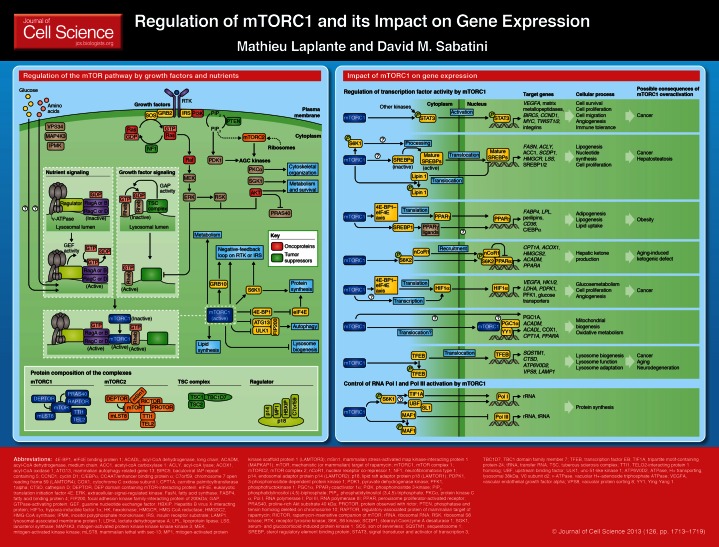
The mechanistic (or mammalian) target of rapamycin (mTOR) is a kinase that regulates key cellular functions linked to the promotion of cell growth and metabolism. This kinase, which is part of two protein complexes termed mTOR complex 1 (mTORC1) and 2 (mTORC2), has a fundamental role in coordinating anabolic and catabolic processes in response to growth factors and nutrients. Of the two mTOR complexes, mTORC1 is by far the best characterized. When active, mTORC1 triggers cell growth and proliferation by promoting protein synthesis, lipid biogenesis, and metabolism, and by reducing autophagy. The fact that mTORC1 deregulation is associated with several human diseases, such as type 2 diabetes, cancer, obesity and neurodegeneration, highlights its importance in the maintenance of cellular homeostasis. Over the last years, several groups observed that mTORC1 inhibition, in addition to reducing protein synthesis, deeply affects gene transcription. Here, we review the connections between mTORC1 and gene transcription by focusing on its impact in regulating the activation of specific transcription factors including including STAT3, SREBPs, PPARγ, PPARα, HIF1α, YY1–PGC1α and TFEB. We also discuss the importance of these transcription factors in mediating the effects of mTORC1 on various cellular processes in physiological and pathological contexts.
References
-
- Bentzinger C. F., Romanino K., Cloëtta D., Lin S., Mascarenhas J. B., Oliveri F., Xia J., Casanova E., Costa C. F., Brink M. et al. (2008). Skeletal muscle-specific ablation of raptor, but not of rictor, causes metabolic changes and results in muscle dystrophy. Cell Metab. 8, 411–424 10.1016/j.cmet.2008.10.002 - DOI - PubMed
Publication types
MeSH terms
Substances
Grants and funding
LinkOut - more resources
Full Text Sources
Other Literature Sources
Miscellaneous