


Exercise-ankle brachial pressure index with one-minute treadmill walking in patients on maintenance hemodialysis
- PMID: 23641284
- PMCID: PMC3635000
- DOI: 10.3400/avd.oa.12.00070
Exercise-ankle brachial pressure index with one-minute treadmill walking in patients on maintenance hemodialysis
Abstract
Background: The ankle-brachial pressure index (ABI) is widely used as a standard screening method for arterial occlusive lesion above the knee. However, the sensitivity of ABI is low in hemodialysis (HD) patients. Exercise stress (Ex-ABI) may reduce the false negative results.
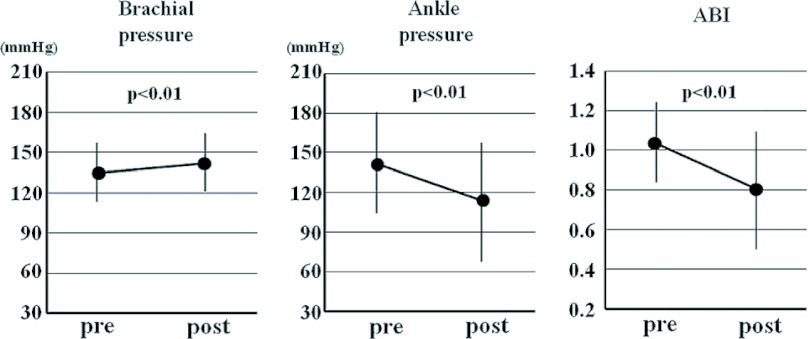
Patients and methods: After measuring resting ABI and toe-brachial pressure index (TBI), ankle pressure and ABI immediately after walking (Post-AP, Post-ABI) were measured using one-minute treadmill walking in 52 lower limbs of 26 HD patients. The definition of peripheral arterial occlusive disease (PAD) required an ABI value of less than 0.90, TBI value of less than 0.60, and decrease of more than 15% of the Post-ABI value and 20 mmHg of Post-AP in Ex-ABI. Computed tomographic angiography (CTA) was performed in 32 lower limbs of 16 HD patients. PAD is defined as presence of stenosis of more than 75% in the case of lesions from an iliac artery to knee on CTA.
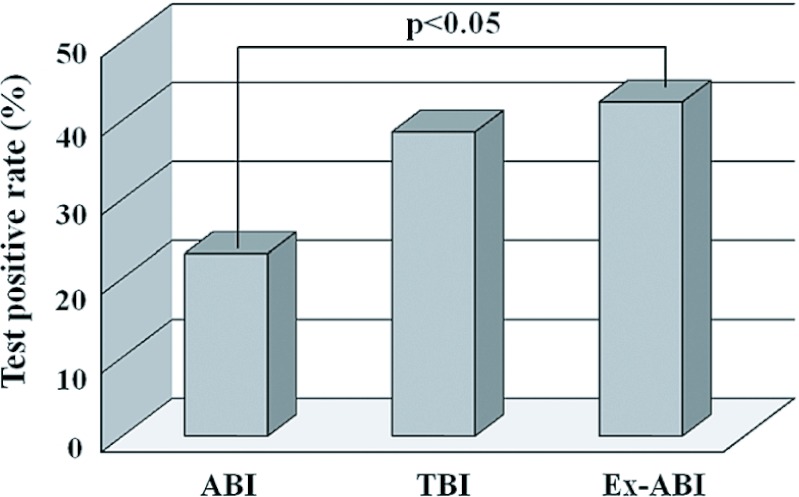
Results: The accuracy of Ex-ABI (Sensitivity, 85.7%; Specificity, 77.7%) was higher than those of ABI (Sensitivity, 42.9%; Specificity, 83.3%) or TBI (Sensitivity, 78.6%; Specificity, 61.1%).
Conclusion: Ex-ABI with one-minute treadmill walking is the most useful tool for the screening of arterial occlusive lesions above the knee in maintenance HD patients.
Keywords: diagnosis; exercise; hemodialysis; peripheral arterial disease; screening.
Figures
References
-
- Okamoto K, Oka M, Maesato K, et al. Peripheral arterial occlusive disease is more prevalent in patients with hemodialysis: comparison with the findings of multidetector-row computed tomography. Am J Kidney Dis 2006; 48: 269–76 - PubMed
-
- Leskinen Y, Salenius JP, Lehtimäki T, et al. The prevalence of peripheral arterial disease and medial arterial calcification in patients with chronic renal failure: requirements for diagnostics. Am J Kidney Dis 2002; 40: 472–9 - PubMed
-
- Okamoto K, Oka M, Maesato K, et al. Non-invasive diagnostic modality for peripheral arterial occlusive disease in hemodialysis patients. J Jpn Coll Angiol 2006; 46: 829–35
-
- Fabry R, Dubost JJ, Pochon P, et al. Comparison of standard one-minute treadmill exercise and strandness test (absolute walking distance) in relation to site of lesion, walking distance, and diastolic blood flow velocity (Doppler curves). Angiology 1990; 41: 869–76 - PubMed
LinkOut - more resources
Full Text Sources
Other Literature Sources