Review
. 2013 Jun;34(6):299-306.
doi: 10.1016/j.it.2013.03.003. Epub 2013 May 1.

Effector and memory T cell responses to commensal bacteria

Affiliations
Review

Effector and memory T cell responses to commensal bacteria

Yasmine Belkaid et al. Trends Immunol. 2013 Jun.

Abstract

Barrier surfaces are home to a vast population of commensal organisms that together encode millions of proteins; each of them possessing several potential foreign antigens. Regulation of immune responses to this enormous antigenic load represents a tremendous challenge for the immune system. Tissues exposed to commensals have developed elaborate systems of regulation including specialized populations of resident lymphocytes that maintain barrier function and limit potential responses to commensal antigens. However, in settings of infection and inflammation these regulatory mechanisms are compromised and specific effector responses against commensal bacteria can develop. This review discusses the circumstances controlling the fate of commensal specific T cells and how dysregulation of these responses could lead to severe pathological outcomes.


Figures

Figure 1
Figure 1
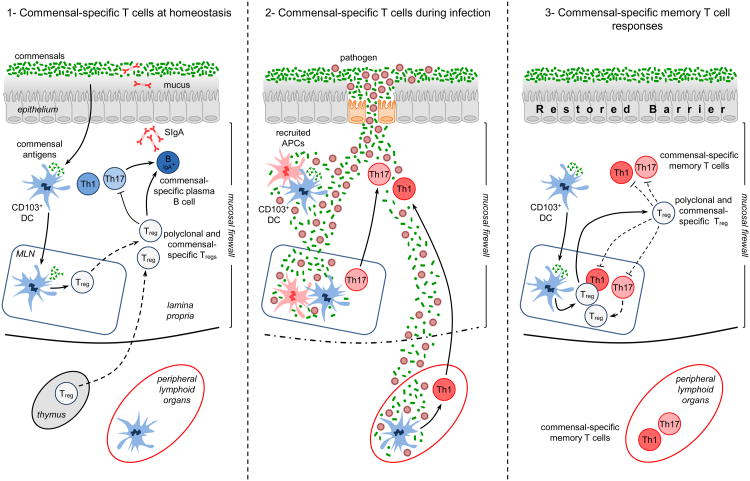
Commensal-specific T cells at homeostasis and during infection: 1) At homeostasis – commensal and food antigens are presented to T cells by CD103+ T cells that have trafficked to the mLN from the lamina propria. Presentation by these DCs to commensal-specific T cells may lead to the differentiation of commensal-specific T regulatory cells (Tregs). Commensal-specific Treg cells traffic to the lamina propria and Peyer's Patches, where they, along with polyclonal Tregs, can regulate effector T cell responses and induce class switching and IgA production from resident commensal-specific B cells, reinforcing the commensal barrier. Critically, the combination of the epithelial barrier, mucus layer, IgA and regulatory DCs and T cells comprises the ‘mucosal firewall’, which limits the passage of commensal and food-derived antigens to the Gut-Associated Lymphoid Tissue (GALT), preventing untoward activation and pathology. 2) During GI infection – Invasion of the intestinal barrier can cause inflammation and tissue damage. This pathology can disrupt the mucosal firewall and allows for systemic translocation of commensal organisms and their associated antigens. During times of translocation, the host immune system becomes unable to discriminate between commensal and pathogen-derived antigens and therefore commensal-specific T cell responses mimic responses to the invasive pathogen. 3) After clearance of the infection –the intestinal barrier reforms and the mucosal firewall is restored perhaps preventing the chronic activation of commensal-specific memory T cells. Treg cells may regulate commensal specific responses either directly or via the modulation of resident dendritic cells.
Figure 2
Figure 2
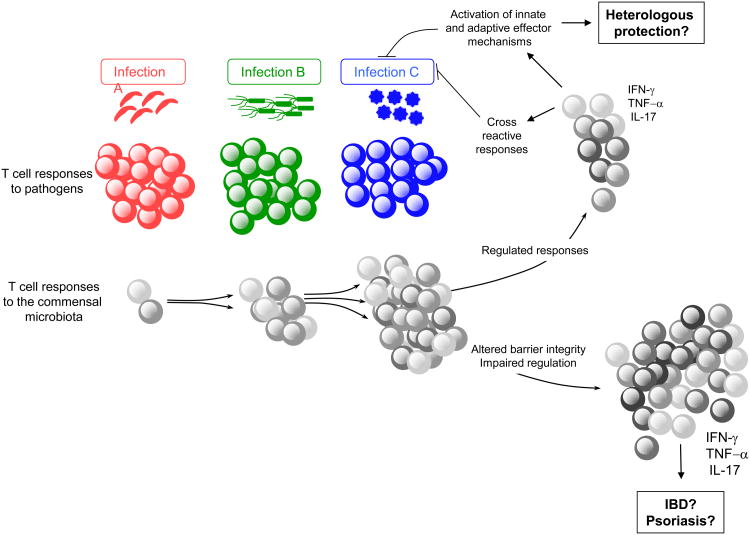
Potential consequences of commensal-specific memory T cells: During infection at barrier sites (gut, skin, airway, genital mucosa) immune responses against the invading agent can be associated with specific T cell responses against a large number of coincident commensal antigens. These commensal-specific effector T cell responses can persist as memory cells that upon subsequent infection will be recalled as secondary commensal-specific effectors, alongside the priming of a novel immune response to the invasive pathogen. Therefore, each infection at barrier surfaces represents an additional opportunity for the reactivation of commensal-specific T cells. Given the extraordinary number of commensal antigens, these responses may represent a significant proportion of memory T cells. If properly controlled, commensal-specific effector/memory cells could contribute to protection against infections by promoting innate and adaptive effector mechanisms that assist in the clearance of the pathogen. Further, commensal memory responses could be protective due to cross reactivity with pathogen-derived antigens. In contrast, in situations where commensal-specific T cells become dysregulated due to impaired regulatory pathways and/or barrier function, these T cells could drive chronic pathology such as IBD or psoriasis.

References

    1. Foulongne V, et al. Human skin microbiota: high diversity of DNA viruses identified on the human skin by high throughput sequencing. PLoS One. 2012;7(6):e38499. - PMC - PubMed
    1. Iliev ID, et al. Interactions between commensal fungi and the C-type lectin receptor Dectin-1 influence colitis. Science. 2012;336(6086):1314–1317. - PMC - PubMed
    1. Reyes A, et al. Viruses in the faecal microbiota of monozygotic twins and their mothers. Nature. 2010;466(7304):334–338. - PMC - PubMed
    1. Eckburg PB, et al. Archaea and their potential role in human disease. Infect Immun. 2003;71(2):591–596. - PMC - PubMed
    1. Grice EA, Segre JA. The human microbiome: our second genome. Annu Rev Genomics Hum Genet. 2012;13:151–170. - PMC - PubMed

Publication types

Substances

LinkOut - more resources