


Methods for diagnosis of bile acid malabsorption in clinical practice
- PMID: 23644387
- PMCID: PMC3783593
- DOI: 10.1016/j.cgh.2013.04.029
Methods for diagnosis of bile acid malabsorption in clinical practice
Abstract
Altered concentrations of bile acid (BA) in the colon can cause diarrhea or constipation. More than 25% of patients with irritable bowel syndrome with diarrhea or chronic diarrhea in Western countries have BA malabsorption (BAM). As BAM is increasingly recognized, proper diagnostic methods are needed to help direct the most effective course of treatment for the chronic bowel dysfunction. We review the methodologies, advantages, and disadvantages of tools that directly measure BAM: the (14)C-glycocholate breath and stool test, the (75)selenium homotaurocholic acid test (SeHCAT), and measurements of 7 α-hydroxy-4-cholesten-3-one (C4) and fecal BAs. The (14)C-glycocholate test is laborious and no longer widely used. The (75)SeHCAT has been validated but is not available in the United States. Measurement of serum C4 is a simple and accurate method that can be used for most patients but requires further clinical validation. Assays to quantify fecal BA (total and individual levels) are technically cumbersome and not widely available. Regrettably, none of these tests are routinely available in the United States; assessment of the therapeutic effects of a BA binder is used as a surrogate for diagnosis of BAM. Recent data indicate the advantages to studying fecal excretion of individual BAs and their role in BAM; these could support the use of the fecal BA assay, compared with other tests. Measurement of fecal BA levels could become a routine addition to the measurement of fecal fat in patients with unexplained diarrhea. Availability ultimately determines whether the C4, SeHCAT, or fecal BA test is used; more widespread availability of such tests would enhance clinical management of these patients.
Keywords: (75)SeHCAT; (75)selenium homotaurocholic acid test; 7 α-hydroxy-4-cholesten-3-one; ASBT; BA; BAM; C4; CA; CDCA; CYP7A1; DCA; Diarrhea; Fecal; GC-MS; Glycocholate; HPLC; IBAT; IBS; LCA; MS; NADH; Na(+)-dependent bile salt transporter; SeHCAT; bile acid; bile acid malabsorption; chenodeoxycholic acid; cholesterol 7α hydroxylase; cholic acid; deoxycholic acid; gas chromatography–mass spectrometry; high-performance liquid chromatography; ileal BA transporter; irritable bowel syndrome; lithocholic acid; mass spectrometry; reduced nicotinamide adenine dinucleotide.
Copyright © 2013 AGA Institute. Published by Elsevier Inc. All rights reserved.
Figures
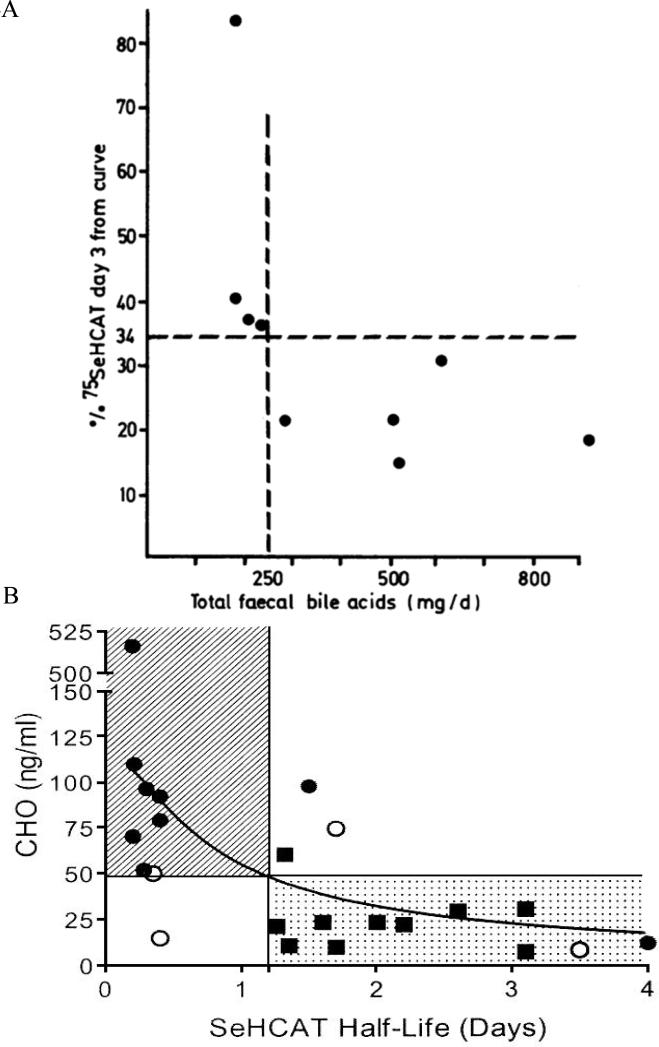
 = response to treatment, ■ = no response to treatment, ● = response not evaluated). The hatched area denotes pathologic values for both tests; the dotted area denotes normal values for both tests. Reproduced from Sauter GH, et al. Dig Dis Sci 1999;44:14-19.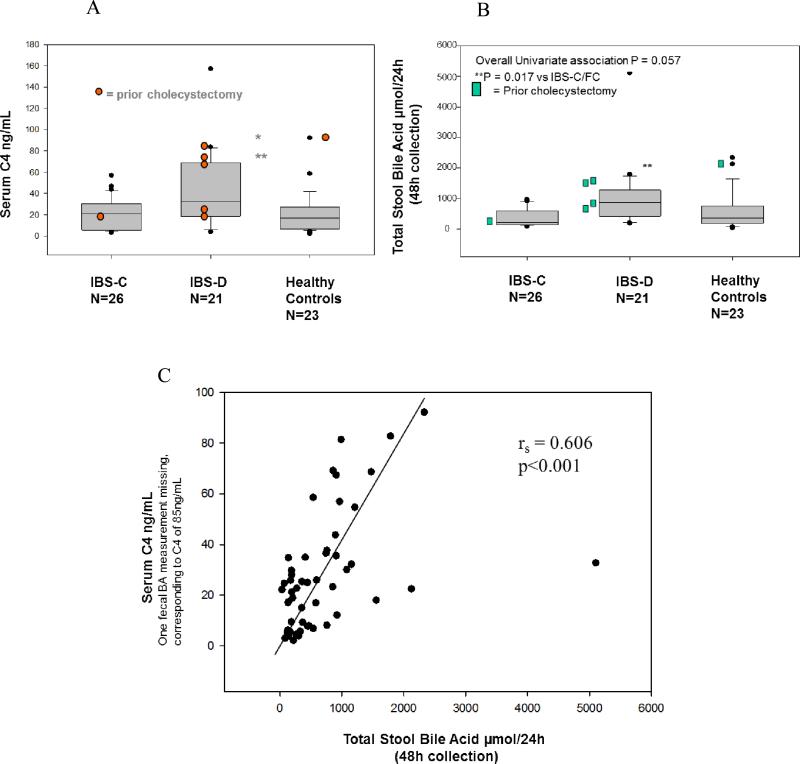
Comment on
-
Bowel functions, fecal unconjugated primary and secondary bile acids, and colonic transit in patients with irritable bowel syndrome.Clin Gastroenterol Hepatol. 2013 Oct;11(10):1270-1275.e1. doi: 10.1016/j.cgh.2013.04.020. Epub 2013 Apr 30. Clin Gastroenterol Hepatol. 2013. PMID: 23639599 Free PMC article.
References
-
- Hofmann AF, Small DM. Detergent properties of bile salts: correlation with physiological function. Annu Rev Med. 1967;18:333–376. - PubMed
-
- Alnouti Y. Bile acid sulfation: a pathway of bile acid elimination and detoxification. Toxicol Sci. 2009;108:224–246. - PubMed
-
- Robben J, Caenepeel P, Van Eldere J, et al. Effects of intestinal microbial bile salt sulfatase activity on bile salt kinetics in gnotobiotic rats. Gastroenterology. 1988;94:494–502. - PubMed
-
- Breuer NF, Rampton DS, Tammar A, et al. Effect of colonic perfusion with sulfated and nonsulfated bile acids on mucosal structure and function in the rat. Gastroenterology. 1983;84:969–977. - PubMed
Publication types
MeSH terms
Substances
Grants and funding
LinkOut - more resources
Full Text Sources
Other Literature Sources
Medical
Research Materials
Miscellaneous
