


Review
doi: 10.3390/ijms14059581.
Where do they come from and where do they go: candidates for regulating extracellular vesicle formation in fungi
Affiliations
- PMID: 23644887
- PMCID: PMC3676800
- DOI: 10.3390/ijms14059581
Item in Clipboard
Review
Where do they come from and where do they go: candidates for regulating extracellular vesicle formation in fungi
Int J Mol Sci.
.
Abstract
In the past few years, extracellular vesicles (EVs) from at least eight fungal species were characterized. EV proteome in four fungal species indicated putative biogenesis pathways and suggested interesting similarities with mammalian exosomes. Moreover, as observed for mammalian exosomes, fungal EVs were demonstrated to be immunologically active. Here we review the seminal and most recent findings related to the production of EVs by fungi. Based on the current literature about secretion of fungal molecules and biogenesis of EVs in eukaryotes, we focus our discussion on a list of cellular proteins with the potential to regulate vesicle biogenesis in the fungi.
Figures
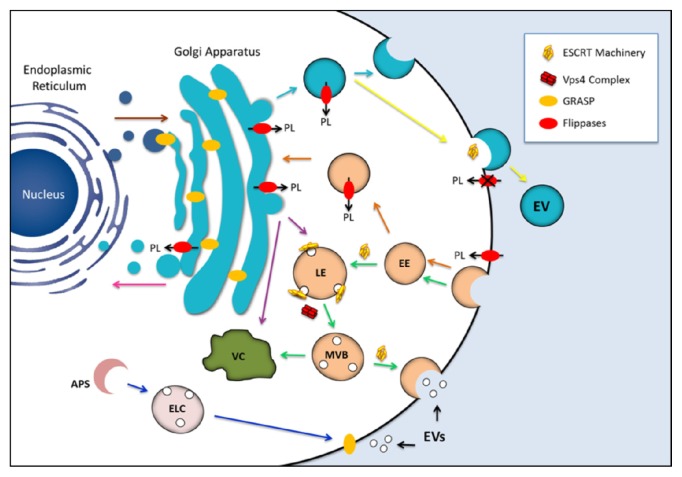
Potential participation of components of the endosomal sorting complex required for transport (ESCRT) machinery, GRASP and flippases in the biogenesis of fungal extracellular vesicles (EVs). The similarities between EVs produced by fungi and mammalian exosomes suggest that ESCRT machinery is required for formation of the fungal compartments (green arrows). Maturation of the late endosome (LE) is accompanied by membrane invagination, giving origin to small intraluminal vesicles and multivesicular bodies (MVB). The ESCRT machinery is recycled through the activity of the Vps4 protein complex. MVB may be directed to vacuolar (VC) degradation pathways, but also to fusion with the plasma membrane, releasing exosomes to the extracellular milieu now receiving the name exosomes. GRASP, a regulator of unconventional secretion by mechanisms that are putatively linked to EV release, was first identified as a structural component of the Golgi cisternae. Alternative roles included tethering activity for endosomal or lysosomal compartments and/or regulation of autophagy-related mechanisms (blue arrows). GRASP may also localize to the plasma membrane, mediating the release of exosomes to the extracellular space. Finally, GRASP can also participate in docking or fusion events involving vesicles originating at the Golgi, thus facilitating anterograde transport through the early secretory pathway (brown arrow). Flippases are involved in vesicle biogenesis through phospholipid translocation across the lipid bilayers. These enzymes can regulate endocytosis at the plasma membrane level (orange arrows) and also drive the formation of exocytic vesicles (light blue arrows). Flippases can also participate in protein trafficking between the trans-Golgi network and endosomal compartment or between the trans-Golgi network and vacuoles (purple arrows). It has been also proposed that flippases may regulate the retrograde transport pathway from the Golgi apparatus to the ER (pink arrow), as well as vesicle budding at the plasma membrane level (yellow arrow). The possibility that cellular pathways regulated by endosomal proteins, GRASPs and flippases are interconnected cannot be ruled out, as previously described for other unconventional secretory pathways [165]. Most of the mechanisms proposed here have been implicated with the physiology of yeast cells, although they also participate in pathways required for molecular degradation and / or export in other eukaryotes. (PL) phospholipid; (EE) early endosome; (LE) late endosome; (MVB) multivesicular bodies; (APS) autophagosome; (ELC) endosomal/lysosomal compartment; (VC) vacuole.
References
-
- Latge J.P., Mouyna I., Tekaia F., Beauvais A., Debeaupuis J.P., Nierman W. Specific molecular features in the organization and biosynthesis of the cell wall of Aspergillus fumigatus. Med. Mycol. 2005;43:S15–S22. - PubMed
-
- Nimrichter L., Rodrigues M.L., Rodrigues E.G., Travassos L.R. The multitude of targets for the immune system and drug therapy in the fungal cell wall. Microbes Infect. 2005;7:789–798. - PubMed
-
- Barbosa M.S., Bao S.N., Andreotti P.F., de Faria F.P., Felipe M.S., dos Santos Feitosa L., Mendes-Giannini M.J., Soares C.M. Glyceraldehyde-3-phosphate dehydrogenase of Paracoccidioides brasiliensis is a cell surface protein involved in fungal adhesion to extracellular matrix proteins and interaction with cells. Infect. Immun. 2006;74:382–289. - PMC - PubMed
Publication types
MeSH terms
Substances
LinkOut - more resources
Full Text Sources
Other Literature Sources
Medical
Miscellaneous
