


doi: 10.3390/s130505749.
Dual-specific interaction to detect DNA on gold nanoparticles
Affiliations
- PMID: 23645111
- PMCID: PMC3690027
- DOI: 10.3390/s130505749
Item in Clipboard
Dual-specific interaction to detect DNA on gold nanoparticles
Sensors (Basel).
.
Abstract
An approach to selectively and efficiently detect single strand DNA is developed by using streptavidin coated gold nanoparticles (StAuNPs) as efficient quenchers. The central concept for the successful detection is the combination the of streptavidin-biotin interaction with specific probe-target DNA hybridization. Biotin labeled probe DNAs act as "bridges" to bring Cy5 labeled targets to the particle surface and the fluorophore dye can be rapidly and efficiently quenched by StAuPNs. By measuring the changes of photoluminescence intensity of Cy5, an efficient, selective, and reversed detection of DNA hybridization is realized. The methodology may pave a new way for simple and rapid detections of biomolecules.
Figures
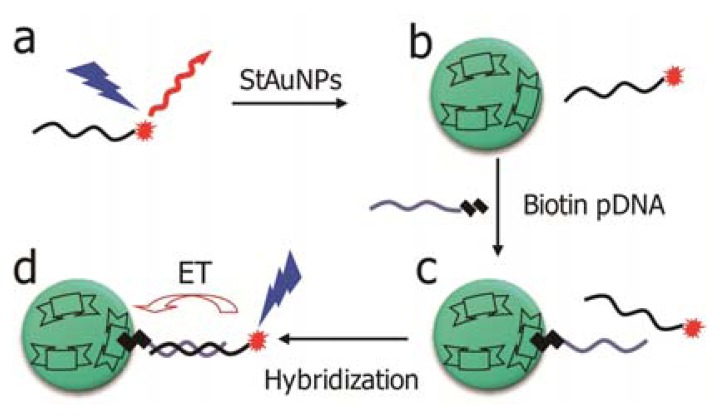
Schematic demonstration of DNA detection based on StAuNPs: (a) Cy5 labeled oligonucleotide targets (T1); (b) Mixture solution of T1 and StAuNPs; (c) The addition of biotin modified complementary biotin tagged probe oligonucleotide (pDNA); (d) With the hybridization, the energy transfer from Cy5 to AuNPs, resulting in subsequent energy quenching of Cy5.

(a) PL emission spectra of Cy5 and (b) UV-Vis absorption spectra of Cy5.
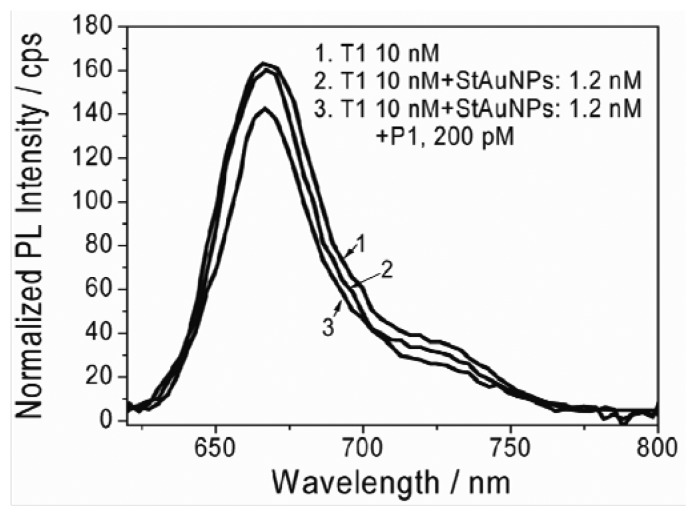
Changes in PL emission spectra of Cy5 after adding (1) T1; (2) 1.2 nM StAuNPs; (3) further 200 pM P1.
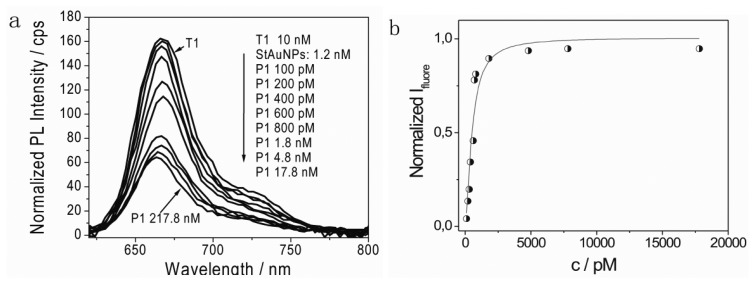
(a) Changes in PL emission spectra of Cy5 (T1) with varying P1 concentration from 100 pM to 17.8 nM. (b) The normalized fluorescence intensity vs. P1 concentration and the calculated KA (1.54 × 10⁹ L·mol−1) for P1 hybridization with T1 from concentration at ½ Ifluoremaxa.
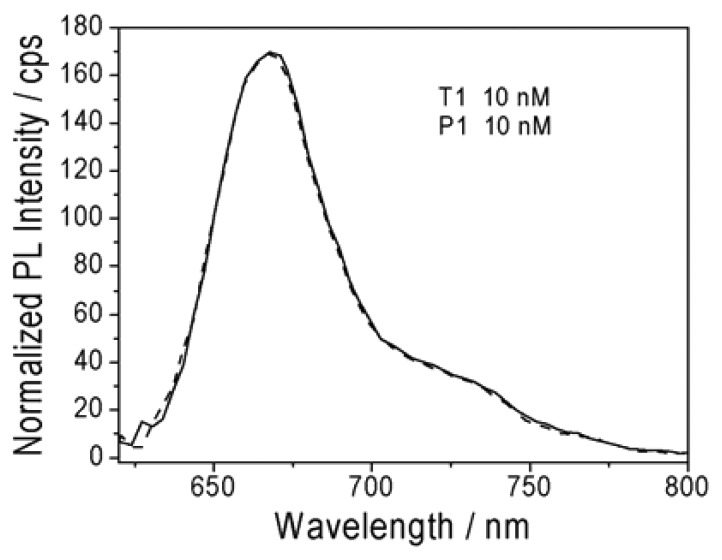
(1) PL emission spectra of Cy5. (2) Changes of PL emission spectra of solution after adding P1.
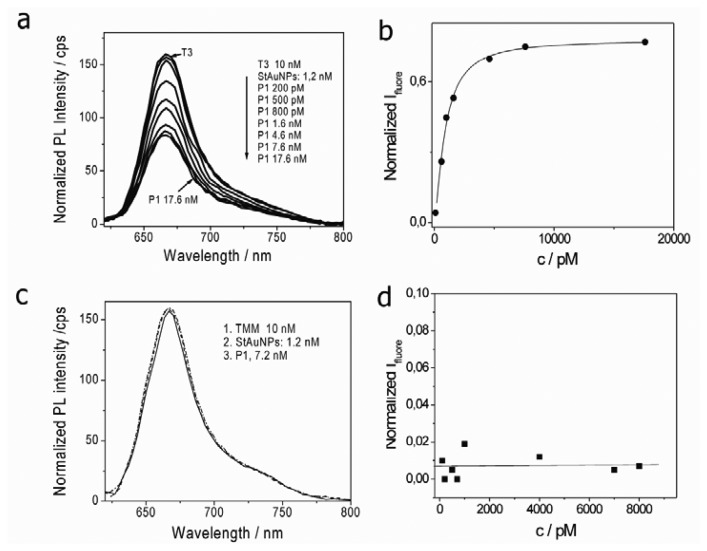
(a) Changes in PL emission spectra of Cy5 modified T3 with varying P1 concentration from 200 pM to 17.6 nM; (b) The normalized fluorescence intensity vs. P1 concentration and the calculated KA (7.8 × 10⁷ L·mol−1) from concentration at ½ Ifluoremaxa for hybridization with T3; (c) PL emission spectra of Cy5 modified TMM by adding 7.2 nM P1; (d) Fluorescence intensity of Cy5 modified TMM vs. P1 concentration.
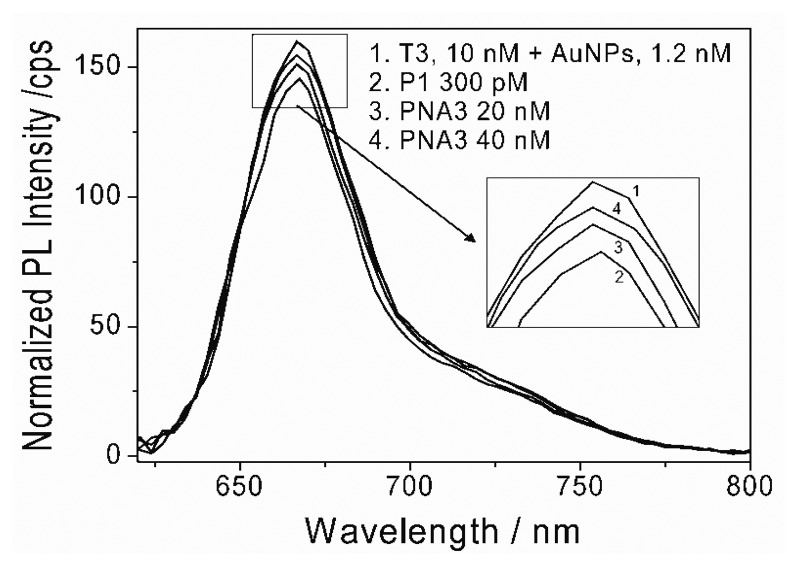
(1) PL emission spectra of T3 and StAuNPs mixture solution; Changes of PL emission spectra of solution after adding (2) 300 pM P1; (3) 20 nM PNA3; (4) 40 nM PNA3.
References
-
- Katz E., Willner I. Integrated nanoparticle-biomolecule hybrid systems: Synthesis, properties, and applications. Angew. Chem. Int. Ed. 2004;43:6042–6108. - PubMed
-
- Lu N., Pei H., Ge Z.L., Simmons C.R., Yan H., Fan C.H. Charge transport within a three-dimensional DNA nanostructure framework. J. Am. Chem. Soc. 2012;134:13148–13151. - PubMed
-
- Niemeyer C.M. Nanoparticles, proteins, and nucleic acids: Biotechnology meets materials science. Angew. Chem. Int. Ed. 2001;40:4128–4158. - PubMed
-
- Moirangthem R.S., Chang Y.C., Wei P.K. Investigation of surface plasmon biosensing using gold nanoparticles enhanced ellipsometry. Opt. Lett. 2011;36:775–777. - PubMed
-
- Liu M., Zhao H.M., Chen S., Yu H.T., Quan X. Interface engineering catalytic graphene for smart colorimetric biosensing. ACS Nano. 2012;6:3142–3151. - PubMed
Publication types
MeSH terms
Substances
LinkOut - more resources
Full Text Sources
Other Literature Sources
