


Screening for new primary cancers in cancer survivors compared to non-cancer controls: a systematic review and meta-analysis
- PMID: 23645522
- PMCID: PMC3734601
- DOI: 10.1007/s11764-013-0278-6
Screening for new primary cancers in cancer survivors compared to non-cancer controls: a systematic review and meta-analysis
Abstract
Purpose: The goal of this study was to synthesize evidence comparing cancer screening receipt between cancer survivors and non-cancer controls by conducting a systematic review and meta-analysis.
Methods: We searched PubMed, EMBASE, and CINAHL databases from inception through April 1, 2010 using search terms related to cancer, survivorship, and cancer screening. Studies were included if they reported a comparison of cancer screening receipt between cancer survivors and non-cancer controls. We performed a meta-analysis on the effect of cancer survivorship on breast, cervical, colorectal, and prostate cancer screening receipt.
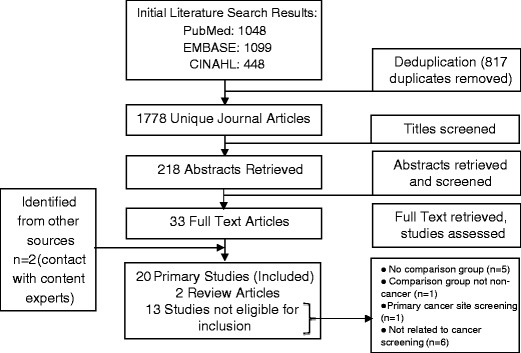
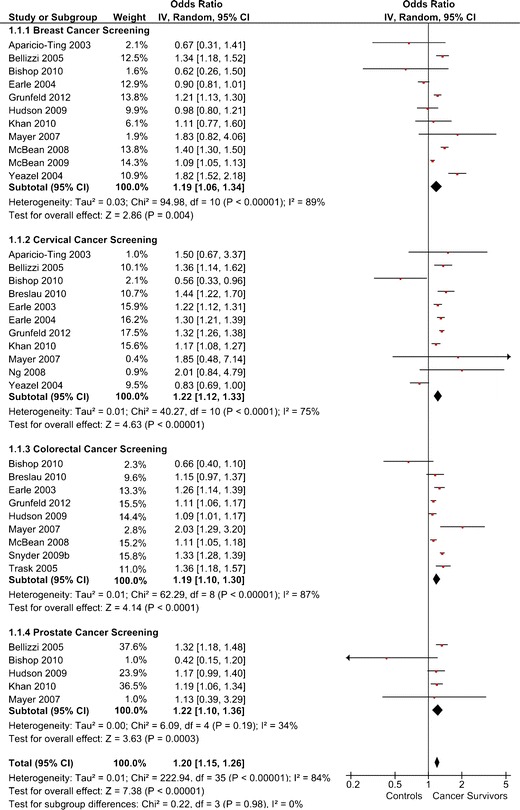
Results: Our search strategy identified 1,778 titles, of which 20 met our inclusion/exclusion criteria. In our meta-analyses, cancer survivors were more likely to be screened for breast, cervical, colorectal, and prostate cancer than non-cancer controls (pooled odds ratio, 1.27; 95 % CI, 1.19-1.36). We observed significant heterogeneity between studies, most of which remained unexplained after subgroup and sensitivity analyses. Important contextual factors, such as how screening programs operate, were not reported in the primary literature. Many cancer survivors (along with non-cancer controls) still did not receive cancer screening.
Conclusion: Compared with non-cancer controls, cancer survivors receive more frequent screening for new primary breast, cervical, colorectal, and prostate cancers. Future research should seek to determine whether increased uptake of cancer screening is associated with improved outcomes during cancer survivorship.
Implications for cancer survivors: Our systematic review and meta-analysis demonstrated that cancer survivors received more frequent screening for second primary breast, cervical, colorectal, and prostate cancers than non-cancer controls. As many cancer survivors are at an increased risk of developing a second primary cancer, future research should seek to determine whether this increased uptake of cancer screening in cancer survivors leads to improved outcomes during cancer survivorship.
Figures
References
-
- Lance Armstrong Foundation LIVESTRONG® Highlights Global Cancer Burden and the 28 Million Cancer Survivors Around the World. . Available from: http://www.marketwire.com/press-release/livestrongr-highlights-global-ca.... Accessed 20 May 2011.
-
- Hewitt ME, Greenfield S, Stovall E. From cancer patient to cancer survivor: lost in transition. Washington, DC: National Academies Press; 2006.
-
- Henderson TO, Amsterdam A, Bhatia S, Hudson MM, Meadows AT, Neglia JP, et al. Systematic review: surveillance for breast cancer in women treated with chest radiation for childhood, adolescent, or young adult cancer. Ann Intern Med. 2010;152:444–455. doi: 10.7326/0003-4819-152-7-201004060-00009. - DOI - PMC - PubMed
-
- Lee KD, Lu CH, Chen PT, Chan CH, Lin JT, Huang CE, et al. The incidence and risk of developing a second primary esophageal cancer in patients with oral and pharyngeal carcinoma: a population-based study in Taiwan over a 25 year period. BMC Cancer. 2009;9:373–383. doi: 10.1186/1471-2407-9-373. - DOI - PMC - PubMed
Publication types
MeSH terms
Grants and funding
LinkOut - more resources
Full Text Sources
Other Literature Sources
Research Materials
Miscellaneous
