


Return to play after thigh muscle injury in elite football players: implementation and validation of the Munich muscle injury classification
- PMID: 23645834
- PMCID: PMC3717808
- DOI: 10.1136/bjsports-2012-092092
Return to play after thigh muscle injury in elite football players: implementation and validation of the Munich muscle injury classification
Abstract
Background: Owing to the complexity and heterogeneity of muscle injuries, a generally accepted classification system is still lacking.
Aims: To prospectively implement and validate a novel muscle injury classification and to evaluate its predictive value for return to professional football.
Methods: The recently described Munich muscle injury classification was prospectively evaluated in 31 European professional male football teams during the 2011/2012 season. Thigh muscle injury types were recorded by team medical staff and correlated to individual player exposure and resultant time-loss.
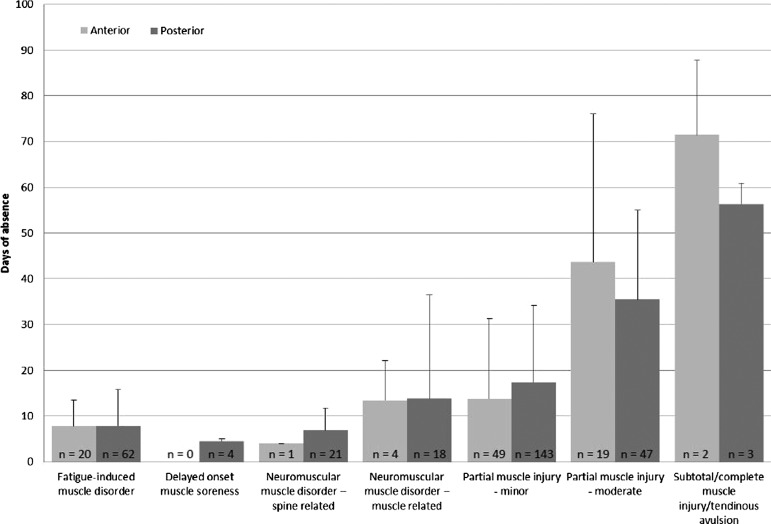
Results: In total, 393 thigh muscle injuries occurred. The muscle classification system was well received with a 100% response rate. Two-thirds of thigh muscle injuries were classified as structural and were associated with longer lay-off times compared to functional muscle disorders (p<0.001). Significant differences were observed between structural injury subgroups (minor partial, moderate partial and complete injuries) with increasing lay-off time associated with more severe structural injury. Median lay-off time of functional disorders was 5-8 days without significant differences between subgroups. There was no significant difference in the absence time between anterior and posterior thigh injuries.
Conclusions: The Munich muscle classification demonstrates a positive prognostic validity for return to play after thigh muscle injury in professional male football players. Structural injuries are associated with longer average lay-off times than functional muscle disorders. Subclassification of structural injuries correlates with return to play, while subgrouping of functional disorders shows less prognostic relevance. Functional disorders are often underestimated clinically and require further systematic study.
Keywords: Hamstring injuries; MRI; Muscle damage/injuries; Muscle injury and inflammation; Soccer.
Figures
References
-
- Ekstrand J, Hägglund M, Waldén M. Epidemiology of muscle injuries in professional football (soccer). Am J Sports Med 2011;39:1226–32 - PubMed
-
- Ekstrand J, Healy JC, Walden M, et al. Hamstring muscle injuries in professional football: the correlation of MRI findings with return to play. Br J Sports Med 2012;46:112–17 - PubMed
-
- Koulouris G, Connell D. Imaging of hamstring injuries: therapeutic implications. Eur Radiol 2006;16:1478–87 - PubMed
-
- Askling CM, Tengvar M, Saartok T, et al. Proximal hamstring strains of stretching type in different sports: injury situations, clinical and magnetic resonance imaging characteristics, and return to sport. Am J Sports Med 2008;36:1799–804 - PubMed
Publication types
MeSH terms
LinkOut - more resources
Full Text Sources
Other Literature Sources
Medical
