


Review
doi: 10.1182/blood-2013-03-456111.
Epub 2013 May 3.
Long noncoding RNAs in biology and hematopoiesis
Affiliations
- PMID: 23645840
- PMCID: PMC3682336
- DOI: 10.1182/blood-2013-03-456111
Item in Clipboard
Review
Long noncoding RNAs in biology and hematopoiesis
Blood.
.
Abstract
Genome and transcriptome sequencing have revealed a rich assortment of noncoding RNAs in eukaryote cells, including long noncoding RNAs (lncRNAs), which regulate gene expression independent of protein coding potential. LncRNAs modulate protein coding gene expression in many cell types by regulating multiple processes, including epigenetic control of transcription, mRNA stability, and protein localization. Although little is known about lncRNAs in hematopoiesis, they are likely to exert widespread roles in this process.
Figures
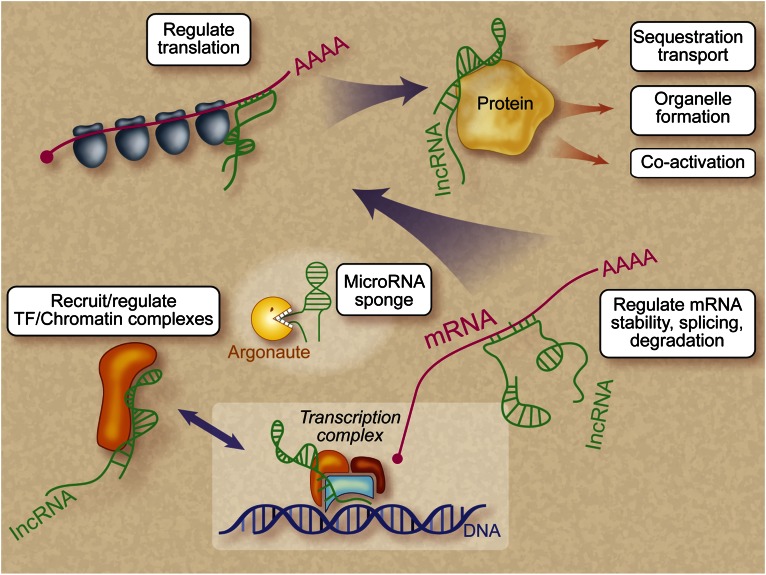
Mechanisms of LncRNA action. In numerous tissues, lncRNAs (indicated in green) have been shown to regulate gene expression at multiple levels: chromatin, transcription, mRNA, translation, and protein. Hematopoietic lncRNAs may act at any of these levels. “MicroRNA sponge” refers to the ability of lncRNAs to sequester cellular microRNAs and prevent them from binding mRNA targets. Professional illustration by Debra T. Dartez.

Potential functions for lncRNAs in normal and malignant hematopoiesis. (A) On the basis of their known activities in many cell types (Figure 1), lncRNAs may function during normal hematopoiesis to recruit transcription factors, coactivators, and activating chromatin factors to lineage-specific genes, thereby modulating gene expression to facilitate the differentiation and maturation of blood lineages. LncRNAs are indicated in green. (B) Absence or inappropriate expression of relevant lncRNAs could alter transcription to block normal differentiation and activate leukemic pathways. (C) Hematological malignancy subtypes may express distinct lncRNA expression profiles that reflect cell type of origin, mechanism of transformation, treatment sensitivities, and prognosis. Professional illustration by Debra T. Dartez.
References
-
- Lander ES, Linton LM, Birren B, et al. International Human Genome Sequencing Consortium. Initial sequencing and analysis of the human genome. Nature. 2001;409(6822):860–921. - PubMed
-
- Carninci P, Kasukawa T, Katayama S, et al. FANTOM Consortium; RIKEN Genome Exploration Research Group and Genome Science Group (Genome Network Project Core Group) The transcriptional landscape of the mammalian genome. Science. 2005;309(5740):1559–1563. - PubMed
-
- O’Connell RM, Baltimore D. MicroRNAs and hematopoietic cell development. Curr Top Dev Biol. 2012;99:145–174. - PubMed
Publication types
MeSH terms
Substances
Grants and funding
LinkOut - more resources
Full Text Sources
Other Literature Sources
