Intergroup relations and health disparities: a social psychological perspective
- PMID: 23646834
- PMCID: PMC3988903
- DOI: 10.1037/a0030358
Intergroup relations and health disparities: a social psychological perspective
Abstract
Objective: This article considers how the social psychology of intergroup processes helps to explain the presence and persistence of health disparities between members of socially advantaged and disadvantaged groups.
Method: Social psychological theory and research on intergroup relations, including prejudice, discrimination, stereotyping, stigma, prejudice concerns, social identity threat, and the dynamics of intergroup interactions, is reviewed and applied to understand group disparities in health and health care. Potential directions for future research are considered.
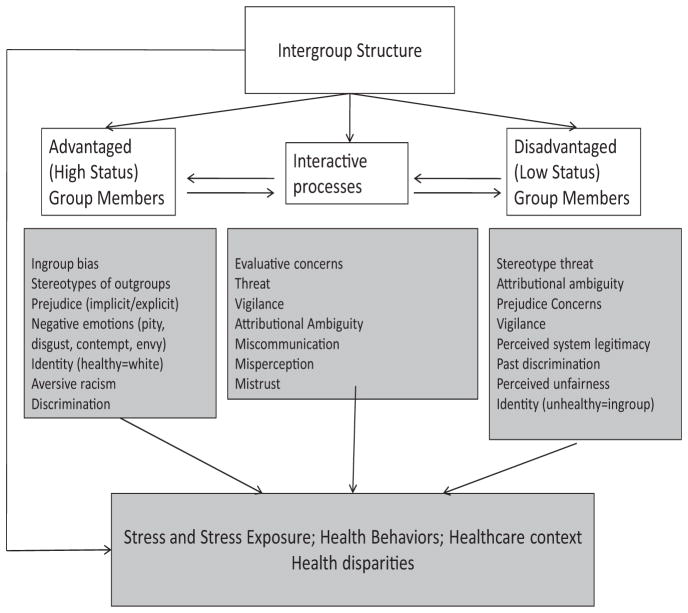
Results: Key features of group relations and dynamics, including social categorization, social hierarchy, and the structural positions of groups along dimensions of perceived warmth and competence, influence how members of high status groups perceive, feel about, and behave toward members of low status groups, how members of low status groups construe and cope with their situation, and how members of high and low status groups interact with each other. These intergroup processes, in turn, contribute to health disparities by leading to differential exposure to and experiences of chronic and acute stress, different health behaviors, and different quality of health care experienced by members of advantaged and disadvantaged groups. Within each of these pathways, social psychological theory and research identifies mediating mechanisms, moderating factors, and individual differences that can affect health.
Conclusions: A social psychological perspective illuminates the intergroup, interpersonal, and intrapersonal processes by which structural circumstances which differ between groups for historical, political, and economic reasons can lead to group differences in health.
PsycINFO Database Record (c) 2013 APA, all rights reserved.
Figures
References
-
- Ambady N, Weisbuch W. Nonverbal behavior. In: Fiske ST, Gilbert DT, Lindzey G, editors. Handbook of social psychology. 5. Vol. 1. Hoboken, NJ: Wiley; 2010. pp. 464–497.
-
- American Medical Association/NHMA/NMA Commission to End Health Care Disparities. Preliminary survey brief: Physicians are becoming engaged to address health disparities. 2005 Retrieved from http://www.ama-assn.org/ama/pub/physician-resources/public-health/elimin....
-
- Blascovich J, Mendes WB. Social psychophysiology and embodiment. In: Fiske ST, Gilbert DT, Lindzey G, editors. Handbook of social psychology. 5. Vol. 1. Hoboken, NJ: Wiley; 2010. pp. 194–227.
Publication types
MeSH terms
Grants and funding
LinkOut - more resources
Full Text Sources
Other Literature Sources
Medical