


The role of acidemia in maternal binge alcohol-induced alterations in fetal bone functional properties
- PMID: 23647364
- PMCID: PMC4183459
- DOI: 10.1111/acer.12118
The role of acidemia in maternal binge alcohol-induced alterations in fetal bone functional properties
Abstract
Background: Heavy alcohol consumption during pregnancy negatively impacts the physical growth of the fetus. Although the deleterious effects of alcohol exposure during late gestation on fetal brain development are well documented, little is known about the effect on fetal bone mechanical properties or the underlying mechanisms. The purpose of this study was to investigate the effects of late gestational chronic binge alcohol consumption and alcohol-induced acidemia, a critical regulator of bone health, on functional properties of the fetal skeletal system.
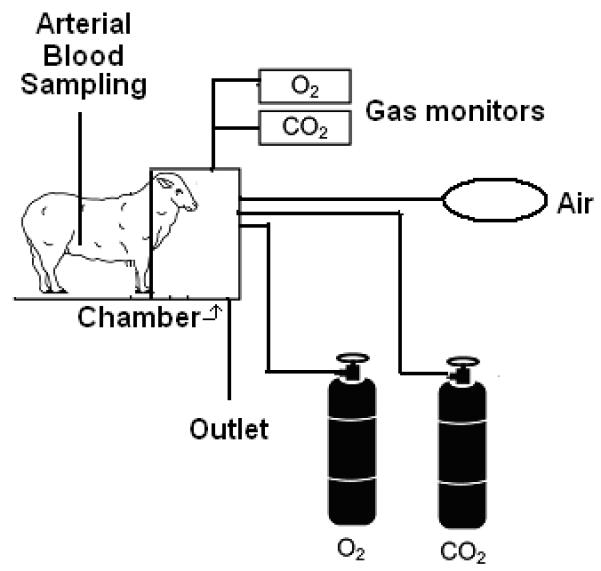
Methods: Suffolk ewes were mated and received intravenous infusions of saline or alcohol (1.75 g/kg) over 1 hour on 3 consecutive days per week followed by 4 days without treatment beginning on gestational day (GD) 109 and concluding on GD 132 (term = 147 days). The acidemia group was exposed to increased inspired fractional concentrations of CO2 to closely mimic the alcohol-induced decreases in maternal arterial pH seen in the alcohol group.
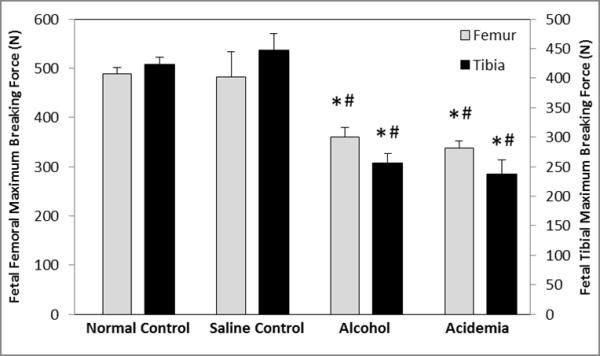
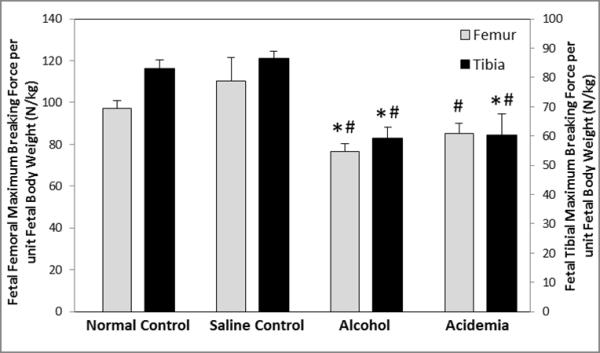
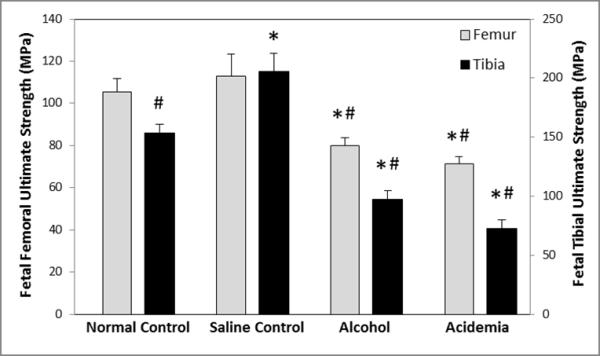
Results: Fetal femurs and tibias from the alcohol and acidemia groups were ~3 to 7% shorter in length compared with the control groups (p < 0.05). Three-point bending procedure demonstrated that fetal femoral ultimate strength (MPa) for the alcohol group was decreased (p < 0.05) by ~24 and 29%, while the acidemia group exhibited a similar decrease (p < 0.05) of ~32 and 37% compared with the normal control and saline control groups, respectively. Bone extrinsic and intrinsic mechanical properties including maximum breaking force (N) and normalized breaking force (N/kg) of fetal bones from the alcohol and acidemia groups were significantly decreased (p < 0.05) compared with both control groups.
Conclusions: We conclude that late gestational chronic binge alcohol exposure reduces growth and impairs functional properties of the fetal skeletal system and that the repeated episodes of alcohol-induced maternal acidemia may be at least partially responsible for these effects.
Keywords: Acidemia; Bone Strength; Fetal Alcohol Spectrum Disorder; Pregnancy; Teratogenicity.
Copyright © 2013 by the Research Society on Alcoholism.
Figures
References
-
- Abel EL. Prenatal effects of alcohol. Drug Alcohol Depend. 1984;14:1–10. - PubMed
-
- Abel EL, Dintcheff BA. Effects of prenatal alcohol exposure on growth and development in rats. J Pharmacol Exp Ther. 1978;207:916–921. - PubMed
-
- Arnett T. Regulation of bone cell function by acid-base balance. Proc Nutr Soc. 2003;62:511–520. - PubMed
-
- Arnett TR, Spowage M. Modulation of the resorptive activity of rat osteoclasts by small changes in extracellular pH near the physiological range. Bone. 1996;18:277–279. - PubMed
-
- Barzel US. The skeleton as an ion exchange system: implications for the role of acid-base imbalance in the genesis of osteoporosis. J Bone Miner Res. 1995;10:1431–1436. - PubMed
Publication types
MeSH terms
Substances
Grants and funding
LinkOut - more resources
Full Text Sources
Other Literature Sources
Medical
