


Association of clinical parameters of operatively treated thoracolumbar fractures with quality of life parameters
- PMID: 23649956
- PMCID: PMC3804682
- DOI: 10.1007/s00586-013-2799-0
Association of clinical parameters of operatively treated thoracolumbar fractures with quality of life parameters
Abstract
Purpose: The intention of the current work was to assess the association between clinical parameters and seven different quality of life (QoL) instruments after surgical treatment of thoracolumbar spinal fractures after an average follow-up of 4.2 years.
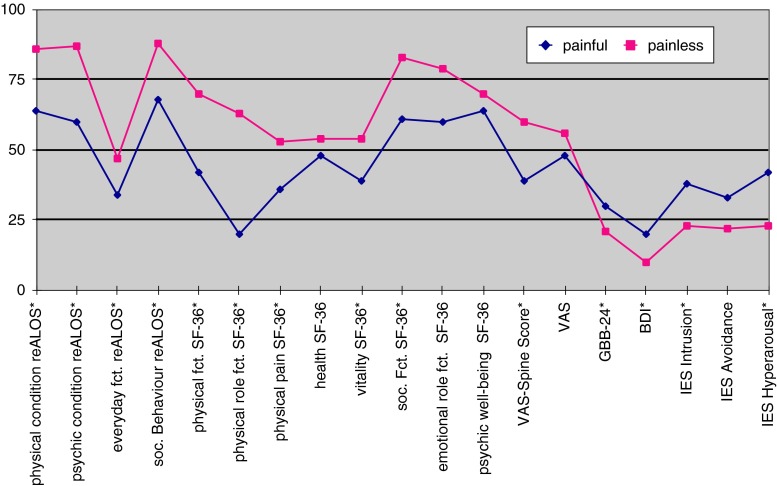
Methods: The following human-related quality of life and PRO measures of 66 patients were correlated to clinical parameters such as fingertip-to-floor distance (FFD), Schober measurement, pressure and percussion pain in the lumbopelvine area (PPP), and paravertebral muscle tension: reALOS, SF-36, VAS, VAS spine score, BDI, the GBB-24, and the IES-R.
Results: Overall, there was a significant association between the clinical parameters of the thoracolumbar spine such as PPP, paravertebral muscle tension, FFD and Schober's sign on one side, and the seven tested instruments on the other side.
Conclusions: PPP and FFD as well as a small Schober measurement are clinical parameters which significantly influence QoL after surgical treatment of thoracolumbar fractures.
Figures



References
-
- Briem D, Meenen NM, Linhart W, Burchard A, Lehmann W, Rueger JM (2000) Dorsale Stabilisierung von Frakturen des thorakolumbalen šberganges. Follow-up-Analyse und Vergleich mit konkurrierenden Methoden. Osteosynthese International, Suppl 1, S215–S216
MeSH terms
LinkOut - more resources
Full Text Sources
Other Literature Sources
Medical
