


A comparison of D2 receptor specific binding in obese and normal-weight individuals using PET with (N-[(11)C]methyl)benperidol
- PMID: 23650017
- PMCID: PMC3778147
- DOI: 10.1002/syn.21680
A comparison of D2 receptor specific binding in obese and normal-weight individuals using PET with (N-[(11)C]methyl)benperidol
Abstract
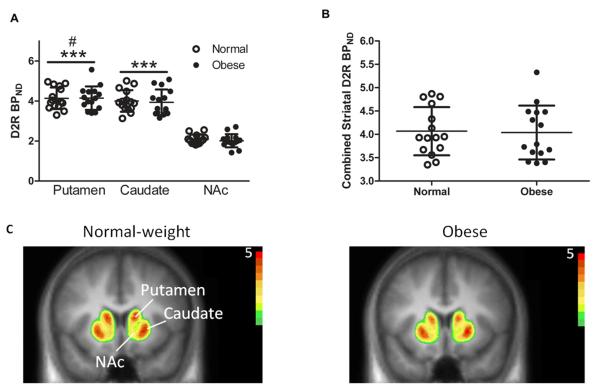
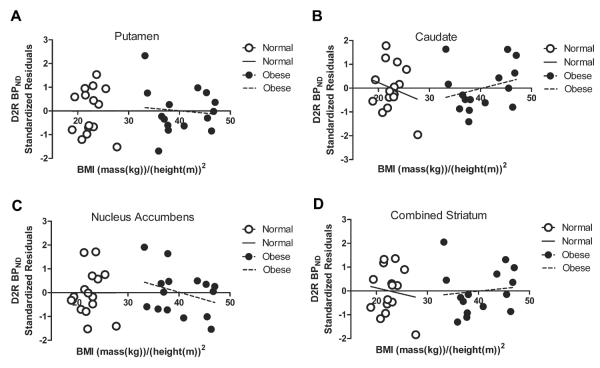
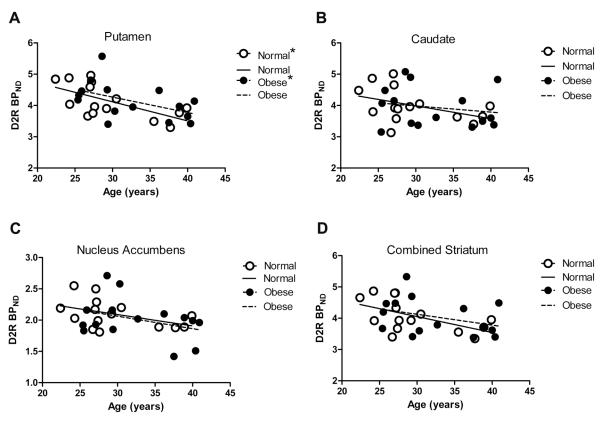
Previous PET imaging studies have demonstrated mixed findings regarding dopamine D2/D3 receptor availability in obese relative to nonobese humans. Nonspecific D2/D3 radioligands do not allow for separate estimation of D2 receptor (D2R) and D3 receptor (D3R) subtypes of the D2 receptor family, which may play different roles in behavior and are distributed differently throughout the brain. These radioligands are also displaceable by endogenous dopamine, confounding interpretation of differences in receptor availability with differing levels of dopamine release. The present study used PET imaging with the D2R-selective radioligand (N-[(11)C] methyl)benperidol ([(11)C]NMB), which is nondisplaceable by endogenous dopamine, to estimate D2R specific binding (BPND) and its relationship to body mass index (BMI) and age in 15 normal-weight (mean BMI = 22.6 kg/m(2)) and 15 obese (mean BMI = 40.3 kg/m(2)) men and women. Subjects with illnesses or taking medications that interfere with dopamine signaling were excluded. Striatal D2R BPND was calculated using the Logan graphical method with cerebellum as a reference region. D2R BPND estimates were higher in putamen and caudate relative to nucleus accumbens, but did not differ between normal-weight and obese groups. BMI values did not correlate with D2R BPND . Age was negatively correlated with putamen D2R BPND in both groups. These results suggest that altered D2R specific binding is not involved in the pathogenesis of obesity per se and underscore the need for additional studies evaluating the relationship between D3R, dopamine reuptake, or endogenous dopamine release and human obesity.
Keywords: NMB; dopamine; obesity.
Copyright © 2013 Wiley Periodicals, Inc.
Figures
References
-
- Antonini A, Leenders KL. Dopamine D2 receptors in normal human brain: Effect of age measured by positron emission tomography (PET) and [11C]-raclopride. Ann NY Acad Sci. 1993;695:81–85. - PubMed
-
- Arnett CD, Shiue CY, Wolf AP, Fowler JS, Logan J, Watanabe M. Comparison of three 18F-labeled butyrophenone neuroleptic drugs in the baboon using positron emission tomography. J Neurochem. 1985;44:835–844. - PubMed
-
- Beaulieu JM, Gainetdinov RR. The physiology, signaling, and pharmacology of dopamine receptors. Pharmacol Rev. 2011;63:182–217. - PubMed
Publication types
MeSH terms
Substances
Grants and funding
- R21 MH098670/MH/NIMH NIH HHS/United States
- DK 37948/DK/NIDDK NIH HHS/United States
- NS058714/NS/NINDS NIH HHS/United States
- P30 DK056341/DK/NIDDK NIH HHS/United States
- R01 NS075321/NS/NINDS NIH HHS/United States
- R01 DK085575/DK/NIDDK NIH HHS/United States
- R01 NS041509/NS/NINDS NIH HHS/United States
- NS41509/NS/NINDS NIH HHS/United States
- T32 DA007261/DA/NIDA NIH HHS/United States
- UL1 TR000448/TR/NCATS NIH HHS/United States
- P30 DK020579/DK/NIDDK NIH HHS/United States
- R01 DK037948/DK/NIDDK NIH HHS/United States
- R01 DK085575-03/DK/NIDDK NIH HHS/United States
- DA007261/DA/NIDA NIH HHS/United States
- RF1 NS075321/NS/NINDS NIH HHS/United States
- K24 MH087913/MH/NIMH NIH HHS/United States
- NS075321/NS/NINDS NIH HHS/United States
- DK 56341/DK/NIDDK NIH HHS/United States
- R01 NS058714/NS/NINDS NIH HHS/United States
LinkOut - more resources
Full Text Sources
Other Literature Sources
Medical