. 2013 May 21;110(21):8453-8.
doi: 10.1073/pnas.1300341110. Epub 2013 May 6.

Persistence and origin of the lunar core dynamo

Affiliations

Persistence and origin of the lunar core dynamo

Clément Suavet et al. Proc Natl Acad Sci U S A. .

Abstract

The lifetime of the ancient lunar core dynamo has implications for its power source and the mechanism of field generation. Here, we report analyses of two 3.56-Gy-old mare basalts demonstrating that they were magnetized in a stable and surprisingly intense dynamo magnetic field of at least ~13 μT. These data extend the known lifetime of the lunar dynamo by ~160 My and indicate that the field was likely continuously active until well after the final large basin-forming impact. This likely excludes impact-driven changes in rotation rate as the source of the dynamo at this time in lunar history. Rather, our results require a persistent power source like precession of the lunar mantle or a compositional convection dynamo.

Keywords: high-K mare basalts; paleomagnetism.


Conflict of interest statement

The authors declare no conflict of interest.

Figures
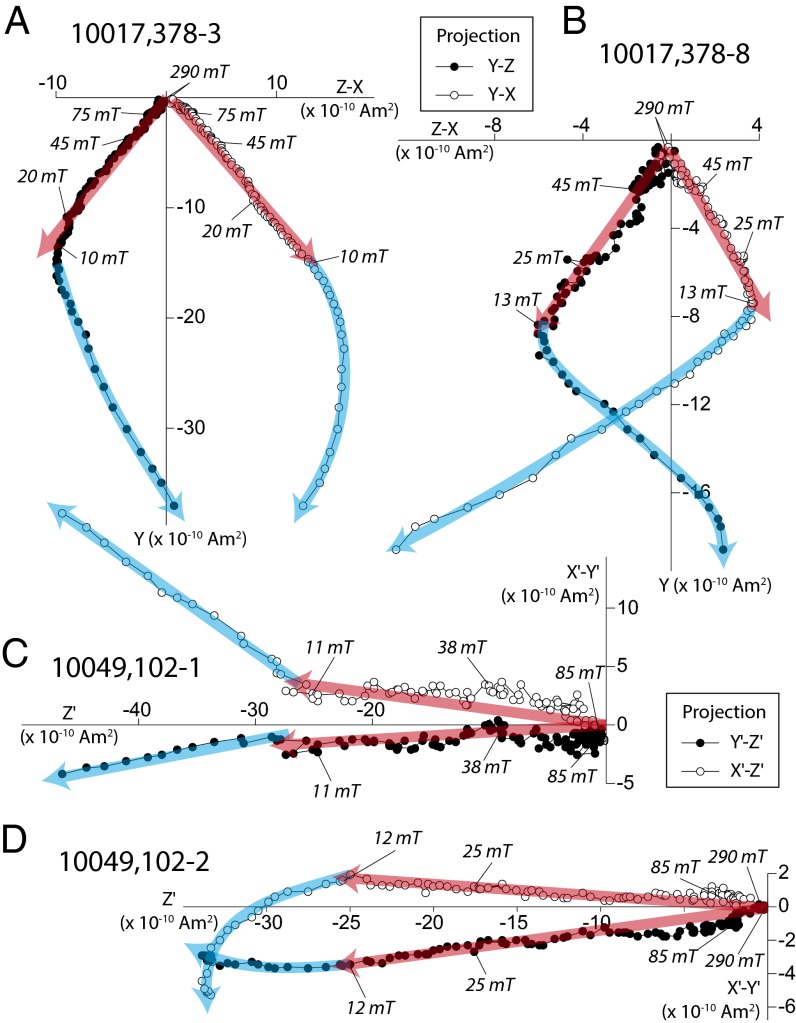
Fig. 1.
Fig. 1.
NRM in mare basalts 10017 and 10049. Shown is a 2D projection of the NRM vectors of subsamples 10017,378-3; 10017,378-8; 10049,102-1; and 10049,102-2 during AF demagnetization. Solid (●) [open (○)] circles represent end points of magnetization projected onto the YZ (XY) planes for 10017 and onto the Y′–Z′ (X′–Z′) planes for 10049. Peak fields for selected AF steps are labeled in microteslas. Red arrows denote HC component directions determined from principal component analyses. Subsample 10017,378-3 (A); subsample 10017,378-8 (B); subsample 10049,102-1 (C); and subsample 10049,102-2 (D).
Fig. 2.
Fig. 2.
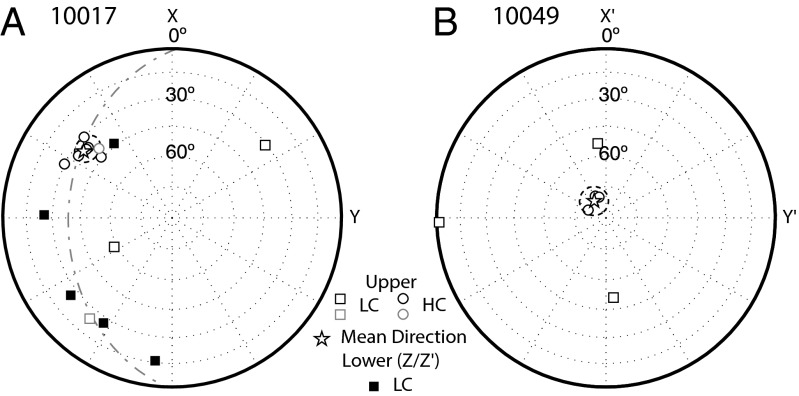
Equal area stereographic projection of NRM component fits. Circles denote HC directions (primary magnetization) for each subsample, and squares denote LC directions (overprint). The stars are the Fisher mean HC direction from principal component analyses, with surrounding dashed ellipses indicating 95% formal confidence intervals on mean directions (not accounting for additional ∼3–5° mutual orientation uncertainty). (A) Sample 10017,378. Black and gray symbols correspond to samples measured at the Massachusetts Institute of Technology and University of California, Santa Cruz, respectively. The dashed great circle denotes a circle fit forced through the origin for the HC data of subsample 10. (B) Sample 10049,102.
Fig. 3.
Fig. 3.
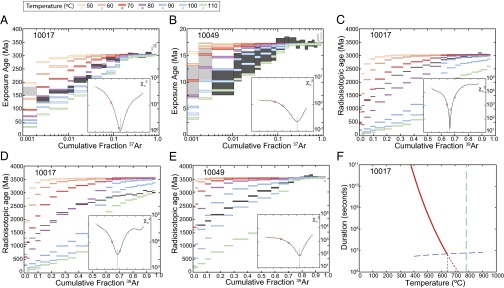
Radiogenic 40Ar and cosmogenic 38Ar thermochronometry of whole-rock mare basalts 10017 and 10049. Production and diffusion of 38Arcos for 10017 (A) and 10049 (B). The observed exposure ages ± 1 SD (gray boxes) are plotted against the cumulative release fraction of 37Ar. 38Arcos was produced in situ while the rocks were exposed at the surface of the Moon. The colored steps are model release spectra calculated using the multiphase, multidomain model (model parameters are provided in SI Appendix) for the production and diffusion of 38Arcos, assuming the rocks were subjected to various constant effective daytime temperatures ranging from 50 to 110 °C during the last 303.1 Ma for 10017 or during the last 17.2 Ma for 10049 (i.e., 38Arcos is produced continuously over this duration, whereas diffusion occurs only over half of this period during elevated daytime temperatures). (Insets) Reduced χ2 fit statistic for each model, identifying ∼80 °C as the best-fit effective mean temperature for 10017 and ∼95 °C as that for 10049. The diffusion of 40Ar* due to solar heating for 10017 is shown, calculated assuming the K/Ar system was reset at 3.03 Ga (C) or 3.56 Ga (D) (symbols and model parameters are the same as in A). (E) Diffusion of 40Ar* due to solar heating, calculated assuming the crystallization age is 3.56 Ga (symbols and model parameters are the same as in B). (F) Duration-temperature conditions required to cause >95% loss of 40Ar* from the most retentive plagioclase domains in 10017 during the proposed 3.0-Ga thermal event (red curve). The dashed blue curve predicts the time required to cool diffusively from an initial temperature, T, to <100 °C in the center of a 6-m-thick ejecta blanket. The intersection of this curve with the solid curve gives the peak temperature that would explain the Ar data under this scenario. The green dashed line represents the Curie temperature of kamacite (780 °C).
Fig. 4.
Fig. 4.
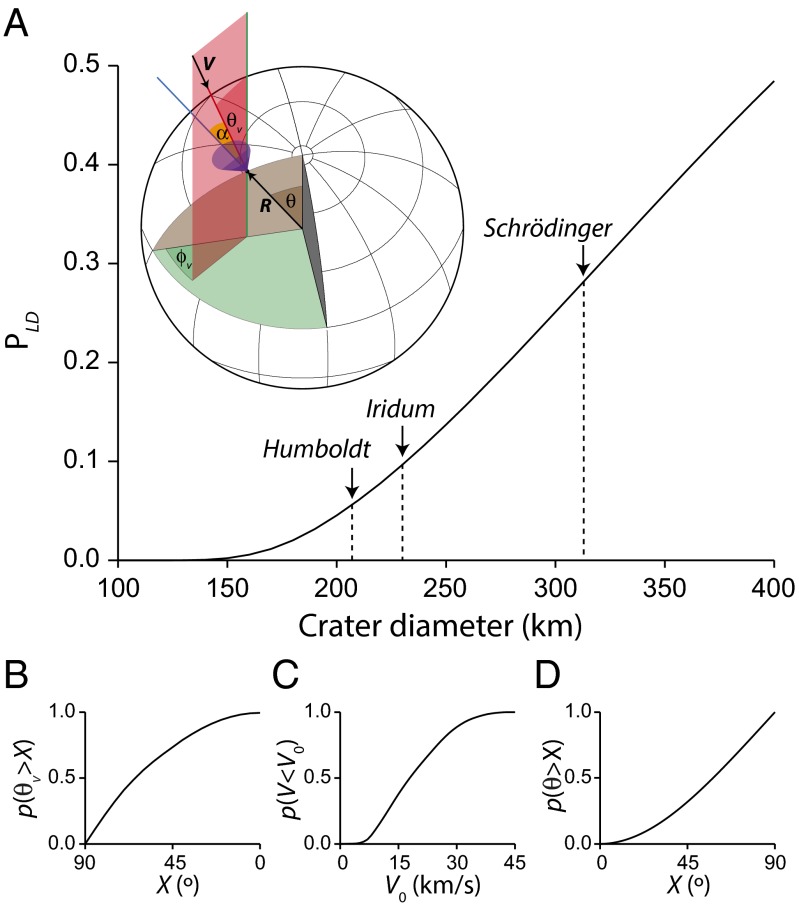
(A) Probability to have induced a libration dynamo as a function of crater diameter. The diameters of the Late Imbrian crater Humboldt and Early Imbrian craters Iridum and Schrödinger are shown. (Inset) Impact geometry. The red line is the impact trajectory; the red surface is the plane defined by the impact trajectory and a line parallel to the lunar spin axis at the impact location. The blue line is the local vertical. The purple cone represents trajectories with α > 80°. (B) Cumulative probability distribution for the inclination of the impact trajectory, θv (45). (C) Cumulative probability distribution for the impact velocity, V (37). (D) Cumulative probability distribution for the impact location colatitude, θ (45).

References

    1. Fuller M, Cisowski SM. Lunar paleomagnetism. In: Jacobs JA, editor. Geomagnetism. Orlando, FL: Academic; 1987. pp. 307–455. Vol 2.
    1. Wieczorek MA, et al. The constitution and structure of the lunar interior. Reviews in Mineralogy and Geochemistry. 2006;60:221–364.
    1. Williams JG, Turyshev SG, Boggs DH, Ratcliff JT. Lunar laser ranging science: Gravitational physics and lunar interior and geodesy. Adv Space Res. 2006;37(1):67–71.
    1. Weber RC, Lin P-Y, Garnero EJ, Williams Q, Lognonné P. Seismic detection of the lunar core. Science. 2011;331(6015):309–312. - PubMed
    1. Garcia RF, Gagnepain-Beyneix J, Chevrot S, Lognonné P. Very preliminary reference Moon model. Physics of the Earth and Planetary Interiors. 2011;188(1–2):96–113.

Publication types

LinkOut - more resources