


Genetic mediators of neurocognitive outcomes in survivors of childhood acute lymphoblastic leukemia
- PMID: 23650422
- PMCID: PMC3731978
- DOI: 10.1200/JCO.2012.46.7944
Genetic mediators of neurocognitive outcomes in survivors of childhood acute lymphoblastic leukemia
Abstract
Purpose: Survivors of childhood acute lymphoblastic leukemia (ALL) are at increased risk for neurocognitive problems, with significant interindividual variability in outcome. This study examined genetic polymorphisms associated with variability in neurocognitive outcome.
Patients and methods: Neurocognitive outcomes were evaluated at the end of therapy in 243 survivors treated on an institutional protocol featuring risk-adapted chemotherapy without prophylactic cranial irradiation. Polymorphisms in genes related to pharmacokinetics or pharmacodynamics of antileukemic agents, drug metabolism, oxidative stress, and attention problems in noncancer populations were examined as predictors of outcome, using multiple general linear models and controlling for age at diagnosis, sex, race, and treatment intensity.
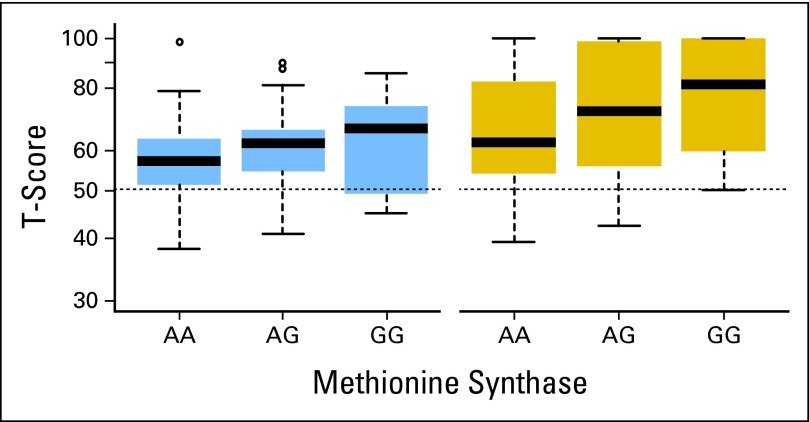
Results: Compared with national norms, the cohort demonstrated significantly higher rates of problems on direct assessment of sustained attention (P = .01) and on parent ratings of attention problems (P = .02). Children with the A2756G polymorphism in methionine synthase (MS) were more likely to demonstrate deficits in attentiveness (P = .03) and response speed (P = .02), whereas those with various polymorphisms in glutathione S-transferase demonstrated increased performance variability (P = .01) and reduced attentiveness (P = .003). Polymorphisms in monoamine oxidase (T1460CA) were associated with increased attention variability (P = .03). Parent-reported attention problems were more common in children with the Cys112Arg polymorphism in apoliopoprotein E4 (P = .01).
Conclusion: These results are consistent with our previous report of association between attention problems and MS in an independent cohort of long-term survivors of childhood ALL treated with chemotherapy only. The results also raise the possibility of an impact from genetic predispositions related to oxidative stress and CNS integrity.
Conflict of interest statement
Authors' disclosures of potential conflicts of interest and author contributions are found at the end of this article.
Figures
References
-
- Krull KR, Okcu MF, Potter B, et al. Screening for neurocognitive impairment in pediatric cancer long-term survivors. J Clin Oncol. 2008;26:4138–4143. - PubMed
-
- Kadan-Lottick NS, Brouwers P, Breiger D, et al. Comparison of neurocognitive functioning in children previously randomly assigned to intrathecal methotrexate compared with triple intrathecal therapy for the treatment of childhood acute lymphoblastic leukemia. J Clin Oncol. 2009;27:5986–5992. - PMC - PubMed
-
- Jain N, Brouwers P, Okcu MF, et al. Sex-specific attention problems in long-term survivors of pediatric acute lymphoblastic leukemia. Cancer. 2009;115:4238–4245. - PubMed
Publication types
MeSH terms
Grants and funding
LinkOut - more resources
Full Text Sources
Other Literature Sources
Medical
