


Comparative transcriptome analysis to investigate the high starch accumulation of duckweed (Landoltia punctata) under nutrient starvation
- PMID: 23651472
- PMCID: PMC3654882
- DOI: 10.1186/1754-6834-6-72
Comparative transcriptome analysis to investigate the high starch accumulation of duckweed (Landoltia punctata) under nutrient starvation
Abstract
Background: Duckweed can thrive on anthropogenic wastewater and produce tremendous biomass production. Due to its relatively high starch and low lignin percentage, duckweed is a good candidate for bioethanol fermentation. Previous studies have observed that water devoid of nutrients is good for starch accumulation, but its molecular mechanism remains unrevealed.
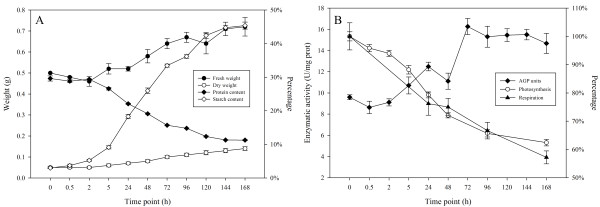
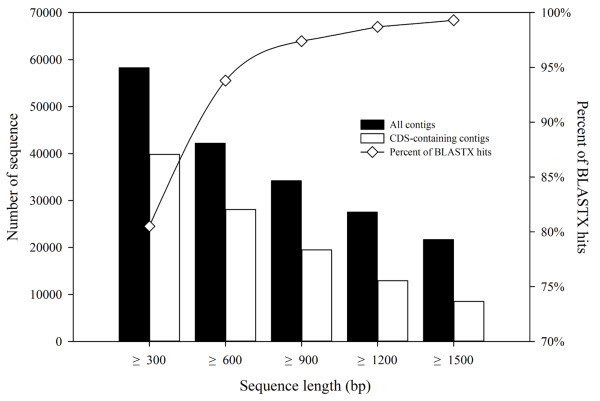
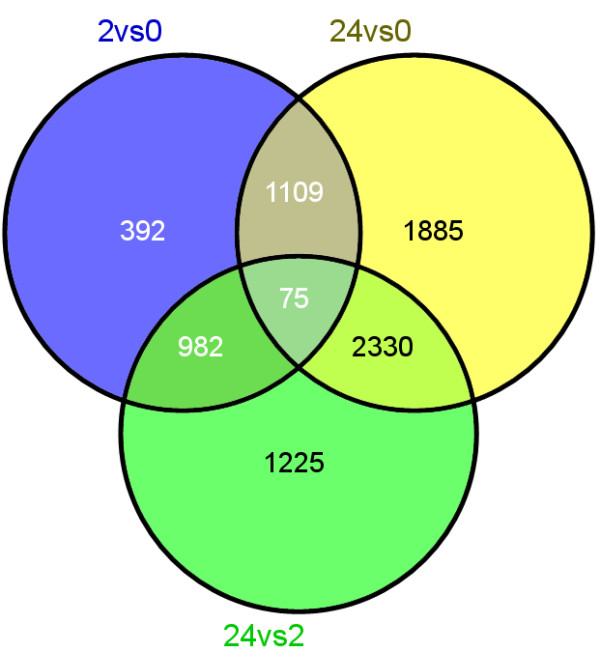
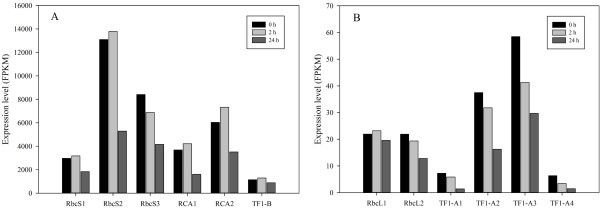
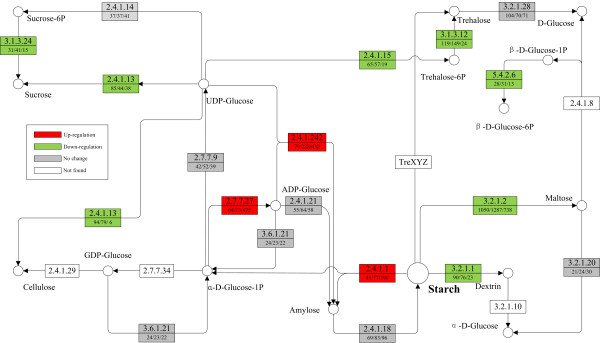
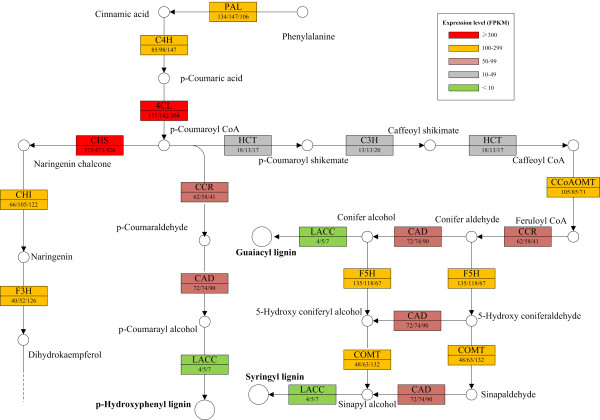
Results: This study globally analyzed the response to nutrient starvation in order to investigate the starch accumulation in duckweed (Landoltia punctata). L. punctata was transferred from nutrient-rich solution to distilled water and sampled at different time points. Physiological measurements demonstrated that the activity of ADP-glucose pyrophosphorylase, the key enzyme of starch synthesis, as well as the starch percentage in duckweed, increased continuously under nutrient starvation. Samples collected at 0 h, 2 h and 24 h time points respectively were used for comparative gene expression analysis using RNA-Seq. A comprehensive transcriptome, comprising of 74,797 contigs, was constructed by a de novo assembly of the RNA-Seq reads. Gene expression profiling results showed that the expression of some transcripts encoding key enzymes involved in starch biosynthesis was up-regulated, while the expression of transcripts encoding enzymes involved in starch consumption were down-regulated, the expression of some photosynthesis-related transcripts were down-regulated during the first 24 h, and the expression of some transporter transcripts were up-regulated within the first 2 h. Very interestingly, most transcripts encoding key enzymes involved in flavonoid biosynthesis were highly expressed regardless of starvation, while transcripts encoding laccase, the last rate-limiting enzyme of lignifications, exhibited very low expression abundance in all three samples.
Conclusion: Our study provides a comprehensive expression profiling of L. punctata under nutrient starvation, which indicates that nutrient starvation down-regulated the global metabolic status, redirects metabolic flux of fixed CO2 into starch synthesis branch resulting in starch accumulation in L. punctata.
Figures
References
-
- Zhang LA, Chen QA, Jin YL, Xue HL, Guan JF, Wang ZY, Zhao H. Energy-saving direct ethanol production from viscosity reduction mash of sweet potato at very high gravity (VHG) Fuel Process Technol. 2010;91:1845–1850. doi: 10.1016/j.fuproc.2010.08.009. - DOI
-
- Ge LL, Wang P, Mou HJ. Study on saccharification techniques of seaweed wastes for the transformation of ethanol. Renew Energ. 2011;36:84–89. doi: 10.1016/j.renene.2010.06.001. - DOI
-
- Crutzen P, Mosier A, Smith K, Winiwarter W. N2O release from agro-biofuel production negates global warming reduction by replacing fossil fuels. Atmos Chem Phys. 2007;7:11191–11205. doi: 10.5194/acpd-7-11191-2007. - DOI
LinkOut - more resources
Full Text Sources
Other Literature Sources
Molecular Biology Databases
