. 2013 May 1;27(9):991-6.
doi: 10.1101/gad.211243.112.

The DEAH-box helicase DHX36 mediates dendritic localization of the neuronal precursor-microRNA-134

Affiliations

The DEAH-box helicase DHX36 mediates dendritic localization of the neuronal precursor-microRNA-134

Silvia Bicker et al. Genes Dev. .

Erratum in

  • Genes Dev. 2013 Jul 15;27(14):1633

Abstract

Specific microRNAs (miRNAs), including miR-134, localize to neuronal dendrites, where they control synaptic protein synthesis and plasticity. However, the mechanism of miRNA transport is unknown. We found that the neuronal precursor-miRNA-134 (pre-miR-134) accumulates in dendrites of hippocampal neurons and at synapses in vivo. Dendritic localization of pre-miR-134 is mediated by the DEAH-box helicase DHX36, which directly associates with the pre-miR-134 terminal loop. DHX36 function is required for miR-134-dependent inhibition of target gene expression and the control of dendritic spine size. Dendritically localized pre-miR-134 could provide a local source of miR-134 that can be mobilized in an activity-dependent manner during plasticity.

Keywords: DHX36; dendritic transport; precursor-microRNA; protein synthesis; synaptic plasticity.


Figures
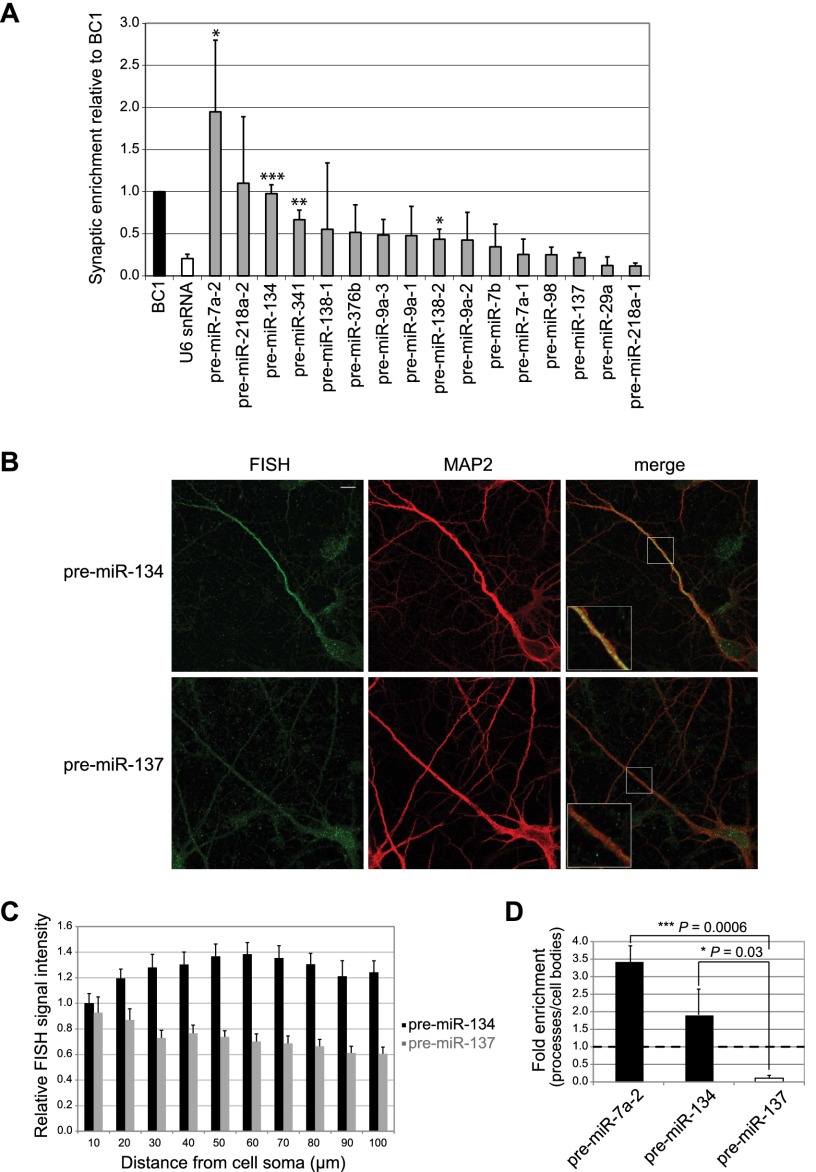
Figure 1.
Figure 1.
pre-miR-134 localizes to neuronal dendrites and synapses. (A) Levels of the indicated pre-miRNAs, BC1, and U6 snRNA in rat postnatal day 15 (P15) synaptosomes relative to whole forebrain measured by qRT–PCR (mean ± SD, n = 3). (*) P < 0.05; (**) P < 0.01; (***) P < 0.001). BC1 was set to one. (B, left) Representative images from FISH on BDNF-treated hippocampal neurons (7 DIV) using LNA probes directed against the terminal loop of either pre-miR-134 (top) or pre-miR-137 (bottom). (Middle) MAP2 immunostaining. (Right) Merge. Inserts at higher magnification illustrate the presence of pre-miR-134 puncta and the absence of pre-miR-137 puncta in distal dendrites. Bar, 10 μm. (C) Quantification of FISH analysis performed in B. Relative signal intensities of dendritic segments derived from 20 neurons of each condition ±SD. (D) Levels of indicated pre-miRNAs in the process compartment of hippocampal neurons relative to cell bodies measured by qRT–PCR (mean ± SD, n = 3).
Figure 2.
Figure 2.
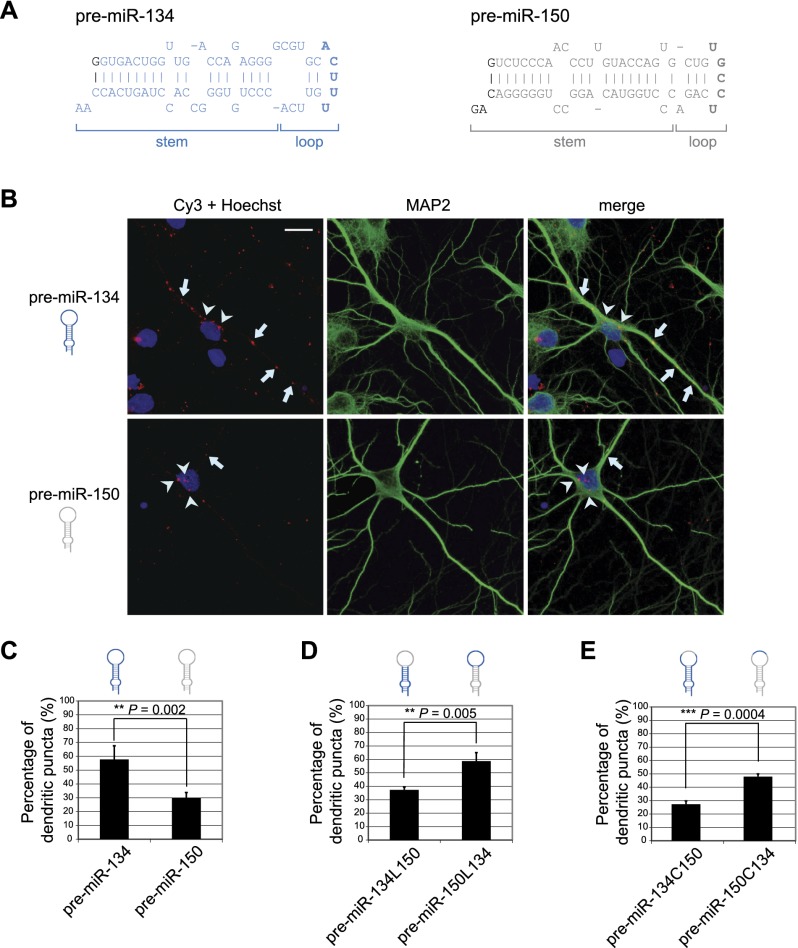
The pre-miR-134 terminal loop is necessary and sufficient for dendritic targeting. (A) Sequences of in vitro transcribed pre-miR-134 (blue) and pre-miR-150 (gray). The five central nucleotides of the terminal loop are shown in bold. Sequence changes required for efficient in vitro transcription (G at position +1) and for correct 3′ termini (2-nt overhang) are indicated in black. (B) Representative images of hippocampal neurons transfected with indicated Cy3-pre-miRNAs. (Left) Cy3-pre-miRNA (red) and Hoechst (blue). (Middle) MAP2 (green). (Right) Merge. Arrows and arrowheads indicate pre-miRNA puncta localized in dendrites or the cell body, respectively. Bar, 10 μm. (C–E) Percentage of dendritic puncta for the indicated pre-miRNAs or mutants (mean ± SD, n = 4, 64 neurons per condition). (L) Loop; (C) central loop.
Figure 3.
Figure 3.
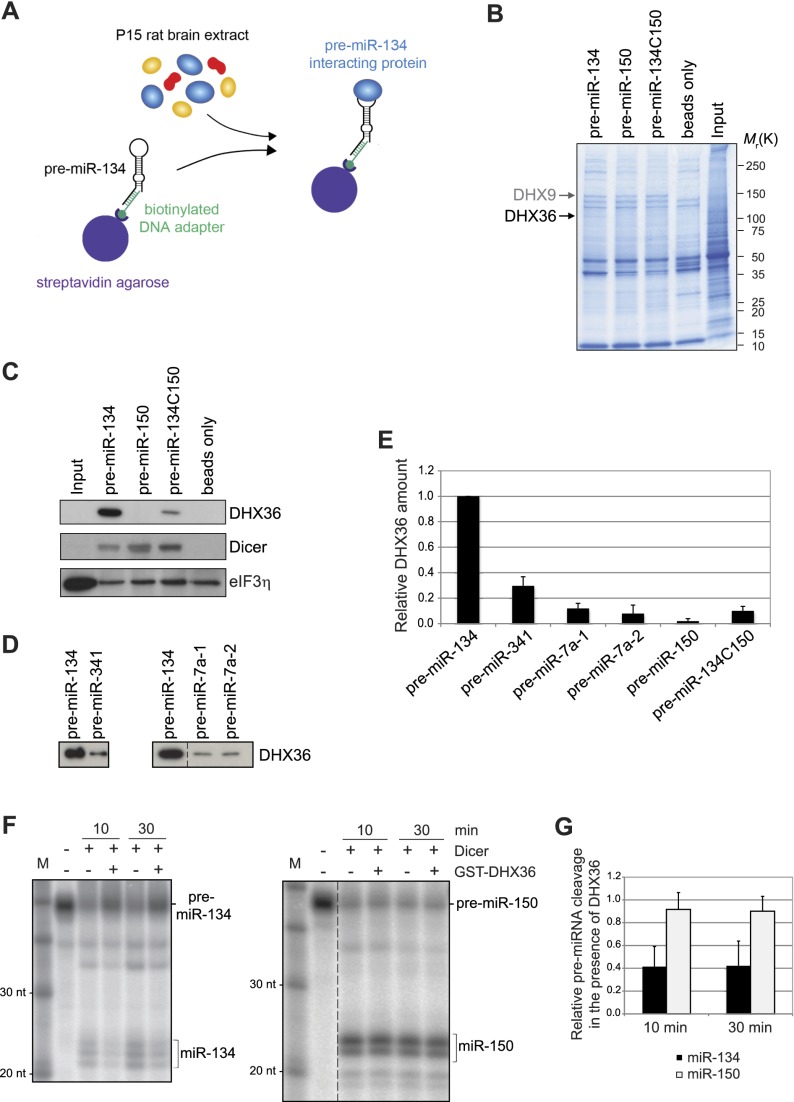
DHX36 interacts with the pre-miR-134 terminal loop. (A) Scheme of the purification strategy used to isolate pre-miR-134-interacting proteins from P15 rat brain extract. (B) Coomassie gel of pull-downs using rat P15 brain extract and the indicated pre-miRNAs. Arrows point to bands that were identified by mass spectrometry as DHX9 (∼140 kDa) and DHX36 (∼110 kDa). (C) Western blot against the indicated proteins with extracts from pull-downs shown in B. (D) Western blot against DHX36 with extracts from the indicated pre-miRNA pull-downs. (E) Quantification of DHX36 binding in pre-miRNA pull-down experiments (pre-miR-134 = 1; mean ± SD, n = 3). (F) In vitro pre-miRNA cleavage assay. pre-miRNAs were incubated with recombinant Dicer for the indicated time in either the presence or absence of GST-DHX36. The position of pre-miRNAs and mature miRNAs is indicated. (G) Ratio of mature miRNA to pre-miRNA as an index for Dicer cleavage activity (mean ± SD, n = 4–5; conditions without DHX36 were set to 1 for both time points).
Figure 4.
Figure 4.
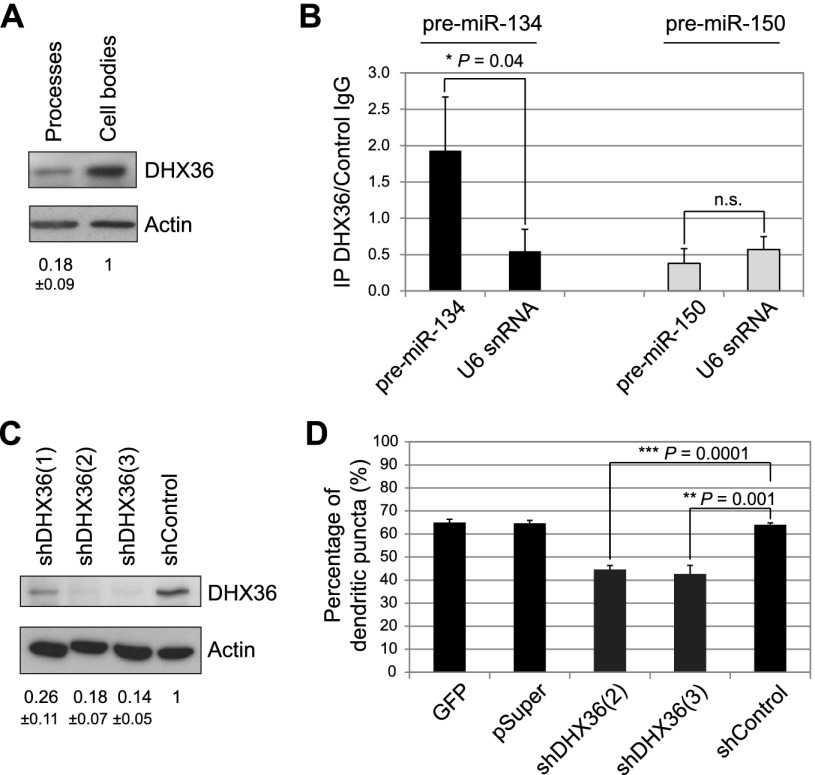
DHX36 is required for dendritic localization of pre-miR-134 in hippocampal neurons. (A) Western blot against the indicated proteins with extracts from process or cell body fractions of hippocampal neurons. Quantification of band intensities is indicated below (mean ± SD, n = 3). (B) RNA-IP of cortical neurons transfected with the indicated pre-miRNAs using a DHX36 or control IgG antibody. Ratio of RNA amounts from DHX36 immunoprecipitates to control IgG immunoprecipitates as determined by qRT–PCR is shown (mean ± SD, n = 3) (C) Western blot against the indicated proteins with extracts from hippocampal neurons nucleofected with the indicated shRNA-expressing constructs. Quantification of band intensities is indicated below (mean ± SD, n = 2). (D) Percentage of dendritic Cy3-pre-miR-134 puncta observed in hippocampal neurons transfected with the indicated constructs (mean ± SD, n = 3, ANOVA: F(4;10) = 84, P < 0.001; 30 neurons per condition).
Figure 5.
Figure 5.
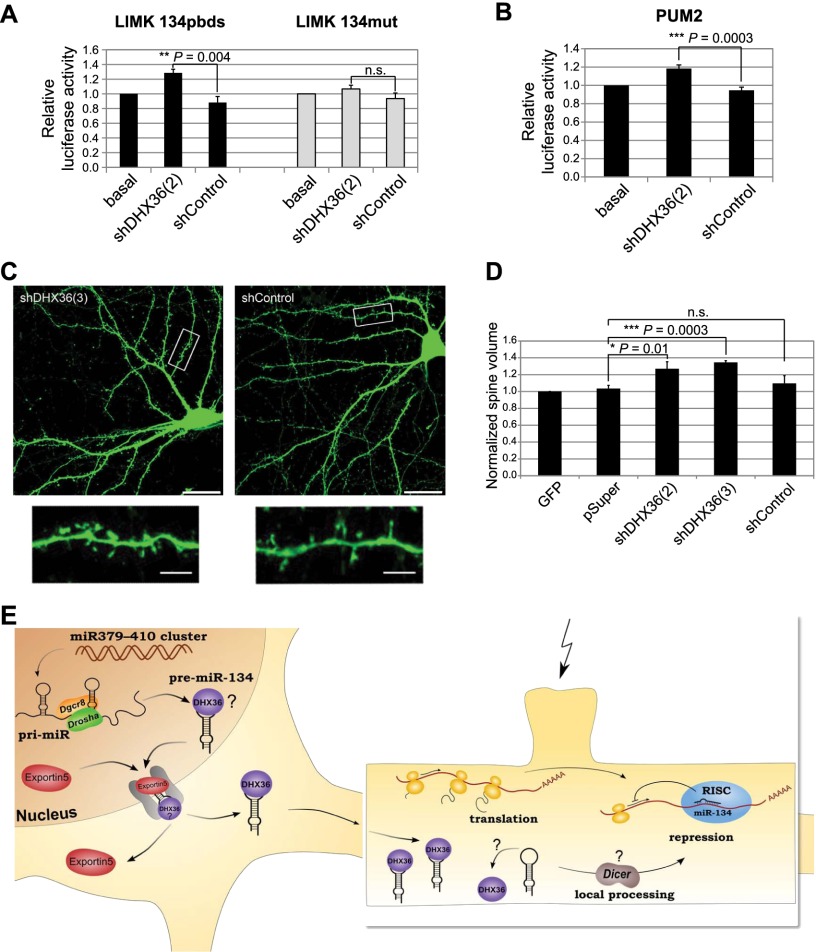
DHX36 is required for miR-134-regulated neuronal functions. (A,B) Reporter gene activity in primary neurons transfected with the indicated shRNA constructs and firefly luciferase reporters containing Limk1 (A; 15 DIV hippocampal neurons) and Pum2 (B; 15 DIV cortical neurons) 3′ UTRs. Cotransfection of empty Renilla reporter served as transfection control. Relative luciferase activity represents the ratio of firefly to Renilla activity; basal condition was set to 1 (mean ± SD, n = 3, each experimental condition measured in duplicates within one experiment). (C) Representative images of hippocampal neurons transfected with either shDHX36(3) (left) or shControl (right) shRNAs. Inserts at higher magnification illustrate increased proportion of large, mushroom-shaped spines in the shDHX36 condition compared with shControl. Bars: main panels, 20 μm; inserts, 5 μm. (D) Quantification of average normalized spine volume as determined by the ratio of GFP signal in dendritic spines to total cell intensity. GFP-only condition was set to 1 (mean ± SD, n = 3; ANOVA: F(3;8) = 15,921, P = 0.001; 18 neurons per condition; 150–200 spines per neuron). (E) Working model for the role of DHX36 in pre-miR-134 dendritic transport and processing. The pre-miR-134 loop contains a cis-acting dendritic targeting element that is recognized by DHX36, resulting in pre-miR-134 transport to the dendrite. In the postsynaptic compartment, stimulation of specific dendritic spines (flash) may trigger Dicer-dependent pre-miRNA processing (possibly involving release of DHX36), thereby enabling an enhanced production of mature miR-134 and repression of miR-134 target mRNAs.

References

    1. Ashraf SI, McLoon AL, Sclarsic SM, Kunes S 2006. Synaptic protein synthesis associated with memory is regulated by the RISC pathway in Drosophila. Cell 124: 191–205 - PubMed
    1. Banerjee S, Neveu P, Kosik KS 2009. A coordinated local translational control point at the synapse involving relief from silencing and MOV10 degradation. Neuron 64: 871–884 - PubMed
    1. Bramham CR, Wells DG 2007. Dendritic mRNA: Transport, translation and function. Nat Rev Neurosci 8: 776–789 - PubMed
    1. Brosius J, Tiedge H 2001. Neuronal BC1 RNA: Intracellular transport and activity-dependent modulation. Results Probl Cell Differ 34: 129–138 - PubMed
    1. Chalupnikova K, Lattmann S, Selak N, Iwamoto F, Fujiki Y, Nagamine Y 2008. Recruitment of the RNA helicase RHAU to stress granules via a unique RNA-binding domain. J Biol Chem 283: 35186–35198 - PMC - PubMed

Publication types

LinkOut - more resources