


doi: 10.1155/2013/285846.
Epub 2013 Apr 4.
Massive secondary postpartum hemorrhage with uterine artery pseudoaneurysm after cesarean section
Affiliations
- PMID: 23653875
- PMCID: PMC3638570
- DOI: 10.1155/2013/285846
Item in Clipboard
Massive secondary postpartum hemorrhage with uterine artery pseudoaneurysm after cesarean section
Case Rep Obstet Gynecol.
2013.
Abstract
Uterine artery pseudoaneurysm is a rare but serious complication of cesarean section. If inadequately treated, it can lead to life-threatening postpartum hemorrhage. Herein, we report the case of a 28-year-old woman who developed secondary postpartum hemorrhage resulting from uterine artery pseudoaneurysm and cesarean scar dehiscence after cesarean section. Angiographic embolization is a safe and effective procedure for treating postpartum hemorrhage resulting from pseudoaneurysm in hemodynamically stable patients. However, uterine artery ligation may be the surgical procedure of choice for hemodynamically unstable patients when fertility preservation is desired.
Figures

A lesion, 20 mm in diameter, consistent with fluid collection, was detected on gray scale sonography.

A cystic mass was observed on the right lateral isthmic region with a size of 22 × 16 mm on gray scale and 3D sonography. Color flow and spectral Doppler imaging of the cystic mass revealed marked aliasing and bidirectional flow representing systolic and diastolic blood flow.

Three-dimensional (3D) sonography or 3D power Doppler mode showed the same cystic mass with a suspicion of irregular incisional track and the highly vascularized cystic mass anastomosed to the uterine vessels.
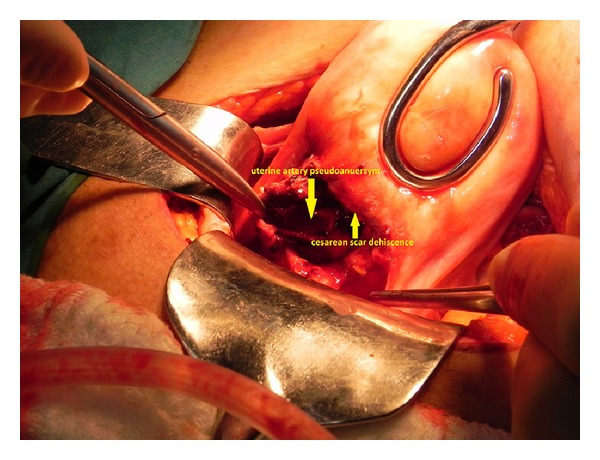
A CSD was inspected and the source of high-flow bleeding was found to be the aneurysmatic formation associated with the right uterine artery, within the uterine cavity.
References
-
- Descargues G, Douvrin F, Gravier A, Lemoine JP, Marpeau L, Clavier E. False aneurysm of the uterine pedicle: an uncommon cause of post-partum haemorrhage after caesarean section treated with selective arterial embolization. European Journal of Obstetrics Gynecology and Reproductive Biology. 2001;97(1):26–29. - PubMed
-
- Eason DE, Tank RA. Avoidable morbidity in a patient with pseudoaneurysm of the uterine artery after cesarean section. Journal of Clinical Ultrasound. 2006;34(8):407–411. - PubMed
-
- ACOG Practice Bulletin. Clinical Management Guidelines for Obstetrician-Gynecologists Number 76, October 2006: Postpartum hemorrhage. Obstetrics and Gynecology. 2006;108:p. 1039. - PubMed
-
- Webber GW, Jang J, Gustavson S, Olin JW. Contemporary management of postcatheterization pseudoaneurysms. Circulation. 2007;115(20):2666–2674. - PubMed
-
- Kwon JH, Kim GS. Obstetric iatrogenic arterial injuries of the uterus: diagnosis with US and treatment with transcatheter arterial embolization. Radiographics. 2002;22(1):35–46. - PubMed
LinkOut - more resources
Full Text Sources
Other Literature Sources
