. 2014 Dec 19;3(12):915-28.
doi: 10.1021/sb300079h. Epub 2012 Dec 28.

Novel synthetic Medea selfish genetic elements drive population replacement in Drosophila; a theoretical exploration of Medea-dependent population suppression

Affiliations

Novel synthetic Medea selfish genetic elements drive population replacement in Drosophila; a theoretical exploration of Medea-dependent population suppression

Omar S Akbari et al. ACS Synth Biol. .

Abstract

Insects act as vectors for diseases of plants, animals, and humans. Replacement of wild insect populations with genetically modified individuals unable to transmit disease provides a potentially self-perpetuating method of disease prevention. Population replacement requires a gene drive mechanism in order to spread linked genes mediating disease refractoriness through wild populations. We previously reported the creation of synthetic Medea selfish genetic elements able to drive population replacement in Drosophila. These elements use microRNA-mediated silencing of myd88, a maternally expressed gene required for embryonic dorso-ventral pattern formation, coupled with early zygotic expression of a rescuing transgene, to bring about gene drive. Medea elements that work through additional mechanisms are needed in order to be able to carry out cycles of population replacement and/or remove existing transgenes from the population, using second-generation elements that spread while driving first-generation elements out of the population. Here we report the synthesis and population genetic behavior of two new synthetic Medea elements that drive population replacement through manipulation of signaling pathways involved in cellular blastoderm formation or Notch signaling, demonstrating that in Drosophila Medea elements can be generated through manipulation of diverse signaling pathways. We also describe the mRNA and small RNA changes in ovaries and early embryos associated from Medea-bearing females. Finally, we use modeling to illustrate how Medea elements carrying genes that result in diapause-dependent female lethality could be used to bring about population suppression.

Keywords: dengue; gene drive; malaria; maternal effect; mosquito; selfish genetic element; synthetic biology.


Figures

Figure 1
Figure 1. Medea genetics, molecular basis of synthetic elements, and cycles of population replacement
Mothers carrying Medea cause the death of all progeny that fail to inherit Medea (A). Synthetic Medea elements consist of two genes. Maternally-expressed miRNAs (the toxin) silence (red line during oogenesis) the expression of a maternally-expressed transcript (grey line) that normally provides a product essential for early embryonic development. Rescue of Medea-dependent maternal-effect lethality occurs when progeny inheriting Medea express a version of the silenced maternal mRNA sufficient to rescue normal development (green line). Progeny that fail to inherit Medea die because the endogenous levels of the maternally-deposited mRNA (red line during embryogenesis) are insufficient for normal development (B). Second-generation Medea elements (n+1) carrying a new cargo, a new toxin, a new antidote, and a copy of the antidote from the previous generation (n), drive into a population at the expense of a first generation element (n), when both elements are located at the same position in the genome so as to force them to compete for germline transmission (C).
Figure 2
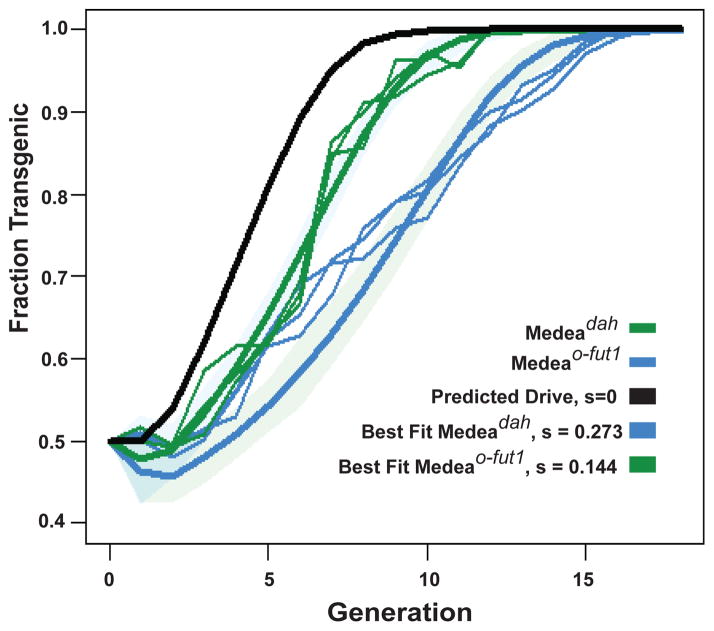
Figure 2. Medeadah and Medeao-fut1 drive population replacement
Fraction of the adult population that is transgenic is plotted versus number of generations for both Medeadah (thin blue lines) and Medeao-fut1 (thin green lines). Expected transgenic frequencies for a Medea with no fitness cost (s = 0) are indicated by the black line. Predicted behavior of Medea elements with fitness costs corresponding to best-fit estimates Medeadah (bold blue line) and Medeao-fut1 (bold green line) were derived from actual Medeadah and Medeao-fut1 behavior. 95% confidence intervals are indicated by light green and blue shading. s = additive fitness cost in Medea homozygotes.
Figure 3
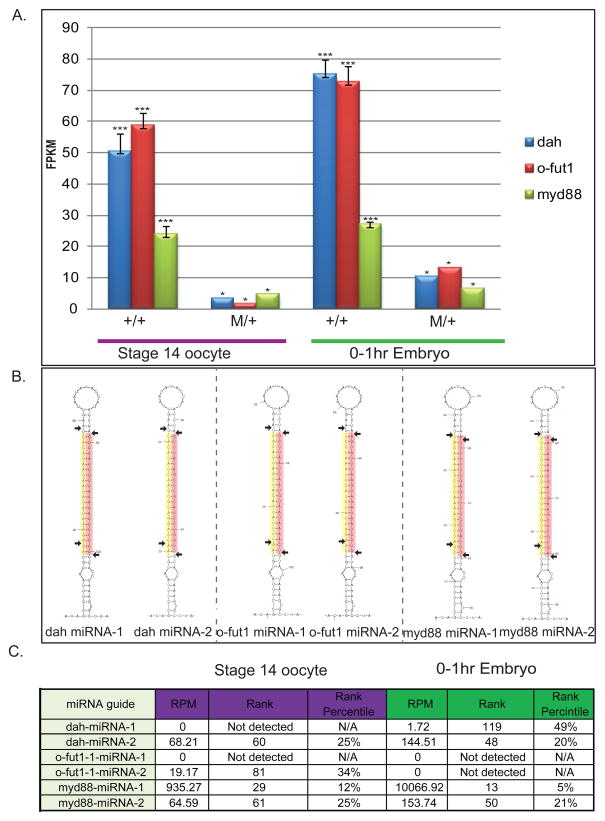
Figure 3. Molecular characterization of stage 14 oocytes and 0–1 hr embryos from mothers of specific genotypes
Levels of myd88, o-fut-1 and dah mRNA determined using RNA-seq (expressed as Fragments per kilobase per million reads, FPKM) in wildtype stage 14 oocytes and 0–1 hr embryos from wildtype mothers and wildtype fathers (+/+), and from oocytes and embryos derived from heterozygous Medeamyd88 (green bars), Medeadah (blue bars) or Medeao-fut1 (red bars) mothers crossed to (+/+) males. Asterisks indicate the number of replicates (A). The structures of the miRNAs used to silence dah, o-fut1, and myd88 are indicated. The orange shaded region indicates the predicted miRNA guide strand; the yellow shaded region represents the miRNA* strand. Horizontal arrows indicate sites of Drosha and Dicer cleavage (B). Small RNA reads for synthetic miRNAs were expressed as reads per million reads (RPM), which normalizes read count to the size of each library. To provide a sense of scale, the expression levels of synthetic miRNAs were also compared to those of endogenous miRNAs expressed in the ovary, both in terms of absolute rank and in terms of rank percentile.
Figure 4
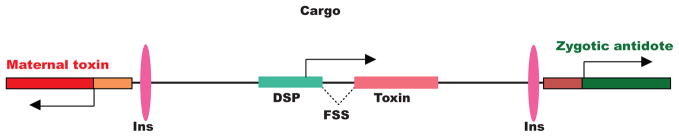
Figure 4. Hypothetical Medea elements carrying a cargo transgene cassette able to induce cue-dependent female killing
The Medea illustrated carries a cargo gene consisting of a diapause-specific promoter (DSP) driving a toxin that is only synthesized as an intact protein in response to female-specific splicing (B). Chromatin insulators (Ins), female specific splicing events (FSS), and 3′ untranslated regions (UTR) are indicated.
Figure 5
Figure 5. Modeling the ability of Medea elements carrying genes that cause cue-dependent female lethality to bring about population eradication
4,000 males homozygous for a Medea carrying a transgene cassette that induces diapause-dependent female killing are released into a total wild population of 10,000. The fate of the total population (red line), transgenics (blue line), and females (green line) are followed for 30 generations. Diapause occurs in generation 13 and generation 26 (A). 6,000 transgenic males are released into the wild population as above (B).

References

    1. Nicholson GM. Fighting the global pest problem: preface to the special Toxicon issue on insecticidal toxins and their potential for insect pest control. Toxicon. 2007;49:413–422. - PubMed
    1. Schmid-Hempel P. Evolutionary ecology of insect immune defenses. Annu Rev Entomol. 2005;50:529–551. - PubMed
    1. Tripet F, Aboagye-Antwi F, Hurd H. Ecological immunology of mosquito-malaria interactions. Trends Parasitol. 2008;24:219–227. - PMC - PubMed
    1. Lambrechts L, Koella JC, Boete C. Can transgenic mosquitoes afford the fitness cost? Trends Parasitol. 2008;24:4–7. - PubMed
    1. Braig HRaYG. The spread of genetic constructs in natural insect populations. In: Letourneau DKaBBE., editor. Genetically Engineered Organisms: Assessing Environmental and Human Health Effects. CRC Press; 2001. pp. 251–314.

Publication types

LinkOut - more resources