Does CALU SNP rs1043550 contribute variability to therapeutic warfarin dosing requirements?
- PMID: 23656803
- PMCID: PMC3692386
- DOI: 10.3121/cmr.2013.1130
Does CALU SNP rs1043550 contribute variability to therapeutic warfarin dosing requirements?
Abstract
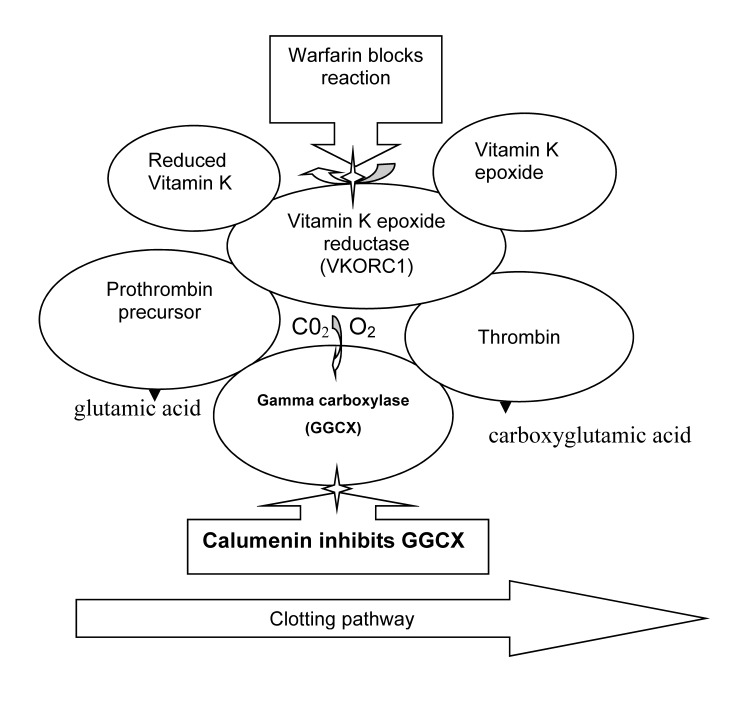
Objectives: Calumenin, a molecular chaperone, exerts a regulatory effect on the vitamin K-dependent γ-carboxylation redox cycle that inhibits transfer of the reduced vitamin K from VKORC1, the pharmacological target of warfarin, to the γ-carboxylase. Because of its polymorphic structure and central role in the warfarin metabolic pathway, a contributory role for calumenin to warfarin dose variability has been posited. The current study sought to validate modulation of therapeutic dosing requirements by a single nucleotide polymorphisms (SNP) occurring in the calumenin gene (CALU) reported in previous studies. The CALU SNP was further modeled to detect interaction with SNPs occurring in VKORC1, CYP2C9, and CYP4F2 genes and characterize any additional contribution to variability in therapeutic warfarin dose requirement.
Setting: The study was undertaken in an established, well-characterized cohort of subjects treated with warfarin in the Anticoagulation Clinic of Marshfield Clinic in Marshfield, Wisconsin.
Methods: Subjects (N=491) previously genotyped for SNPS known to contribute variability to therapeutic warfarin dose requirement were genotyped for CALU SNP rs1043550, using TaqMan assays. Contribution of CALU SNP rs1043550 was modeled relative to other genotypic and phenotypic characteristics including gender, diagnosis, age, body surface area, underlying indication for warfarin, comorbidities, and pharmacological exposures. Interaction between SNPs impacting on warfarin dose requirements and calumenin SNPs was also modeled.
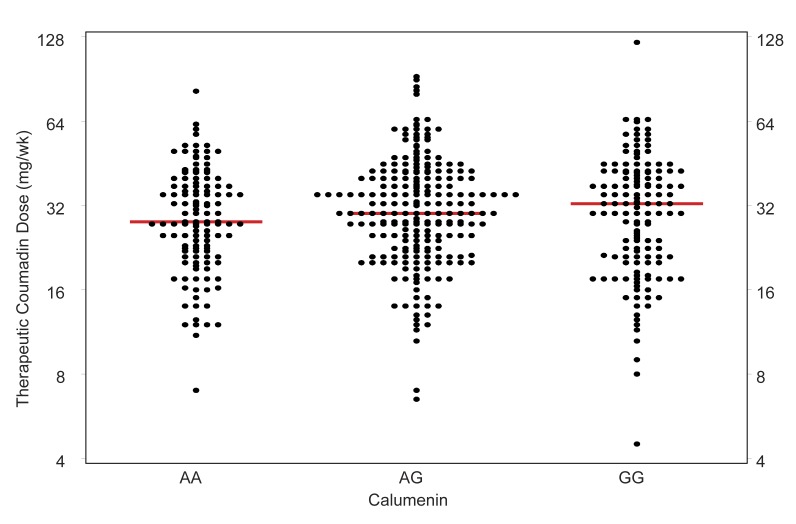
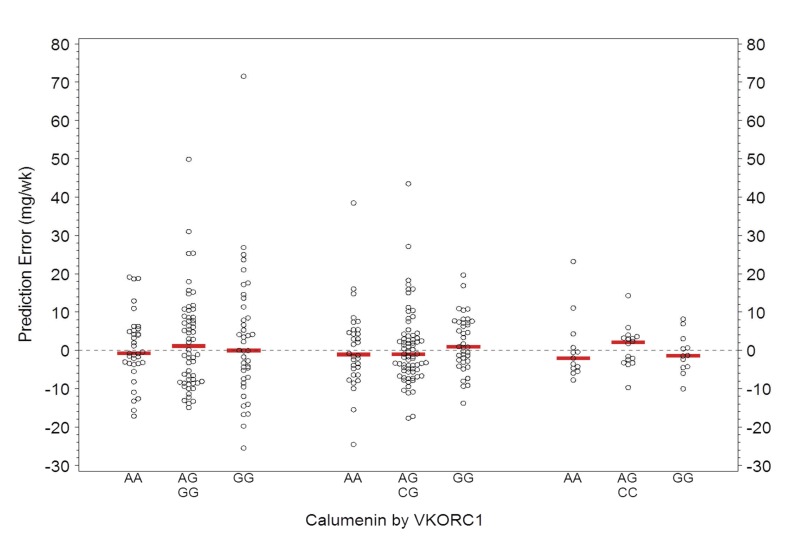
Results: Small differences in warfarin dosing requirements detected among individuals encoding the mutant G allele in the calumenin SNP were not statistically or clinically significant relative to therapeutic warfarin dose requirement and did not independently contribute significantly to the warfarin dosing model. Interaction between calumenin and VKORC1 SNPs contributed only minor additional variability to that ascribed to the wild type VKORC1 genotype.
Conclusions: The impact of the CALU SNP on warfarin dose variability was minor and did not contribute significantly to therapeutic warfarin dose requirement in our study cohort. While no contribution was noted for the SNP examined in the present study, further examination of interaction between genetic elements contributing major impact on therapeutic warfarin dose requirements and genes exhibiting a lesser contribution is warranted.
Keywords: Anticoagulation; Calumenin; VKORC1; Vitamin K; Warfarin.
Figures
References
-
- Suttie JW. Vitamin K-dependent carboxylase. Annu Rev Biochem 1985;54:459–477 - PubMed
-
- Berkner KL. The vitamin K-dependent carboxylase. Annu Rev Nutr 2005;25:127–149 - PubMed
-
- Glurich I, Burmester JK, Caldwell MD. Understanding the pharmacogenetic approach to warfarin dosing. Heart Fail Rev 2010;15:239–248 - PubMed
-
- Yabe D, Taniwaki M, Nakamura T, Kanazawa N, Tashiro K, Tasuku H. Human calumenin gene (CALU): cDNA isolation and chromosomal mapping to 7q32. Genomics 1998; 49:331–333 - PubMed
-
- Yabe D, Nakamura T, Kanazawa N, Tashiro K, Honjo T. Calumenin, a Ca 2+-binding protein retained in the endoplasmic reticulum with a novel carboxyl-terminal sequence, HDEF. J Biol Chem 1997;272:18232–18239 - PubMed
Publication types
MeSH terms
Substances
LinkOut - more resources
Full Text Sources
Other Literature Sources
Medical