


Interventions for children affected by war: an ecological perspective on psychosocial support and mental health care
- PMID: 23656831
- PMCID: PMC4098699
- DOI: 10.1097/HRP.0b013e318283bf8f
Interventions for children affected by war: an ecological perspective on psychosocial support and mental health care
Abstract
Background: Children and adolescents exposed to armed conflict are at high risk of developing mental health problems. To date, a range of psychosocial approaches and clinical/psychiatric interventions has been used to address mental health needs in these groups.
Aims: To provide an overview of peer-reviewed psychosocial and mental health interventions designed to address mental health needs of conflict-affected children, and to highlight areas in which policy and research need strengthening.
Methods: We used standard review methodology to identify interventions aimed at improving or treating mental health problems in conflict-affected youth. An ecological lens was used to organize studies according to the individual, family, peer/school, and community factors targeted by each intervention. Interventions were also evaluated for their orientation toward prevention, treatment, or maintenance, and for the strength of the scientific evidence of reported effects.
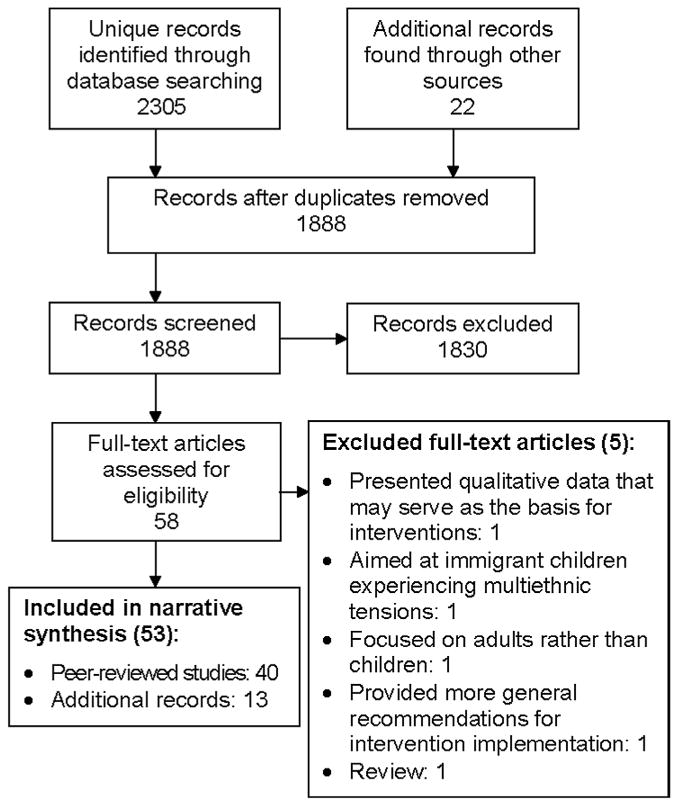
Results: Of 2305 studies returned from online searches of the literature and 21 sources identified through bibliography mining, 58 qualified for full review, with 40 peer-reviewed studies included in the final narrative synthesis. Overall, the peer-reviewed literature focused largely on school-based interventions. Very few family and community-based interventions have been empirically evaluated. Only two studies assessed multilevel or stepped-care packages.
Conclusions: The evidence base on effective and efficacious interventions for conflict-affected youth requires strengthening. Postconflict development agendas must be retooled to target the vulnerabilities characterizing conflict-affected youth, and these approaches must be collaborative across bodies responsible for the care of youth and families.
Conflict of interest statement
Figures
References
-
- Shibley HL, Stoddard FJ., Jr . Child and adolescent psychiatry interventions. In: Stoddard FJ Jr, Pandya A, Katz CL, editors. Disaster psychiatry: readiness, evaluation, and treatment. Arlington, VA: American Psychiatric Publishing; 2011. pp. 287–312.
-
- Brymer M, Jacobs A, Layne C, et al. Psychological first aid: field operations guide. National Child Traumatic Stress Network, National Center for PTSD. 2006 https://www.medicalreservecorpsgov/File/Promising_Practices_Toolkit/Guid....
-
- Barenbaum J, Ruchkin V, Schwab-Stone M. The psychological aspects of children exposed to war: practice and policy initiatives. J Child Psychol Psychiatry. 2004;45:41–62. - PubMed
-
- Attanayake V, McKay R, Joffres M, Singh S, Burkle F, Mills E. Prevalence of mental disorders among children exposed to war: a systematic review of 7,920 children. Med Confl Surviv. 2009;25:19. - PubMed
-
- Inter-agency Standing Committee. IASC guidelines on mental health and psychosocial support in emergency settings. Geneva: IASC; 2007. - PubMed
Publication types
MeSH terms
Grants and funding
LinkOut - more resources
Full Text Sources
Other Literature Sources
Medical